
Globular stink bug
Coptosoma variegatum
Description
How to identify
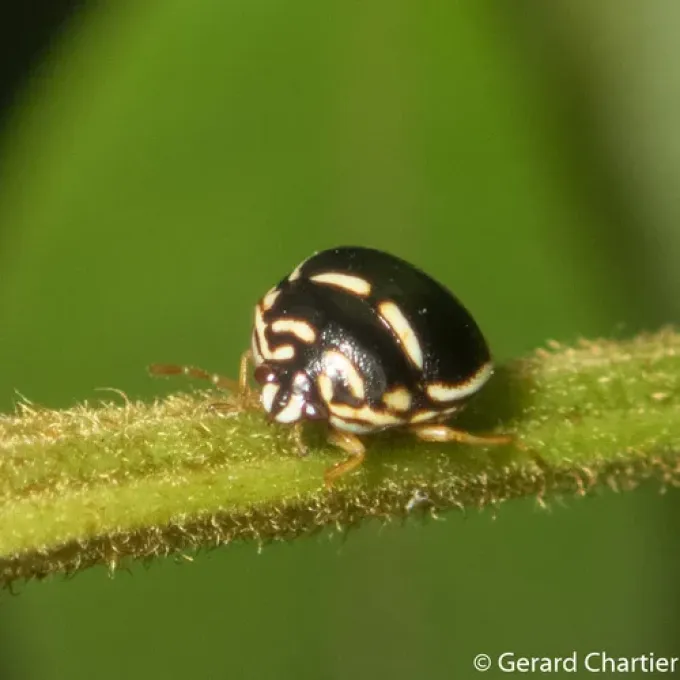
The globular stink bug (Coptosoma variegatum) belongs to the family Plataspidae within the order Hemiptera. These insects are easily recognized by their small, rounded, and highly convex body shape, which typically measures between 3 and 5 mm in length.
Their coloration is generally dark brown to black, often featuring a distinctively mottled or patterned appearance with light yellowish markings on the scutellum and pronotum.
The head is relatively small and pressed close to the body, contributing to the insect's compact, shield-like appearance, which is a signature trait of the Plataspidae family.
They deposit eggs in characteristic clusters, often arranged in two parallel rows, which serves as a reliable diagnostic feature for agronomists during field scouting.
Nymphs resemble smaller, wingless versions of the adults, undergoing several molts while transitioning through their developmental stages until they reach the final adult form.
What it damages
The globular stink bug primarily targets crops from the legume family, with soybean, peas, and various beans being the most vulnerable to infestation.
These bugs use their piercing-sucking mouthparts to feed on plant juices, which causes significant stress to the host plant and impairs overall development.
The pest tends to hide in sheltered areas, such as leaf axils, flower buds, or at the base of the stems, making them difficult to detect during standard field checks.
Infestations often result in leaf yellowing, distorted growth, and severe damage to developing pods, which frequently leads to shriveled or underdeveloped seeds.
Beyond agricultural crops, the bug thrives on various wild legumes, maintaining populations in surrounding hedgerows or uncultivated field borders.
When it appears
Adult bugs overwinter in protected sites such as leaf litter, under the bark of trees in field borders, in dry weeds, or within the upper layer of the soil.
Emergence from hibernation occurs in late spring when temperatures consistently reach 15–18 degrees Celsius, prompting them to move toward suitable legume host plants.
Peak activity and feeding phases typically occur from late May through June, coinciding with the rapid vegetative growth stages of legume crops.
While one generation is standard in most regions, warmer climates may support a partial second generation if environmental conditions remain favorable throughout the summer.
In autumn, as host plants mature or die off, the adult bugs gradually move back into their hibernation sites to survive the winter months.
Signs of infestation
The first indicator of infestation is the appearance of tiny chlorotic spots on the leaves, marking the sites where the insect has punctured the tissue to feed.
Heavy infestations lead to widespread yellowing, premature leaf senescence, and twisted, stunted growth of the main stems and branches.
On reproductive parts, necrotized spots on pods and flowers are common, preventing proper seed formation and causing yield losses in terms of weight and quality.
Clusters of dark excrement spots left on the foliage and pods act as a visual sign of a well-established colony living on the plant.
Scouting during the early morning hours is most effective, as the bugs tend to be more active on the exterior parts of the plant before seeking shade from the midday heat.
Control measures
Effective crop rotation is the primary preventive measure, as moving legume crops to non-host fields disrupts the bug's localized life cycle and population buildup.
Rigorous management of weeds and wild leguminous plants in adjacent areas significantly reduces the alternative food sources that sustain the pests.
When infestation levels exceed the economic threshold, the application of systemic or contact insecticides is necessary to prevent significant yield damage.
Timing is critical: applications should avoid peak bloom periods to minimize harmful effects on vital pollinator populations such as bees.
- Regular field monitoring during the pod-setting phase.
- Use of resistant or early-maturing crop varieties where available.
- Targeted border spray treatments to intercept migrating populations.
Taxonomy
- Latin name
- Coptosoma variegatum
- Order
- Hemiptera (bugs, aphids, leafhoppers)
- Family
- Plataspidae
- EPPO code
- COPSVA
Discussion
No discussions yet — be the first.