
Bean shield bug
Coptosoma punctatissimum
Description
How to identify
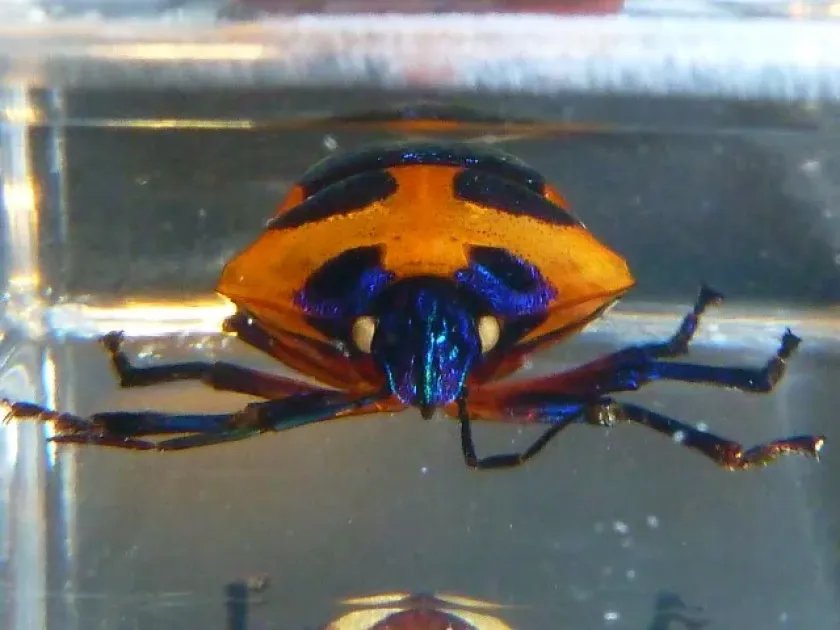
The bean shield bug (Coptosoma punctatissimum) belongs to the family Plataspidae within the order Hemiptera. Adult insects have a characteristic rounded, convex body shape, resembling a small shield, measuring approximately 4 to 5 millimeters in length.
Their coloration ranges from dark brown to black, featuring a distinct dotted pattern on the elytra. They possess well-developed membranous wings that allow them to fly actively over long distances in search of suitable host plants and food sources.
Eggs are cylindrical and typically laid by females in compact groups arranged in two parallel lines on the underside of leaves or along stems. These egg masses are often protected by a specialized secretion that shields them from environmental stress and predation.
Nymphs resemble the adults in general appearance but are smaller and have a lighter, often yellowish-brown color. Throughout their development, they pass through several instars, gradually developing darker pigmentation and fully formed wings.
The biology of this pest is closely linked to warm and humid conditions, which allow for rapid reproduction during the crop growing season. The high fecundity of females facilitates a rapid population surge under favorable weather conditions.
What it damages
The primary hosts for this pest are leguminous plants, particularly soybeans and beans. The bugs utilize piercing-sucking mouthparts to penetrate plant tissues and extract vital sap, which deprives the plant of necessary nutrients.
The bugs cause damage at all stages of development, from the emergence of seedlings to the pod-filling phase. The most critical period is during the formation and filling of pods, as damage to reproductive organs significantly reduces overall grain yield.
During heavy infestations, this pest can affect a large percentage of plants in a field, leading to severe economic losses. Sustained sap extraction causes wilting and yellowing, weakening the plant and increasing susceptibility to secondary fungal infections.
As they feed, the bugs inject salivary enzymes into the plant tissues, which cause cell necrosis. This leads to pod deformation, shriveled seeds, and a significant reduction in seed germination rates for the following season.
Beyond direct damage, some individuals may act as vectors for plant pathogens, further complicating the health of the crop. Consequently, the productivity of the agroecosystem declines, and the quality of the harvested grain often fails to meet market standards.
When it appears
Adults hibernate in forest litter, under fallen leaves, or in the upper soil layers, waiting out unfavorable winter conditions. With the arrival of sustained spring warmth, the bugs emerge and begin actively seeking host plants.
The first appearance of these pests in legume fields coincides with the active growth phase, typically when temperatures rise above 15-18 degrees Celsius. During this time, they engage in supplemental feeding and mating before the females begin laying eggs.
The summer generation develops quite rapidly, completing its life cycle in a short time, which allows the pest to produce multiple generations per season. Population peaks often occur in the second half of summer when the soybeans are in the flowering and pod-setting stage.
Insect activity peaks during sunny days; they prefer the warmer parts of the field. In the evenings or during temperature drops, the pests move to the lower canopy of the plants to hide under leaves for protection.
In the autumn, following harvest, a portion of the population migrates to wild legumes or other shelters to enter diapause. Timely late-summer monitoring is essential for assessing the population size and forecasting the threat level for the upcoming year.
Signs of infestation
The first visual sign of infestation is the presence of adult insects clustered on the underside of leaves and on young stems. During inspections, characteristic egg masses laid in neat rows can often be observed on the plant foliage.
The second sign is the appearance of small chlorotic spots on leaves where the bugs have pierced the tissue. Over time, these spots may merge, causing yellowing and premature leaf drop, which often mimics general plant stress or nutrient deficiencies.
When pods are infested, dark depressed dots are visible where the bug's proboscis has penetrated. Seeds inside damaged pods are often underdeveloped, shriveled, or entirely absent, as the pod failed to receive sufficient nutrients for proper development.
A characteristic sign of a high population density is a sharp, unpleasant odor emitted from the insects' scent glands when disturbed. This smell is often noticeable during field operations or when inspecting the crops on calm, windless days.
Additionally, the presence of excrement in the form of tiny dark specks on leaves and stems can serve as an indirect indicator. Massive clustering on flower racemes leads to wilting and flower drop, which is easily detected during a field walkthrough.
Control measures
Agronomic control methods include strict adherence to crop rotation, which helps disrupt the pest's reproductive cycle. It is crucial to manage weed populations, especially wild legumes, which serve as reservoirs for the bugs throughout the season.
Chemical control is the most effective approach once the economic threshold of damage is reached. The application of systemic or contact insecticides approved for use on legumes helps to rapidly reduce population numbers during critical crop growth phases.
It is recommended to apply treatments during early morning or late evening when the insects are less active and less mobile. Thorough coverage of all plant parts, especially the lower canopy where they hide, is essential for treatment success.
Biological control involves the use of natural enemies, such as egg parasitoids like Trichogramma, which parasitize the bug's eggs. The use of biological preparations based on fungi or bacteria that specifically target hemipterans is a growing trend in sustainable agriculture.
Monitoring with pheromone traps allows farmers to determine the exact timing of field colonization and the necessity for insecticide applications. Regular field scouting helps identify infestation hotspots at an early stage, allowing for localized treatment before the pest spreads.
Taxonomy
- Latin name
- Coptosoma punctatissimum
- Order
- Hemiptera (bugs, aphids, leafhoppers)
- Family
- Plataspidae
- EPPO code
- COPSPU
Discussion
No discussions yet — be the first.