
Violet four-legged mite
Coptophylla violae
Description
How to identify
The violet four-legged mite (Coptophylla violae) is a microscopic pest belonging to the Eriophyidae family. Because of their minute size, measuring roughly 0.1–0.2 mm, they are invisible to the naked eye and can only be confirmed using a high-powered microscope.
Their bodies are worm-like and elongated, with a translucent or whitish-yellow hue. A defining characteristic of the entire Eriophyidae group is the presence of only two pairs of legs situated at the very front of the body, which sets them apart from spider mites.
These mites reproduce rapidly within the plant tissues. The females deposit eggs in protected areas such as the center of the rosette or leaf axils, where the larvae can begin feeding immediately upon hatching, leading to quick population growth.
They are highly host-specific, primarily infesting members of the Viola genus, including the popular indoor Saintpaulia (African violets). Their stealthy lifestyle often allows them to remain undetected until severe damage occurs.
Diagnosis requires a systematic examination of symptomatic plants. If an infestation is suspected, one should look for characteristic deformities, as the pests themselves will not be seen without specialized equipment or staining techniques in a laboratory.
What it damages
The damage caused by the four-legged mite is primarily inflicted on the plant's growth points. As they feed, they extract cellular sap, which disrupts the normal development of leaves and buds, causing systemic stunting and deformity.
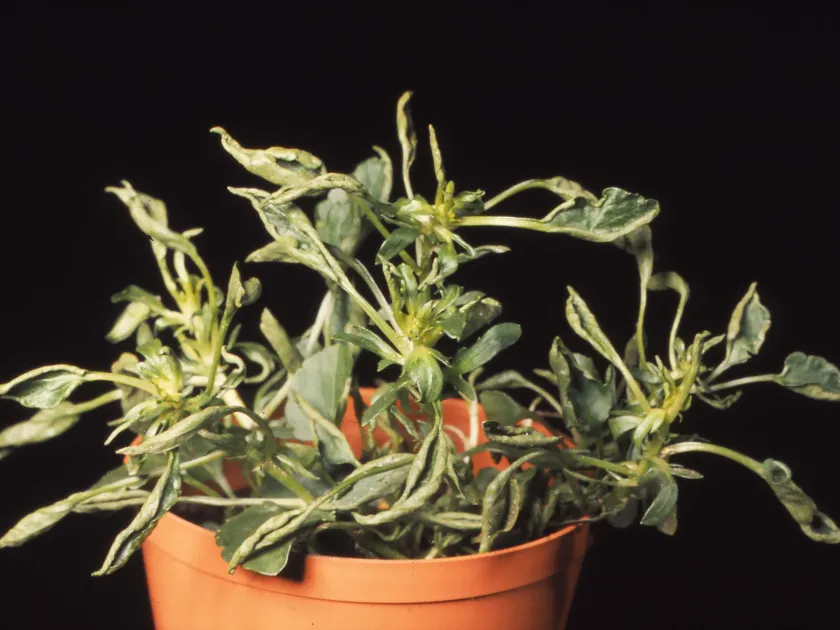
The leaves emerging from the center of the rosette appear shrunken, curled, and abnormally fuzzy. The leaf stalks (petioles) become shortened, and the overall plant architecture becomes tightly congested, giving it a distorted, "cabbage-like" appearance.
The mites inject toxic saliva into the leaf tissue, which forces the plant to produce abnormal growth patterns. This leads to the loss of natural color and texture, making leaves appear brittle, rough, or covered in a dusty layer that does not wash off.
Flowering is significantly impacted, with buds often failing to open or developing into twisted, malformed shapes. In severe cases, the plant may stop growing altogether, as the apical meristem is constantly under attack by the mite population.
Weakened by the mite's feeding, the plant's immune system declines, leaving it susceptible to secondary infections like powdery mildew or bacterial rot, which often develop on the damaged and necrotic tissue surfaces.
Signs of infestation
The most reliable sign of an infestation is a sudden change in the appearance of the plant's center. If the young leaves are becoming stiff, tightly packed, and excessively hairy, this is a major red flag for the presence of the four-legged mite.
A standstill in growth is a critical indicator. When the center of the plant remains "stuck" and the new foliage refuses to unfurl, it is almost certain that an active colony of mites is draining the vitality of the plant.
The plant loses its aesthetic quality, becoming messy and irregular in form. The leaves may develop an uneven, bumpy texture, and in some varieties, you might see localized browning or patches of damaged cells that look like chemical burns.
Reproductive failure is another common symptom. If a plant that usually blooms well suddenly fails to produce flowers or sheds its buds before they reach maturity, you should inspect the plant for mite damage as a potential cause.
It is important to differentiate mite damage from cultural issues such as light overexposure or excessive fertilization. Mite infestations typically spread from plant to plant in a collection, starting with the most susceptible varieties.
Control measures
Controlling the violet four-legged mite requires immediate quarantine. Any infested plant must be isolated from the healthy collection to prevent the spread of the mites, which can travel on hands, tools, or air currents.
Systemic acaricides are the most effective way to manage these pests. Since the mites live deep within the leaf folds and growth points, contact sprays often fail, while systemic products move through the sap and reach the mites wherever they feed.
A rigorous treatment schedule is necessary, typically involving at least three applications spaced 7–10 days apart. This ensures that any eggs hatching after the initial treatment are eliminated by subsequent applications.
To prevent resistance, it is crucial to rotate between acaricides with different active ingredients. Because of their biology, Eriophyid mites can develop tolerance to chemicals if the same product is used repeatedly over a long period.
After treatment, provide the plant with optimal growing conditions, including stable humidity and appropriate light, to support recovery. It may take several months for the plant to push out new, normal-looking foliage and regain its original health.
Taxonomy
- Latin name
- Coptophylla violae
- Order
- Mites
- Family
- Eriophyidae
- EPPO code
- COPOVI
Discussion
No discussions yet — be the first.