
Coptophylla
Coptophylla
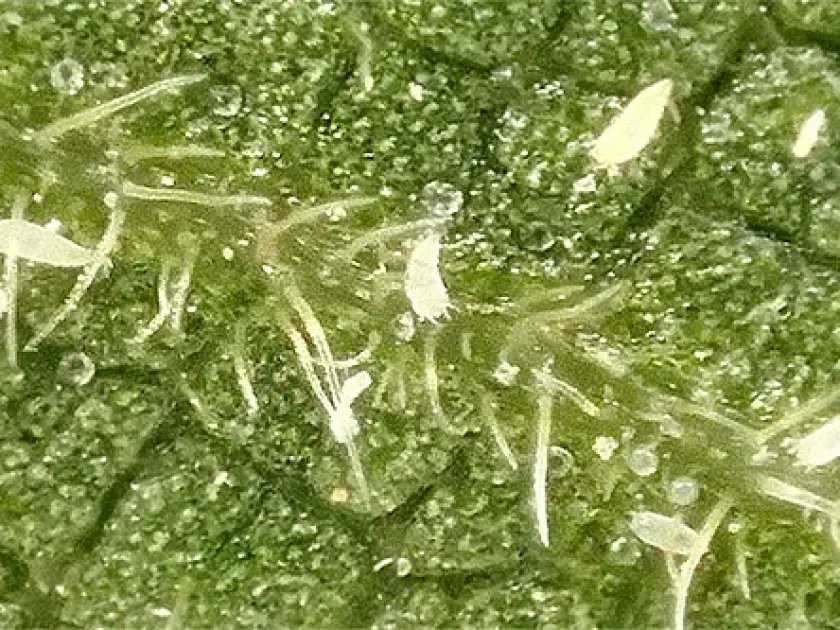
Description
How to identify
Coptophylla is a genus of eriophyid mites (family Eriophyidae, order Trombidiformes). These are microscopic arthropods characterized by a worm-like body and only two pairs of legs located at the anterior end.
Due to their minute size, these mites are almost invisible to the naked eye, which significantly complicates the primary diagnosis of infestation during the early stages of colony development.
The life cycle of Coptophylla includes egg, larva, protonymph, and adult stages, with development occurring very rapidly under favorable temperature conditions.
Typically, fertilized females overwinter by finding refuge in bark crevices, bud scales, or in plant debris left on the soil surface after harvest.
The dispersal of this pest in agroecosystems occurs primarily through passive means, such as wind currents, insect vectors, or through the movement of infested plant material.
What it damages
This pest primarily attacks woody plants and shrubs, including fruit crops, where it specializes in feeding on leaf tissues and young shoots.
The mites suck juices from epidermal cells, which disrupts the normal metabolism of the plant and reduces its photosynthetic activity.
Young, tender leaves are the most susceptible to damage, becoming deformed, curled, and losing their natural pigmentation during intense colonization.
Prolonged infestation by Coptophylla causes premature leaf drop, which significantly weakens the plant and reduces its cold hardiness during the winter period.
Economic damage manifests as a reduction in total yield, degradation of fruit quality, and potential death of young seedlings when mite population density is high.
Signs of infestation
The first sign of Coptophylla presence is the appearance of characteristic yellowing or "rusting" on the underside of the leaf, which gradually spreads.
In feeding areas, tissue necrosis occurs, appearing as small spots that may eventually merge into larger damaged zones.
Leaves damaged by the mite take on an atypical shape, become coarse to the touch, and are often covered with a specific residue consisting of pest waste products.
When examined under a microscope or strong magnifying lens, mite colonies can be found clustered along leaf veins for easier access to nutrients.
The overall condition of the plant noticeably deteriorates: the growth of terminal shoots slows down, and internodes may shorten, giving the plant a stunted appearance.
Control measures
The protection system against Coptophylla is based on the use of selective acaricides that effectively suppress the activity of all stages of mite development.
An important element is the implementation of preventive spraying during bud break and active growth phases, when the pest is most vulnerable to chemical treatments.
Agrotechnical measures include mandatory cleanup and subsequent destruction of plant debris, which serve as the primary reservoir for the population during the off-season.
It is recommended to maintain spatial isolation between infested and healthy plots, as well as to use virus-free planting material when establishing new orchards.
Biological control involves the introduction or preservation of natural predators, such as phytoseiid mites, which naturally limit the reproduction of Coptophylla.
Taxonomy
- Latin name
- Coptophylla
- Order
- Mites
- Family
- Eriophyidae
- EPPO code
- COPOSP
Discussion
No discussions yet — be the first.