
Poplar moth
Condylorrhiza vestigialis
Description
How to identify
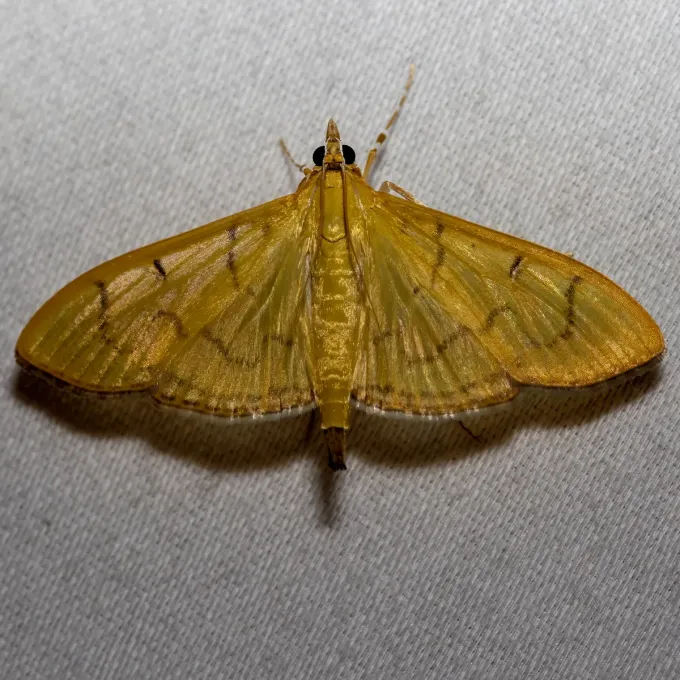
The poplar moth (Condylorrhiza vestigialis) belongs to the order Lepidoptera and the family Crambidae. The adult moth has a wingspan of 30–35 mm and is characterized by yellowish-brown wings with dark transverse lines.
Larvae, or caterpillars, undergo several growth stages, shifting their color from light green to a darker olive tone. They are highly active and possess the ability to drop from leaves on silk threads when disturbed.
Pupation occurs in dense white cocoons, often found within folded leaves or sheltered bark crevices. The pupa is the stage in which this insect typically overwinters, waiting for favorable temperatures.
Females deposit eggs in clusters on the undersides of leaves, covering them with a secretion that hardens into a protective layer against external elements.
Depending on the climatic zone, the poplar moth can complete multiple generations within a single growing season, leading to rapid population growth during warm summers.
What it damages
The primary hosts for this pest include species of the genus Populus (poplar), such as Lombardy and black poplars. Willow trees (Salix) are also susceptible to infestation.
Young larvae skeletonize the foliage, while older caterpillars consume the entire leaf, leaving only the central vein. This extensive feeding behavior results in significant loss of leaf area.
Severe infestations often cause total defoliation, which severely taxes the tree's energy reserves and makes it difficult for the plant to maintain photosynthesis.
Defoliated trees are significantly more susceptible to secondary attacks from wood-boring insects and various fungal pathogens that thrive on stressed tree hosts.
Economic damage includes reduced biomass growth in forestry plantations, loss of aesthetic value in urban landscaping, and the potential death of young saplings after repeated defoliation.
Signs of infestation
The first signs of infestation are leaves that are folded and held together by fine white silk webbing, within which the larvae live and feed.
Visible skeletonization of leaves, followed by large, irregular holes, provides clear evidence of caterpillar presence. Accumulations of frass on the leaves are also common.
During peak feeding times, one may observe larvae crawling along the branches and stems, searching for fresh foliage once the current leaf has been consumed.
White cocoons located in bark folds or at the base of branches indicate the transition of the population to the pupal stage, marking the end of the feeding cycle.
Visible webbing on new shoots is a critical warning sign that the infestation density is high and warrants immediate intervention to save the tree canopy.
Control measures
Chemical control involves the application of systemic or contact insecticides during the larval hatching period to effectively target young, vulnerable caterpillars.
Biological control using Bacillus thuringiensis sprays is highly recommended for urban or eco-sensitive areas, as it targets the larvae without harming other beneficial insects.
Silvicultural practices, such as the removal and destruction of infested foliage and branches, are essential for reducing the overwintering population of the moth.
Pheromone traps are used for monitoring adult flights, allowing managers to time their control efforts precisely for maximum effectiveness.
- Regular inspection of poplar and willow canopies for early signs of webbing.
- Promotion of natural predatory insects and bird populations in the affected area.
- Strategic pruning to improve air circulation and remove heavily infested parts of the tree.
Taxonomy
- Latin name
- Condylorrhiza vestigialis
- Order
- Lepidoptera (butterflies)
- Family
- Crambidae
- EPPO code
- CONRVE
Discussion
No discussions yet — be the first.