
Litchi erinose mite
Colomerus novahabridensis
Description
How to identify
The litchi erinose mite (Colomerus novahabridensis, formerly Eriophyes litchii) is a microscopic pest belonging to the family Eriophyidae, within the order Trombidiformes. It is a highly specialized mite that affects Litchi chinensis.
The adult mites are extremely small, measuring about 0.1 to 0.2 mm in length, and have a worm-like, elongated body with four legs located near the head. They are nearly invisible to the naked eye.
These mites do not possess respiratory organs and absorb oxygen through their soft cuticle. They typically cluster in groups within the dense hair-like structures they induce on the host plant.
Their life cycle is rapid; under optimal temperatures, they can complete a generation in as little as 10 to 14 days, leading to significant population outbreaks.
They overwinter as adults, finding shelter in the dormant buds, leaf crevices, or under the bark of young shoots, emerging when the plant begins new growth.
What it damages
The litchi erinose mite is highly host-specific, primarily attacking the leaves, buds, and floral structures of the litchi tree. It pierces the plant cells to extract sap.
As the mite feeds, it releases salivary secretions that stimulate the plant to produce a dense growth of trichomes, forming a pathological structure known as "erinose" or "felt."
This felt-like growth provides a protected habitat for the mites to feed and reproduce, effectively shielding them from many external environmental pressures.
Severe infestations lead to a drastic reduction in photosynthesis, leaf deformation, and premature leaf drop, which weakens the overall health of the tree.
If the mites attack the flower panicles, they can cause the floral parts to wither and fall off, resulting in significant or total loss of the fruit harvest.
Signs of infestation
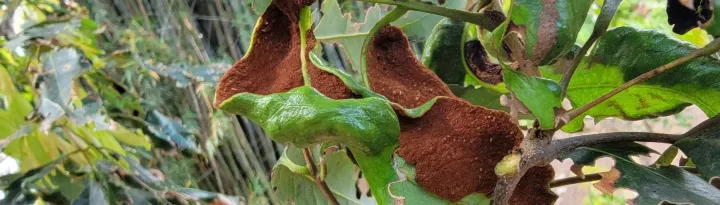
The most characteristic sign of an infestation is the appearance of brownish or rusty-colored felt-like patches on the underside of the leaves.
In the early stages, these patches appear as white or light-colored velvet-like structures, but they transition to a dark brown as the tissue ages.
Leaves affected by these mites become distorted, often curling downward and exhibiting a hardened, leathery texture compared to healthy foliage.
When the mites infest the young shoot tips, the growth becomes stunted, and the overall canopy of the litchi tree may appear thin and yellowed.
- Characteristic velvet-like "felt" patches on leaves.
- Leaf curling and deformation.
- Browning or blackening of the infested leaf tissue.
- Stunted growth of new shoots and flower panicles.
- Premature fruit and flower drop.
Control measures
Effective control requires the use of specialized acaricides, applied thoroughly to ensure contact with the mites, particularly during the dormant season.
Pruning and destroying heavily infested branches is a crucial cultural practice to reduce the mite population density within the orchard.
Biological control methods involving predatory mites, such as those from the family Phytoseiidae, can provide sustainable suppression of populations.
Applying dormant oils or sulfur-based sprays before the emergence of new spring growth helps to kill overwintering mites and disrupt their life cycle.
Strict quarantine measures should be observed when introducing new plants into an orchard to prevent the spread of this pest via infested nursery stock.
Taxonomy
- Latin name
- Colomerus novahabridensis
- Order
- Mites
- Family
- Eriophyidae
- EPPO code
- COOMNO
Discussion
No discussions yet — be the first.