
Grape erineum mite
Colomerus
Description
How to identify
The grape erineum mite, known scientifically as Colomerus vitis, is a tiny pest belonging to the family Eriophyidae, commonly referred to as rust or blister mites.
Adult mites are extremely small, measuring approximately 0.15 to 0.2 mm in length, and possess an elongated, cylindrical, and worm-like body.
Unlike most mites, they have only four legs, which are located at the front of their body, allowing them to crawl efficiently across the leaf surface.
These mites are almost invisible to the naked eye and are primarily identified by the distinct damage patterns they induce on the host plant tissue.
Their life cycle is relatively rapid, allowing for multiple generations to occur during a single growing season, provided that climate conditions remain favorable.
What it damages
This pest exclusively attacks grapevines (genus Vitis), feeding on the epidermal cells of leaves by piercing them with their specialized mouthparts.
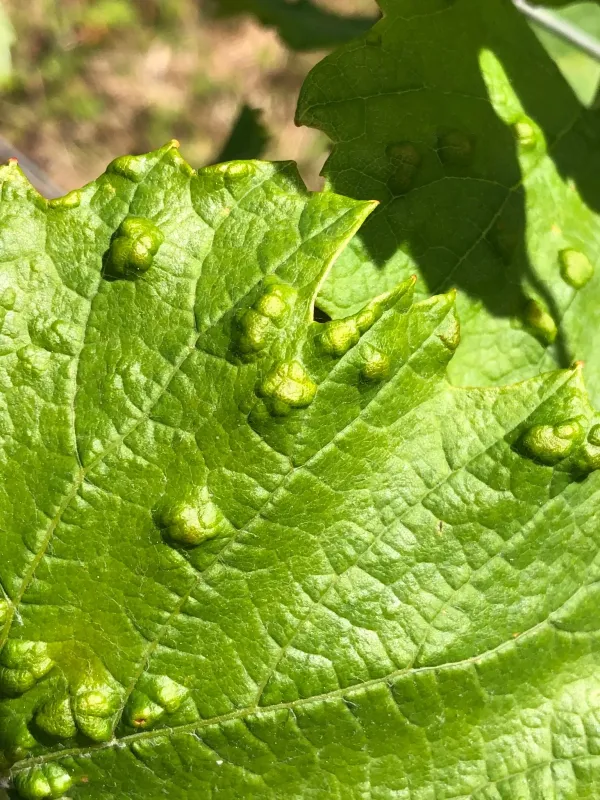
During feeding, the mites inject salivary enzymes into the plant, which trigger the formation of characteristic galls or blister-like swellings on the leaf surface.
The underside of the leaf develops a dense, felt-like patch of hair, which is actually a reaction of the plant to mite feeding; this is where the mites hide and breed.
Severe infestations interfere with photosynthesis and transpiration, causing stunted growth of shoots and potentially reducing the sugar content in the berries.
In extreme cases, heavy mite pressure can lead to partial or total loss of young leaves and damage to inflorescences, impacting the total vineyard yield.
When it appears
The mites overwinter as fertilized females primarily in the protective scales of dormant buds and occasionally within the crevices of the vine's bark.
As temperatures rise in the spring, coinciding with bud burst, the mites become active and move onto the newly emerging leaves to feed and lay eggs.
Peak population levels are typically reached during the mid-summer period when warm temperatures and high humidity create optimal breeding conditions.
As the season progresses, the mites continue to spread across the vine, inhabiting both the youngest foliage and older leaves if the conditions persist.
With the arrival of autumn and cooler temperatures, the female mites abandon the leaves to migrate toward the buds in preparation for winter dormancy.
Signs of infestation
The most recognizable symptom is the presence of pale, yellowish, or reddish raised blisters on the upper surface of the affected grape leaves.
The underside of these blisters is covered with a thick, white, felt-like growth, which gradually turns brown or rust-colored as the season progresses.
Affected leaves may exhibit curling, distortion, or reduced size, depending on the severity of the infestation and the susceptibility of the grape variety.
In cases of heavy infestation, flowers and young fruitlets may also show symptoms, leading to reduced fruit set or complete necrosis of the clusters.
- raised galls on the upper leaf surface;
- white to brown felt-like patches on the underside of leaves;
- stunted or distorted leaf growth;
- premature leaf drop in severe cases.
Control measures
The primary control measure involves the application of sulfur-based products during the dormant stage or at bud burst to kill mites before they colonize the leaves.
Sanitation practices, such as removing infested prunings and maintaining healthy vines, help to reduce the population levels significantly over time.
If mite pressure becomes economically damaging during the summer, specific acaricides can be applied, targeting the mites while sparing beneficial insects.
Encouraging the presence of natural predators, such as predatory phytoseiid mites, is a sustainable way to keep the erineum mite population in check.
Managing canopy density through proper training and leaf removal improves air circulation and sunlight exposure, creating an environment less suitable for mites.
Taxonomy
- Latin name
- Colomerus
- Order
- Mites
- Family
- Eriophyidae
- EPPO code
- COOMSP
Discussion
No discussions yet — be the first.