
Lodgepole needle miner
Coleotechnites milleri
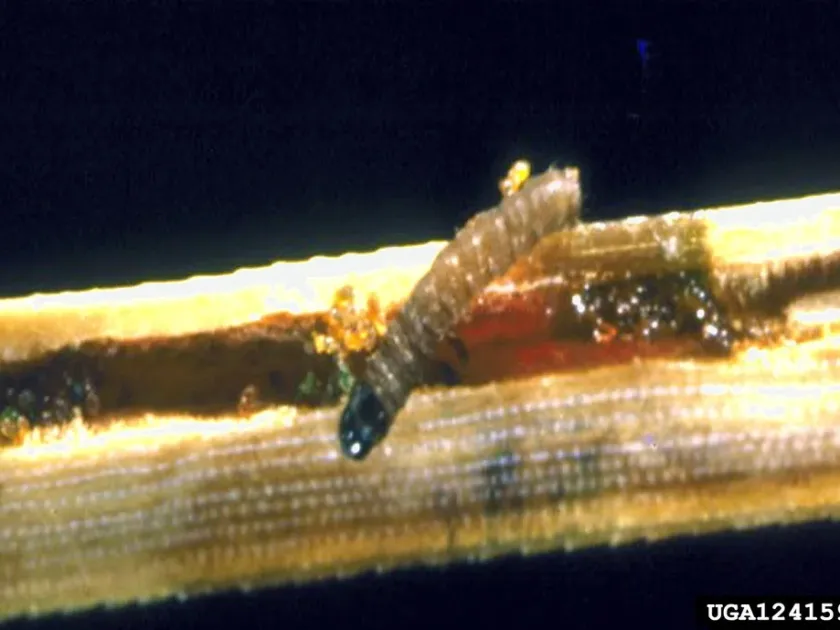
Description
How to identify
The lodgepole needle miner (scientific name: Coleotechnites milleri) is a moth species belonging to the family Gelechiidae. Adult moths are small with a wingspan of approximately 12–15 mm and have a grayish-brown appearance that provides camouflage on tree bark.
The life cycle of this pest typically spans two years in colder climates, though in warmer regions, it may follow a one-year cycle. The larvae are the primary damaging stage, living inside the needles.
The adult moths emerge in mid-summer to mate and lay eggs. Each female deposits eggs singly on the needles, often near the base, which allows the larvae immediate access to the internal tissue upon hatching.
Once hatched, the young larva bores into the needle and creates a mine, where it remains protected from the environment and many predators for the majority of its development.
The insect undergoes pupation either within the mined needle or, less frequently, in the forest litter, emerging as an adult moth to begin the cycle anew.
What it damages
The primary host for this species is the lodgepole pine (Pinus contorta), although it can occasionally infest other pine species when their ranges overlap significantly.
Larvae feed exclusively on the mesophyll tissue inside the pine needles, which effectively disrupts the plant's ability to perform photosynthesis efficiently.
The needles affected by the larvae lose their vibrant green color, turning yellowish or reddish-brown, which can give an entire forest stand a scorched or unhealthy appearance.
Severe infestations lead to premature needle drop, which puts the tree under intense physiological stress and makes it highly susceptible to secondary attacks by bark beetles.
Repeated yearly damage over long periods can cause stunted tree growth, reduced wood production, and in severe outbreak scenarios, mortality of younger or weakened trees.
Signs of infestation
The most visible sign of an infestation is the discoloration of needles in the lower and mid-canopy of the pine trees, which appear brittle and faded compared to healthy needles.
Upon closer examination, tiny entry holes can be observed on the surface of the needles, which serve as the primary indicator of larval boring activity.
Discolored needles often show linear mining tracks when held up to the light, indicating the internal consumption of the tissue by the growing larva.
Increased presence of bird activity, such as woodpeckers, can sometimes serve as an indicator of an underlying pest outbreak in a previously healthy-looking stand.
During the peak of an outbreak, the ground beneath the affected trees may be covered with shed, brown needles that have fallen prematurely due to the larvae's feeding.
Control measures
Integrated pest management (IPM) for this species relies heavily on monitoring adult moth populations using pheromone traps to determine the best window for treatment.
Biological control, particularly the protection and encouragement of native parasitoid wasps, is crucial as these natural enemies often keep needle miner populations in balance.
In high-value forest areas or plantations, the application of systemic insecticides that are absorbed into the needle tissues can effectively kill larvae inside their mines.
Sanitation practices, such as the removal and proper disposal of heavily infested, dying trees, can help prevent the spread of the moth to adjacent healthy stands.
Applying microbial insecticides like Bacillus thuringiensis (Bt) during the early larval stage is a preferred method for reducing impact while minimizing damage to non-target beneficial insects.
Taxonomy
- Latin name
- Coleotechnites milleri
- Order
- Lepidoptera (butterflies)
- Family
- Gelechiidae
- EPPO code
- RECUMI
Discussion
No discussions yet — be the first.