
Juniper webworm
Coleotechnites juniperella
Description
How to identify
The Juniper webworm (Coleotechnites juniperella) belongs to the Gelechiidae family of moths. These are small insects, with adults reaching a wingspan of approximately 10-12 millimeters.
The forewings of the moth are typically brownish-gray with complex patterns, providing excellent camouflage against the bark of juniper shrubs.
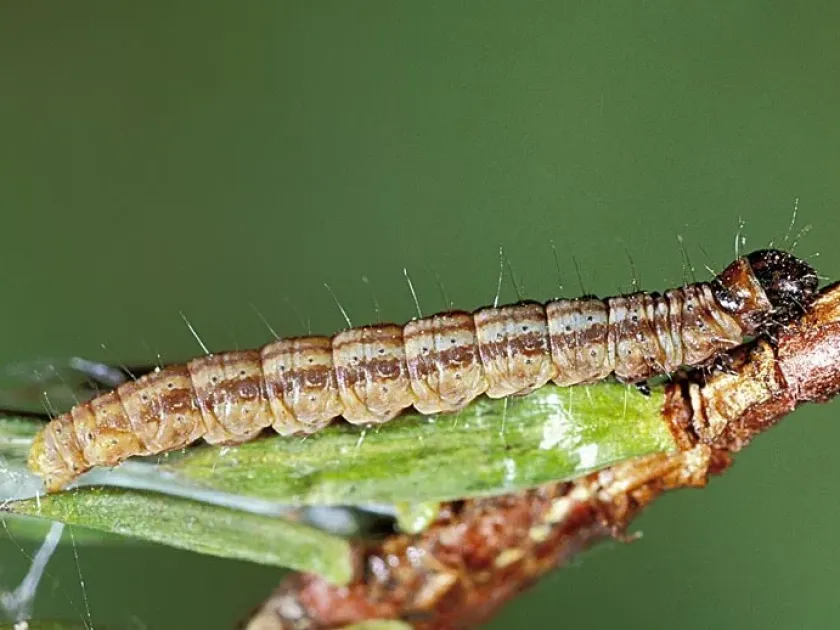
The larvae are small, yellowish-green caterpillars with dark heads. They spend most of their life cycle inside the needles, making them a difficult pest to detect early on.
The species usually has one generation per year, with the lifecycle synchronized with the growth stages of its host plant.
Pupation occurs either within the mined needle or inside a small silken cocoon woven between the needles, protected by characteristic webbing.
What it damages
The primary host for this pest is the common juniper (Juniperus communis) and its various ornamental cultivars found in gardens and landscapes.
Caterpillars mine the interior of the needles, turning them into hollow shells. From the outside, the needle often appears intact for a considerable amount of time.
As the infestation progresses, needles turn brown and fall off. Heavy infestations can lead to significant thinning of the shrub's foliage and general decline.
Affected plants often develop a ragged, unkempt appearance, which is particularly detrimental for decorative shrubs used in high-end landscaping.
In nursery settings, this pest can cause significant economic losses by rendering plants unsaleable due to the visible damage to the crown's density.
When it appears
Adult moths typically emerge in late spring to early summer to mate and lay eggs on the needles of the host plant.
The larval stage is the most active period for feeding, which occurs throughout the summer and autumn months as the caterpillars grow.
The pest overwinters primarily as a larva, often remaining inside the mined needles or within dense silken webs hidden deep within the foliage.
In early spring, larvae resume feeding for a short period before undergoing pupation, completing the annual developmental cycle.
Monitoring the adult population using pheromone traps is the most effective way to determine the timing of the next generation and plan control.
Signs of infestation
The initial sign of infestation is the discoloration of needles, which turn pale yellow or brown as they are hollowed out by the feeding larvae.
The presence of fine webbing that binds needles together is a definitive sign of webworm activity, distinguishing it from general needle drop.
- Brown, hollowed-out needles that crumble easily when pressed.
- Accumulation of small, dark frass pellets within the silken webs.
- Premature needle drop when the branch is gently shaken.
- Tiny, circular exit holes found on the surface of damaged needles.
Because the larvae are concealed, infestations are often misidentified until the foliage begins to show clear patches of dieback or thinning.
Control measures
Effective management requires a combination of cultural practices and targeted applications of systemic insecticides.
Pruning and destroying heavily infested branches helps to significantly reduce the local population of the pest during the dormant or early growth season.
Systemic insecticides are the preferred choice for chemical control, as they are absorbed by the plant tissues and reach the larvae inside the needles.
Biological control agents, such as formulations containing Bacillus thuringiensis, can be effective if applied during the early larval development stage.
Maintaining plant vigor through proper irrigation and fertilization is crucial for helping the juniper recover from the stress caused by the moth larvae.
Taxonomy
- Latin name
- Coleotechnites juniperella
- Order
- Lepidoptera (butterflies)
- Family
- Gelechiidae
- EPPO code
- RECUJU
Discussion
No discussions yet — be the first.