
Spruce needle miner
Coleotechnites apicitripunctella
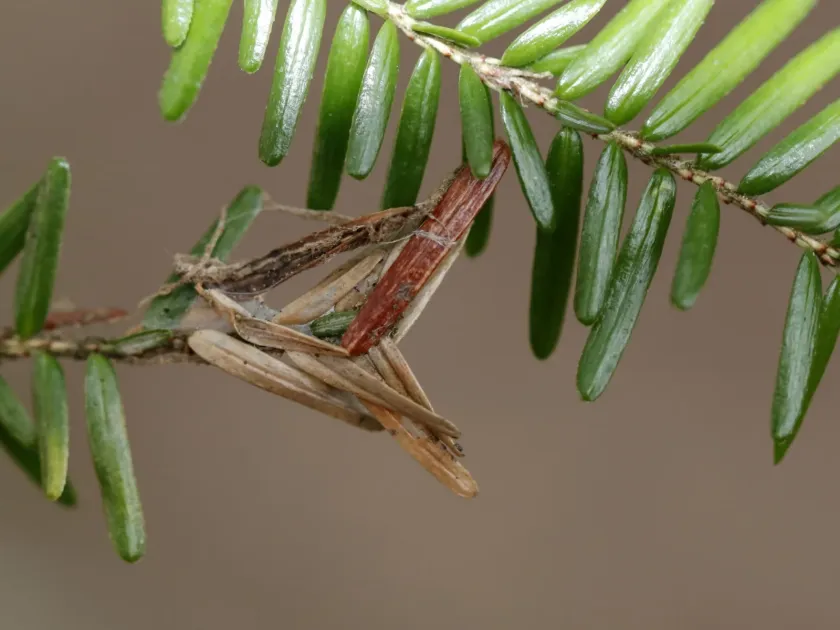
Description
How to identify
The spruce needle miner (Coleotechnites apicitripunctella) is a small moth belonging to the Gelechiidae family, known for its cryptic lifestyle within the needles of coniferous trees.
Adult moths are typically small with a wingspan of about 10–12 mm, displaying mottled brown or greyish coloration that provides excellent camouflage against tree bark.
The larval stage is the primary developmental phase, where the caterpillar transitions through several instars, becoming darker and more robust as it grows.
Identification is often assisted by the presence of characteristic mines, as the actual adults are elusive and primarily active during the night.
The pupa, typically dark brown, is formed either within the hollowed-out needle or inside a small, webbed structure spun between needles.
What it damages
This pest exclusively targets spruce trees, with various species (including Picea abies and Picea pungens) being susceptible to infestation.
Larvae consume the interior tissue of the needles, leaving only the outer sheath intact, which effectively destroys the needle's ability to perform photosynthesis.
Severe infestations can lead to significant needle drop, causing the tree to lose its natural density and vigor, which is particularly detrimental to young nursery saplings.
In ornamental settings, the loss of foliage results in a ragged, unsightly appearance, reducing the aesthetic and landscape value of the specimens.
Persistent attacks over multiple growing seasons can weaken the tree, leaving it susceptible to secondary pests or environmental stressors.
When it appears
The spruce needle miner follows a univoltine life cycle, meaning it completes one generation per year, with larvae spending the winter inside the needles.
As spring temperatures rise, the overwintering larvae resume feeding, actively expanding their mines and consuming the fresh spring foliage.
Pupation occurs in late spring or early summer, followed by the emergence of adult moths that mate and lay eggs on the current season's needles.
The flight period of adults generally lasts several weeks, during which they seek suitable hosts to deposit eggs, ensuring the next generation's survival.
Newly hatched larvae settle into the needles by late summer, where they begin their development and prepare to enter the diapause required for overwintering.
Signs of infestation
The earliest symptom is the presence of pale, discolored patches on the needles, caused by the larva feeding on the internal chlorophyll-containing tissues.
As damage progresses, the affected needles turn light brown or rusty, becoming brittle and eventually falling off the tree prematurely.
Closer inspection reveals fine, silken webbing between needles, which the larvae use to anchor themselves and protect their feeding site.
One may also observe small, round entry or exit holes on the surface of the needles, indicating the movement of the miner between different needles.
Widespread infestation gives the tree an overall thinning, sickly appearance, with significant needle loss concentrated in the lower to mid-canopy sections.
Control measures
Integrated pest management (IPM) is the most effective approach, starting with the removal and disposal of heavily infested branches to reduce the population.
Biological control using Bacillus thuringiensis sprays can target larvae specifically during their active feeding phase without harming beneficial predatory insects.
Systemic insecticides are recommended for severe infestations, as they are absorbed by the tree and reach the larvae residing inside the needles.
Timing is critical; applications should be coordinated with the period immediately following the moth flight when eggs are hatching into larvae.
- Regular tree monitoring using pheromone traps.
- Proper pruning of infested foliage in late winter or early spring.
- Targeted insecticide applications during the larval emergence phase.
Taxonomy
- Latin name
- Coleotechnites apicitripunctella
- Order
- Lepidoptera (butterflies)
- Family
- Gelechiidae
- EPPO code
- RECUAP
Discussion
No discussions yet — be the first.