
Brown soft scale
Coccus hesperidum
Description
How to identify
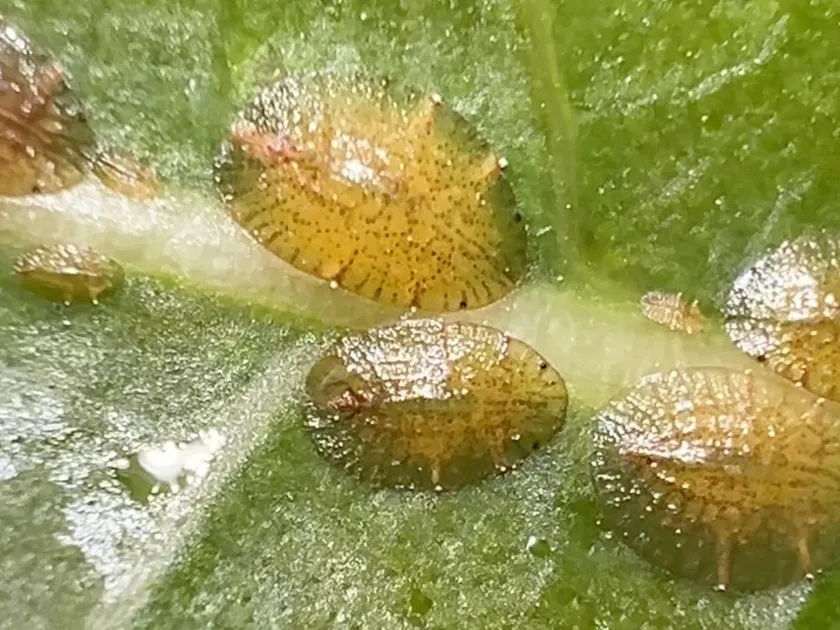
The brown soft scale (Coccus hesperidum) belongs to the order Hemiptera, family Coccidae. The adult female has a flat, oblong-oval body measuring 3–4 mm in length, with a yellowish-brown or brown coloration.
The female's body does not have a separate shield; instead, it is covered by a dense, smooth cuticle that becomes harder and more convex with age. Males are extremely rare and play almost no role in the reproduction process.
This species is viviparous, which allows the pest to rapidly colonize new areas of a plant without laying visible eggs. The crawlers (first-instar larvae) are highly mobile and have a pale yellow color, making them difficult to spot in the early stages.
Unlike armored scale insects, the brown soft scale lacks a protective shell that can be detached from the insect's body. The entire structure of the pest is unified, which is a crucial factor to consider when performing mechanical removal.
The insect spreads primarily through contaminated planting material, as well as via wind or by crawlers moving along connecting branches between adjacent plants.
What it damages
The pest attacks a wide range of crops, including citrus, laurel, oleander, palms, ficus, and many other ornamental and fruit plants. It is particularly dangerous for collections in greenhouses and indoor environments.
The scale insect resides primarily on leaves, positioning itself along the main veins, as well as on young shoots. During heavy infestations, colonies can cover almost the entire surface of the leaf blade.
The insect feeds on plant sap, piercing the epidermis with its proboscis to suck out nutrients. This leads to general plant exhaustion, shoot deformation, and premature leaf drop.
During its life cycle, the pest excretes large amounts of honeydew (a sticky liquid). This medium becomes an ideal substrate for the growth of sooty mold, which blocks photosynthesis.
The consequences of damage include stunted growth, reduced plant immunity, and the complete loss of commercial value for ornamental crops or significant yield losses in fruit trees.
When it appears
In greenhouses or indoor conditions, the brown soft scale can reproduce year-round, as the temperature remains consistently favorable for the development of all life stages.
Optimal conditions for high insect activity are high air humidity and a lack of direct sunlight. At temperatures between +20 and +25 degrees Celsius, the development cycle of one generation is shortened to 40–50 days.
In outdoor environments in warm regions, the pest is most active during the spring and summer. Population peaks often occur in the second half of summer when weather conditions favor mass crawler emergence.
Adults overwinter in southern regions on the bark of evergreen plants. In northern latitudes, the species is found exclusively on houseplants and in greenhouses.
Generations often overlap, so it is common to find first-instar larvae, nymphs, and adult females on the same plant simultaneously.
Signs of infestation
The first sign of infestation is the appearance of a sticky coating (honeydew) on the leaves, which attracts dust and creates conditions for the growth of sooty mold — a black, powdery substance.
Upon close inspection, characteristic convex brown "plaques" are found along the leaf veins. These structures are stationary and firmly attached to the leaf surface.
The presence of large numbers of small ants on a plant often indicates the presence of scale insects, as ants feed on the honeydew and actively "farm" the pest colonies.
Leaves of infested plants begin to yellow, curl, and shoots stop growing and eventually dry out. Without control measures, a plant may die completely within a few months.
In the early stages, the pest reveals itself through the presence of translucent young individuals, which appear as tiny yellowish dots concentrated on the underside of the leaf.
Control measures
Control measures include a comprehensive approach: mechanical cleaning, agronomic practices, and the use of chemical plant protection products.
- Mechanical removal of pests using a soft brush or a swab soaked in an alcohol or soap solution.
- Regular warm showers to wash off the sticky residue and a portion of the larvae.
- Application of systemic insecticides, as the pest is protected by dense outer coverings.
- Use of oil-based products to create a film that restricts the insect's access to oxygen.
- Isolation of infested specimens and systematic inspection of neighboring plants in the collection.
Taxonomy
- Latin name
- Coccus hesperidum
- Order
- Hemiptera (bugs, aphids, leafhoppers)
- Family
- Coccidae
- EPPO code
- COCCHE
Discussion
No discussions yet — be the first.