
Capper scale
Coccus capparidis
Description
How to identify
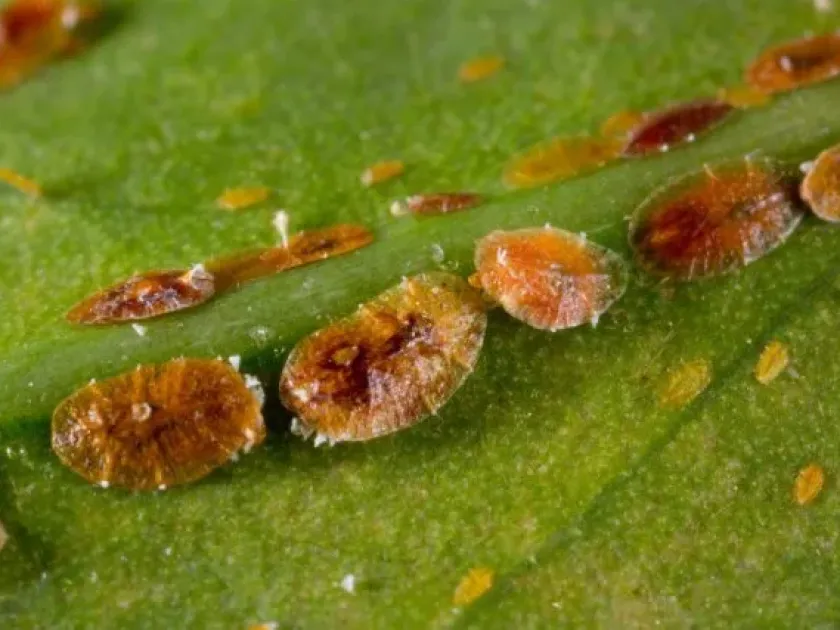
The Capper scale (Coccus capparidis) is a member of the Coccidae family within the order Hemiptera. Adult females are characterized by a convex, oval-shaped body that typically displays yellow-brown to dark brown coloration.
Unlike armored scale insects, this species does not possess a separate protective shield. Instead, the female's own body hardens to provide the necessary protection. The surface is smooth and often covered by a thin, waxy coating, which makes it resistant to various environmental stressors.
The immature stages, commonly known as "crawlers," are very small, mobile, and pale yellow. They are highly active and disperse across the plant to find suitable feeding sites on young stems and the underside of leaves.
Males are rarely encountered and are distinguished by the presence of wings, allowing them to move in search of mates. Conversely, females lead a sessile life, remaining firmly attached to the host plant throughout their adult stage.
Adult scales usually measure between 3 and 5 millimeters in length. Due to their coloration, they often blend in perfectly with the bark or veins of the host plant, making early detection a significant challenge for growers.
What it damages
This pest is a polyphage, primarily targeting subtropical crops such as citrus, pomegranates, and capers, as well as various ornamental plants found in greenhouses. Infestations typically cluster along twigs and the midribs of leaves.
By sucking plant sap, the scale insects weaken the host significantly. This energy drain results in stunted growth, reduced yields, and lower fruit quality, posing a serious threat to both domestic gardens and commercial orchards.
In cases of severe infestation, the plant may suffer from widespread leaf drop and the drying out of entire branches. If left untreated, the cumulative damage can lead to the death of the entire plant due to lack of nutrients.
The pest secretes honeydew, which serves as a substrate for sooty mold fungi. This thick, black coating covers the foliage, severely hindering photosynthesis and detracting from the aesthetic value of the plants.
Feeding sites often develop necrotic spots where the plant tissue has been damaged. Infested plants also become significantly more susceptible to secondary infections, such as viruses or bacterial pathogens entering through the feeding wounds.
When it appears
The development of the Capper scale is strictly governed by local climate and temperature. In warm regions, the pest can produce multiple generations per year, creating a continuous pressure on plant health.
The peak activity of the crawler stage occurs as temperatures rise during the spring and summer. This is the optimal window for the pest to colonize new areas, including healthy parts of the plant or adjacent host plants.
In indoor environments like greenhouses, the pest can reproduce year-round due to stable temperatures and the absence of natural predators, allowing populations to expand rapidly without seasonal interruptions.
Favorable conditions include high humidity and stable temperatures. These factors allow for accelerated transition between development stages, quickly increasing the density of the colony on the host plant.
Activity diminishes slightly toward the end of the season; however, adult females possess the ability to survive through colder periods by overwintering on the bark, ensuring they remain ready to reproduce as soon as conditions improve.
Signs of infestation
A primary indicator of infestation is the presence of convex, brown bumps or "plaques" on the twigs and the undersides of leaves, which can be mistaken for natural growth or buds.
The foliage often becomes sticky to the touch due to honeydew secretions. This symptom is frequently visible before the scale insects grow to their full, easily recognizable size.
The presence of ants on the plant is a strong indirect sign of a scale infestation. Ants are attracted to the sugary honeydew and often act to protect the scale colony from natural enemies.
Leaves may show signs of chlorosis, yellowing, curling, or dropping prematurely. This happens because the plant is struggling to maintain its physiological functions under the heavy pressure of sap-sucking parasites.
- Brown, plaque-like bumps on stems.
- Sticky honeydew residues on leaves.
- Black, soot-like fungal growth on foliage.
- Increased ant activity around the plant.
- General decline and stunted growth.
Control measures
For effective management, a multi-faceted approach is recommended. Mechanical removal of visible colonies by scrubbing infested areas with a soapy alcohol solution can be highly effective for small plants.
The use of systemic insecticides is the standard for chemical control. These chemicals are absorbed into the plant's vascular system, ensuring that the pest is neutralized as it consumes the contaminated sap.
Timing is critical: applications should be performed during the crawler stage, as they are not yet protected by a tough waxy layer, making them highly susceptible to contact and systemic treatments.
Biological control, including the release of specific parasitoids or predatory ladybirds, can effectively suppress scale populations, especially in organic farming or greenhouse settings.
Preventive measures include regular inspection of all plant parts, maintaining appropriate humidity levels, and ensuring proper airflow. Early intervention is essential to prevent the spread of the pest to adjacent plants.
Taxonomy
- Latin name
- Coccus capparidis
- Order
- Hemiptera (bugs, aphids, leafhoppers)
- Family
- Coccidae
- EPPO code
- COCCCA
Discussion
No discussions yet — be the first.