
Cletus punctiger
Cletus punctiger
Description
How to identify
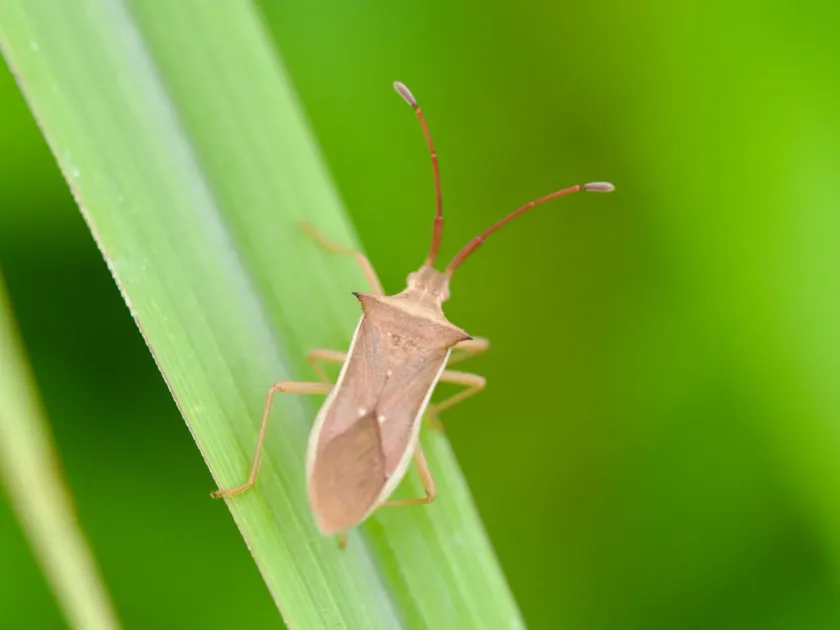
Cletus punctiger is a species of leaf-footed bug belonging to the family Coreidae. These insects are characterized by an elongated body shape, typically measuring between 10 and 12 millimeters in length as adults.
The coloration of the adult bug ranges from yellowish-brown to dark brown, providing excellent camouflage against the stems and foliage of host plants. A defining feature is the fine puncturing on the pronotum and elytra.
The head is relatively small and equipped with a piercing-sucking mouthpart (proboscis), which is used to feed on plant sap. The antennae are prominent, consisting of four distinct segments, a key feature for identification.
Nymphs resemble smaller, wingless versions of the adults. They often exhibit a lighter green or brownish color and are typically found feeding in clusters, particularly near the reproductive structures of the plant.
Being highly mobile, these bugs can quickly migrate between fields. They are most commonly encountered during the vegetative and reproductive stages of leguminous crops.
What it damages
Cletus punctiger primarily infests leguminous crops, with soybean being a major host. The bugs use their proboscis to pierce tissues, extracting sap from both leaves and developing pods.
The most severe damage occurs when the pest feeds on the developing seeds inside the pods. This leads to reduced seed weight, poor quality, and a significant decrease in overall yield potential.
Pierced areas often become susceptible to secondary infections by various pathogens, causing the pods to blacken and wither. This condition is frequently referred to as pod rot or shriveling.
Plants under heavy infestation show signs of physiological stress, including stunted growth and uneven maturation. The feeding process drains the plant of essential nutrients and moisture.
In high-density populations, the economic damage can be substantial, leading to yield losses of 20% or more, depending on the stage of the crop at the time of the infestation.
When it appears
The life cycle of Cletus punctiger is closely tied to the growing season of its host plants. Adults typically overwinter in protected areas, such as leaf litter, crop residues, or soil cracks.
Activity begins in the spring when temperatures rise. Initial populations often establish themselves on wild host plants or weeds before migrating to agricultural fields as the crops emerge.
Mid-summer is usually the period of peak activity, during which multiple overlapping generations may occur. Warm and humid conditions significantly accelerate their development cycle.
As the season progresses toward autumn, adults move toward their overwintering sites. Monitoring during this transition is crucial for assessing potential population density for the following year.
Agronomists should schedule field inspections starting from the early flowering stage of the crop, as this is when the bugs begin to concentrate on the reproductive parts of the plants.
Signs of infestation
The first visual signs of infestation include small, yellowish spots on the leaves at the site of feeding punctures. Over time, these spots can become necrotic and dark in color.
Close inspection of the pods reveals characteristic tiny dark puncture marks. Opening these pods often reveals damaged, shriveled, or improperly developed seeds inside.
General crop malaise is a common indicator. Plants may appear wilted or yellowed despite adequate water supply, as the pest prevents the plant from maintaining its water and nutrient balance.
Nymphs can often be found congregating on the undersides of leaves or within the canopy of the plants. Their presence is a clear sign that a reproductive population is established.
During the harvest, high levels of seed damage, such as discoloration or shriveling, provide retrospective evidence of a severe infestation by this specific coreid bug.
Control measures
Cultural control practices, such as maintaining field hygiene and managing weeds along field borders, are effective in reducing the initial reservoir of the pest.
Deep plowing after harvest is highly recommended to bury crop residues and destroy the overwintering sites of adults, thereby reducing the population size for the next season.
Chemical control is necessary when monitoring reveals that the insect population has exceeded the economic injury level. Systemic insecticides are preferred for their ability to protect the developing pods.
It is important to follow integrated pest management (IPM) protocols by rotating insecticides to minimize the risk of developing resistance in the bug population.
Encouraging natural predators and parasitoids can provide partial control. However, in regions with severe outbreaks, timely chemical intervention remains the primary method for protecting the yield.
Taxonomy
- Latin name
- Cletus punctiger
- Order
- Hemiptera (bugs, aphids, leafhoppers)
- Family
- Coreidae
- EPPO code
- CLESPU
Discussion
No discussions yet — be the first.