
Clavigralla gibbosa
Clavigralla gibbosa
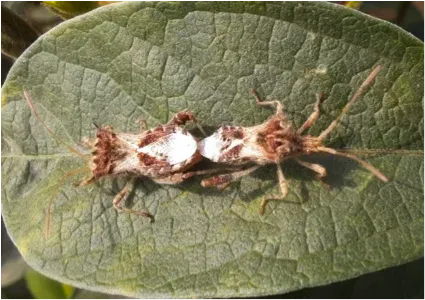
Description
How to identify
Clavigralla gibbosa is a significant agricultural pest belonging to the Coreidae family (leaf-footed bugs). It is known for its distinct morphology, characterized by sharp thoracic spines or "humps" on the pronotum.
Adult insects typically measure between 8 and 10 mm in length. Their coloration ranges from yellowish-brown to dark brown, which provides excellent camouflage against the foliage and pods of host plants.
Nymphs undergo five developmental stages. While they resemble adults, they lack fully developed wings and have a variable coloration, often appearing green or reddish-brown to blend in with stems.
This species is highly adapted to arid and semi-arid climates. The adults are strong flyers, allowing them to rapidly colonize agricultural fields during the growing season.
The life cycle involves eggs laid in small clusters on the underside of leaves or pod surfaces. This positioning ensures that newly hatched nymphs have immediate access to food sources.
What it damages
The primary hosts of this pest include pulse crops such as chickpeas, pigeon peas, and lentils. It is considered one of the most destructive bugs for legumes in its native range.
Damage is caused by both adults and nymphs piercing the plant tissue with their specialized mouthparts. They focus their feeding on succulent parts, particularly young pods and developing seeds.
Feeding punctures cause the pod tissue to wither and turn necrotic. As a result, the seeds inside fail to develop properly, becoming shriveled, deformed, and significantly reduced in weight.
In addition to physical damage, feeding punctures serve as entry points for fungal and bacterial pathogens, which can lead to pod rot and total loss of the yield in infested areas.
In severe infestations, the insect can cause substantial economic losses, with reports of damage impacting up to 50% of the grain yield if left unmanaged.
When it appears
The activity of Clavigralla gibbosa is closely linked to the crop cycle, specifically the flowering and pod-filling stages. High temperatures and low humidity accelerate their reproductive cycles.
The overwintering adults emerge in the spring as soon as temperatures rise. They migrate to early-season crops, where they begin feeding and establishing the first generation of the year.
Multiple generations can occur within a single growing season. This leads to continuous pressure on the crop, particularly if staggered planting dates are used in the field.
Overwintering occurs in crop residues, leaf litter, or in the upper soil profile, where the bugs remain in a state of diapause until environmental conditions become favorable.
Populations tend to peak during the mid-to-late growth stages of pulse crops, coinciding with the critical period for pod formation and grain maturation.
Signs of infestation
A primary indicator of an infestation is the appearance of small, whitish spots on the pods, which eventually darken into necrotic lesions due to the bug's saliva toxicity.
Plants infested by these bugs often exhibit signs of stress, such as yellowing and premature drying of pods. In some cases, buds and flowers may drop prematurely, reducing the overall yield potential.
Observing the field closely often reveals nymphs or adults hiding on the stems or pods. They are sensitive to vibration and will move to the underside of plant parts when approached.
Post-harvest analysis often reveals a high percentage of damaged, shriveled, or empty grains. These seeds show visible depressions and are often unsuitable for storage or germination.
- necrotic spots on pod surfaces;
- deformed and shriveled grain;
- premature pod drop;
- unpleasant odor upon field disturbance.
Control measures
Integrated Pest Management (IPM) is essential. Cultural practices, such as crop rotation and the destruction of post-harvest residues, are vital to reducing overwintering populations.
Field sanitation, including the removal of alternative host weeds from field margins, helps prevent the initial build-up of bug populations before they migrate to the primary crop.
Biological control methods involve the use of natural enemies, such as egg parasitoids, which help regulate population density in a sustainable manner.
Chemical control should be applied based on economic threshold levels. Systematic insecticides are most effective when applied during the early flowering stage to prevent the bugs from reaching the pods.
It is recommended to rotate chemical groups and apply insecticides during the early morning or evening when insects are less active and more accessible for direct contact treatments.
Taxonomy
- Latin name
- Clavigralla gibbosa
- Order
- Hemiptera (bugs, aphids, leafhoppers)
- Family
- Coreidae
- EPPO code
- CLAGGI
Discussion
No discussions yet — be the first.