
Olive-backed sunbird
Cinnyris jugularis
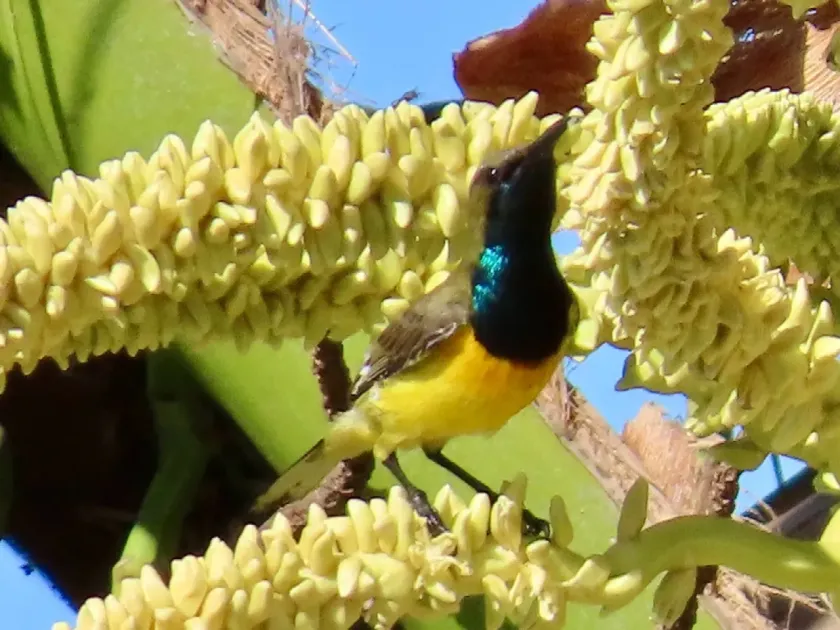
Description
How to identify
The Olive-backed sunbird (Cinnyris jugularis) is a small, energetic passerine bird belonging to the Nectariniidae family, widely found in tropical regions.
The male typically features a dark brown to metallic green throat and breast, contrasting sharply with its vibrant yellow belly.
The female has a more subtle, olive-grey appearance on the back and a bright yellow underbelly, lacking the darker plumage seen in males.
The species is equipped with a thin, downward-curved beak specifically evolved for extracting nectar from the base of tubular flowers.
These birds are known for their fast, darting flight and their ability to hover momentarily, which makes them highly efficient at visiting various flowers.
What it damages
While often seen as pollinators, Olive-backed sunbirds can become pests when they practice "nectar robbing" on cultivated plants.
By piercing the base of the flower to access nectar, they effectively bypass the pollination process and destroy the plant's reproductive organs.
This behavior results in the wilting and premature shedding of flower buds, significantly reducing the potential yield of fruit or flowers.
Ornamental shrubs and specific fruit-bearing trees are particularly susceptible to damage during their peak flowering seasons.
Heavy infestation by these birds can ruin entire crops, leading to significant economic losses for gardeners and commercial growers.
When it appears
Their activity levels are highly seasonal, dictated by the phenology of flowering plants and the availability of nectar-rich sources.
In tropical climates, they are active year-round, but their tendency to rob nectar from crops increases during the dry season when flowers are scarce.
The peak period of damage coincides with the spring bloom and the early reproductive stages of agricultural plants.
During the nesting season, the birds become increasingly active, foraging intensively to provide nutrition for their growing offspring.
Early morning hours represent the most critical time for protection, as the birds exhibit their highest foraging activity during this period.
Signs of infestation
The primary indicator of sunbird damage is the presence of small, clean puncture holes at the base of the flower's calyx or corolla tube.
Widespread dropping of damaged, underdeveloped flowers and buds beneath the canopy is a clear sign of sunbird activity in the orchard.
Discolored or necrotic patches near the base of the petals occur as the damaged plant tissue begins to die following the birds' visits.
Gardeners may observe the birds hovering around the same cluster of flowers for several minutes, moving rapidly between blooms.
The presence of high-pitched, short metallic calls emanating from the treetops is a common auditory signal of their presence in the garden.
Control measures
The most effective physical barrier is the installation of fine-mesh bird netting, which prevents access to the flower canopy without harming the birds.
Visual deterrents, including reflective tapes, holographic discs, or motion-activated devices, can discourage birds from settling in the garden.
Diversionary planting of non-crop nectar sources located away from vulnerable plants can help reduce the pressure on high-value crops.
Ultrasonic bird repellers are occasionally used in professional orchards to disrupt the birds' behavior using targeted frequency bursts.
Consistent monitoring and the implementation of multiple deterrent strategies are recommended to prevent the birds from adapting to a single method.
Taxonomy
- Latin name
- Cinnyris jugularis
- Family
- Nectariniidae
- EPPO code
- CINNJU
Discussion
No discussions yet — be the first.