
Copper sunbird
Cinnyris cupreus
Description
How to identify
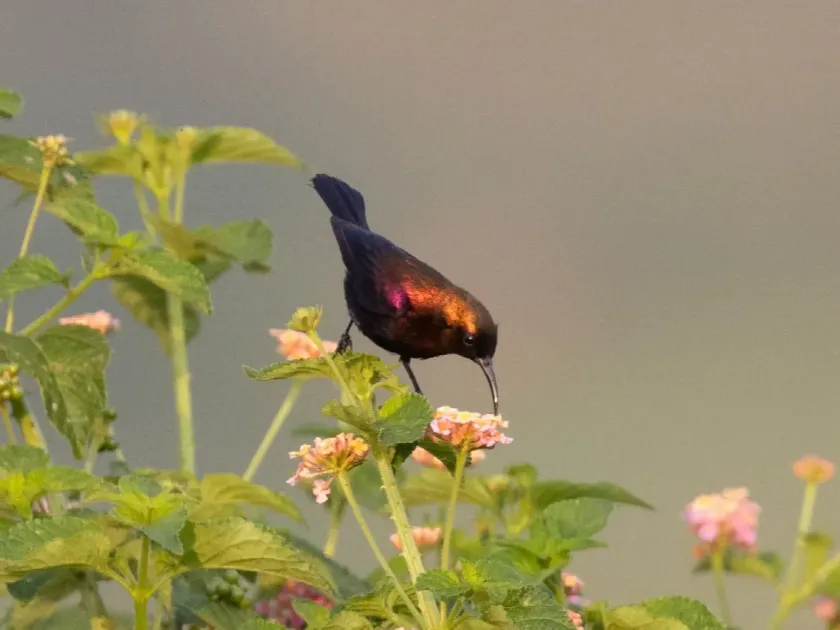
The Copper sunbird (Cinnyris cupreus) is a small bird species within the Nectariniidae family, belonging to the order Passeriformes. Adult males are distinguished by their stunning metallic-copper or bronze-green plumage, which reflects light brilliantly. Females display more muted, brownish tones, providing effective camouflage while nesting.
The primary identification feature is the long, slender, and slightly decurved bill. This specialized anatomy is evolved for probing deep into tubular flowers to reach nectar, making them highly efficient foragers, but also potentially damaging to cultivated plant reproductive structures.
These birds measure approximately 10–12 centimeters in length. They are exceptionally agile in flight, possessing the ability to hover momentarily near flowers, similar to hummingbirds, which allows them to feed on blossoms that cannot support their weight.
The species is widespread across tropical Africa, inhabiting forest edges, savannas, and increasingly, human-altered landscapes such as orchards and botanical gardens where flowering plants are abundant throughout the year.
Their presence is often announced by high-pitched, melodic, yet sharp whistle calls. Observing their erratic flight patterns around tree canopies is a reliable way to spot them in a garden setting.
What it damages
Although the Copper sunbird feeds primarily on nectar, it can cause significant damage to floral buds and developing ovaries of cultivated plants. When probing for nectar, the bird's sharp bill often punctures the outer tissues of the buds.
Commercial crops and ornamental plants, including citrus, figs, and various exotic flowers, are particularly susceptible. The mechanical damage caused by the sunbird's bill leads to deformed blossoms and a subsequent reduction in fruit yields.
Beyond direct physical trauma, the puncture wounds created by the birds serve as entry points for various pathogens, including fungi and bacteria. This secondary infection often leads to bud decay and further loss of productive capacity in the garden.
In regions where the Copper sunbird population is dense, they can destroy the entire bloom of specific plant species, resulting in severe aesthetic and economic losses for nurseries and floriculture farms.
The level of damage typically spikes during drought periods when natural food sources are scarce. In these conditions, birds rely more heavily on cultivated gardens for hydration and energy, increasing the pressure on horticultural crops.
When it appears
The seasonal presence of the Copper sunbird is intrinsically linked to the blooming phenology of their preferred food sources. Their activity within a garden peaks during the active budding and flowering stages of local flora.
In tropical climates, these birds can be active throughout the year, but their foraging intensity increases during wet seasons when vegetation growth and flower production are at their peak. This is when human-managed orchards face the highest risk.
Migration and local movement patterns also play a significant role. Sunbirds often follow the blooming cycles of specific tree species, meaning their appearance in a specific area can be unpredictable but intense once they arrive.
Diurnal activity is highest in the early morning hours. During this time, they are most aggressive in searching for high-energy nectar, making it the most critical period for garden monitoring and protection.
As the flowering season draws to a close and nectar becomes less available, the sunbirds adapt their diet to include small insects and larvae found in tree bark, which naturally shifts their focus away from cultivated floral buds.
Control measures
Physical exclusion remains the most effective management strategy against the Copper sunbird. Fine-mesh netting draped over small trees or delicate flowering shrubs prevents birds from accessing the blossoms without harming them.
Visual deterrents, such as reflective tape, CDs, or predatory bird decoys, can be employed. However, these are generally effective only in the short term, as intelligent birds like the Copper sunbird quickly adapt to stationary scare tactics.
Ultrasonic bird repellers that emit varying frequencies can be effective, provided they are maintained and moved periodically to prevent birds from habituating to the sound signal. These devices work best when paired with other deterrents.
- Pruning dense canopies to remove hiding spots and reduce habitat attractiveness.
- Using high-quality bird netting on high-value ornamental trees.
- Rotating multiple types of deterrents to minimize the risk of behavioral adaptation.
Chemical control against birds is generally discouraged and often prohibited due to ecological risks and potential harm to non-target species. Integrated pest management, focusing on physical barriers and garden sanitation, provides the most sustainable path to crop protection.
Taxonomy
- Latin name
- Cinnyris cupreus
- Family
- Nectariniidae
- EPPO code
- CINNCU
Discussion
No discussions yet — be the first.