
Six-spotted moth
Chrysoesthia sexguttella
Description
How to identify
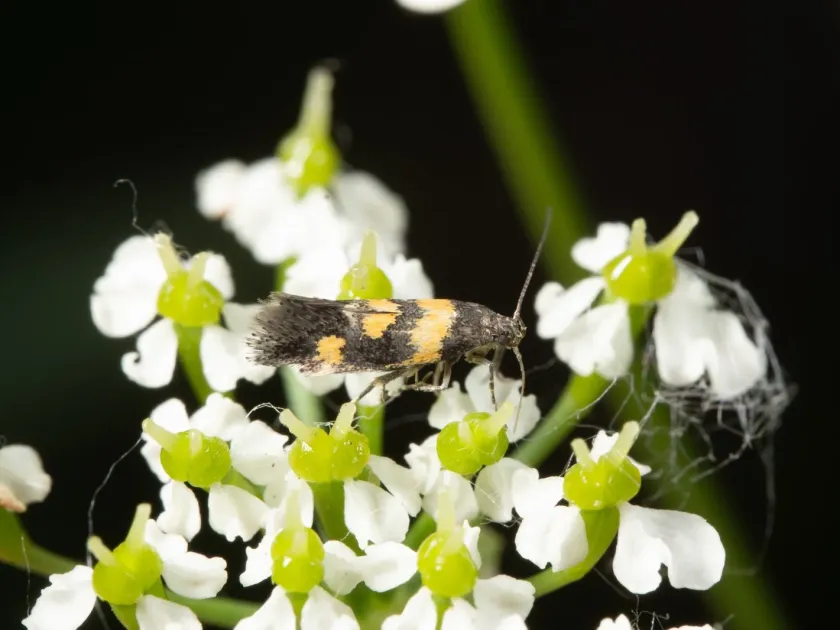
The six-spotted moth (Chrysoesthia sexguttella) belongs to the order Lepidoptera and the family Gelechiidae. It is a small moth with a wingspan typically ranging from 10 to 12 millimeters.
The forewings are dark-colored, usually bronze-brown, and marked with distinctive light spots, which gives the species its common and scientific name.
Larvae are small, reaching about 6–8 mm in length. Their bodies are typically yellowish-green, featuring a darker head capsule, which is adapted for their life inside the leaf tissue.
Pupation occurs either within the larval mine or in the upper soil layer, often protected by debris from the host plant or surrounding weeds.
The life cycle undergoes complete metamorphosis, consisting of the egg, larval, pupal, and adult stages. Depending on regional climate, it can complete multiple generations per season.
What it damages
The primary host plants for this pest include members of the Amaranthaceae family, most notably garden beet, sugar beet, and spinach crops.
The moth also thrives on wild species of Chenopodiaceae, such as lambsquarters (Chenopodium album), which often serve as primary sources of infestation for neighboring fields.
The larvae feed on the leaf parenchyma, excavating mines while leaving the epidermis intact. This feeding behavior destroys the photosynthetic cells of the leaf.
Significant infestations can lead to a reduction in the plant's overall photosynthetic capacity, which directly negatively affects root development and sugar accumulation.
Severe mining causes leaves to wither and die prematurely, resulting in reduced yields and a weakened physiological state of the crop.
Signs of infestation
The most visible sign of infestation is the presence of white or brown spots on leaves, known as mines, which are formed by the feeding tunnels of the larvae.
Inside these mines, the presence of frass (larval excrement) is a key diagnostic feature, allowing growers to distinguish these mines from those of other leaf-mining insects.
As the infestation progresses, the mined leaf areas turn brown and brittle, eventually causing parts of the leaf to dry out and collapse.
During the early stages, the mines may appear as narrow, winding tracks before expanding into larger, irregular patches across the leaf surface.
Detecting the adult moth is more difficult as they are generally nocturnal or crepuscular, spending daylight hours hiding within the canopy of the plants.
Control measures
Effective management begins with aggressive weed control, specifically targeting wild Chenopodiaceae, which act as alternative hosts for the six-spotted moth.
Deep plowing following the harvest is an essential cultural practice to bury pupae, preventing their survival and emergence in the following growing season.
Implementing crop rotation is highly recommended to disrupt the life cycle of the pest, ensuring that susceptible hosts are not grown in the same field consecutively.
When monitoring indicates that the population has exceeded the economic threshold, systemic insecticides can be applied to suppress larval development.
The use of pheromone traps for monitoring is crucial to time insecticide applications accurately, ensuring effective control while minimizing unnecessary chemical exposure.
Taxonomy
- Latin name
- Chrysoesthia sexguttella
- Order
- Lepidoptera (butterflies)
- Family
- Gelechiidae
- EPPO code
- KRYSSE
Discussion
No discussions yet — be the first.