

Pest · Coleoptera (beetles) · affects Fodder beet, Winter barley, Winter wheat
Tortoise beetle
Chirida
Description
How to identify
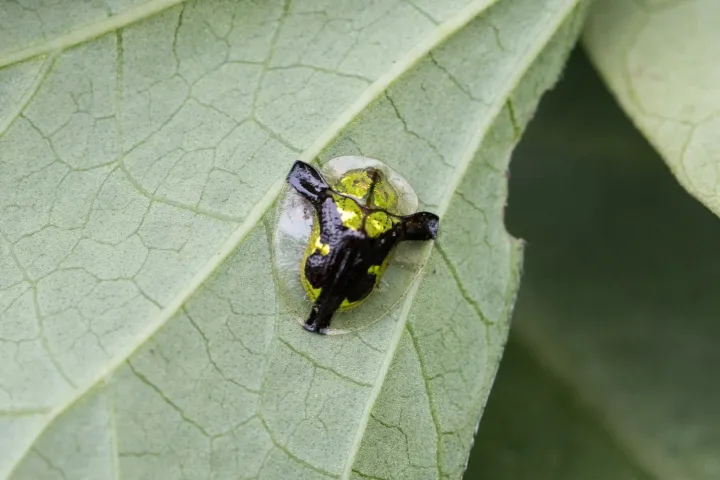
Tortoise beetles (genus Chirida) belong to the family Chrysomelidae within the order Coleoptera. These beetles are characterized by their flattened, shield-like appearance, where the margins of the pronotum and elytra extend outwards to cover the head and legs entirely.
The coloration of adults is often highly variable, ranging from metallic green to golden or spotted patterns, which serves as a highly effective camouflage mechanism against foliage. The body shape is typically oval or rounded, with a smooth, glossy surface and lengths ranging between 5 and 10 millimeters.
Larvae of the tortoise beetle look vastly different from adults: they have an elongated, flattened body lined with branched spines along the sides, and a distinct, long projection at the rear of the abdomen used to store excrement.
Reproduction involves laying eggs on the undersides of host plant leaves. Females often cover these eggs with a protective, fast-hardening secretion that forms a thin film or a dense protective case to shield them from predators and desiccation.
The lifecycle consists of four distinct stages: egg, larva, pupa, and adult. Adults typically overwinter in plant debris, under fallen leaves, or in the upper soil layers, emerging once the ambient temperatures remain consistently warm.
What it damages
Tortoise beetles are specialized feeders that primarily target members of the Convolvulaceae family, such as sweet potatoes (Ipomoea batatas) and morning glory, as well as some species of nightshades and brassicas.
The damage is most severe in warm climate regions, where multiple generations of the pest can complete their lifecycle within a single growing season. In more temperate regions, peak activity usually coincides with mid-summer.
Signs of infestation
The primary symptom of infestation is the presence of multiple irregular, shot-hole pattern perforations across the leaf surface, often referred to as skeletonization when only the larger leaf veins remain.
Larvae feed primarily on the underside of the leaves, meaning early-stage damage often goes unnoticed. The presence of dark fecal matter, which the larvae attach to their abdominal appendages, is a diagnostic sign of their recent activity.
Infested plants suffer from significantly reduced photosynthetic capacity, stunted growth, and general physiological stress. In cases of high population density, young shoots may be entirely consumed or deformed, leading to yield loss.
Scouting should include checking the undersides of leaves and leaf folds where both larvae and adults congregate to avoid direct sunlight and dehydration during the hottest hours of the day.
Yellowing, wilting, or curled leaves can also indicate an established colony of tortoise beetles, as their feeding disrupts the plant's ability to maintain proper transpiration and nutrient transport.
Control measures
Cultural control is the first line of defense, focusing on crop rotation and the removal of wild host plants, particularly wild bindweed, which acts as a reservoir for populations during the off-season.
Mechanical control, such as manual hand-picking of larvae and adults, is highly effective in small-scale garden settings or greenhouses where early intervention can prevent large-scale outbreaks.
When populations reach economic threshold levels, the use of contact-stomach insecticides registered for specific crops is recommended, ensuring strict adherence to pre-harvest intervals to ensure safety.
Biological control involves encouraging natural enemies, including predatory stink bugs and various parasitic wasps, which can naturally regulate beetle populations without the need for synthetic chemical applications.
Effective soil management, including thorough post-harvest plowing, is critical to disrupt the life cycle by destroying overwintering sites for the adult beetles, reducing the pressure for the following growing season.
Content graph
Connections · Tortoise beetle
Most often together:
Marketplace
Products · 1
Biology
Taxonomy
- Latin name
- Chirida
- Order
- Coleoptera (beetles)
- Family
- Chrysomelidae
- EPPO code
- CHIDSP
Community
Discussion
No discussions yet — be the first.