
Spruce needle moth
Chionodes tragicella
Description
How to identify
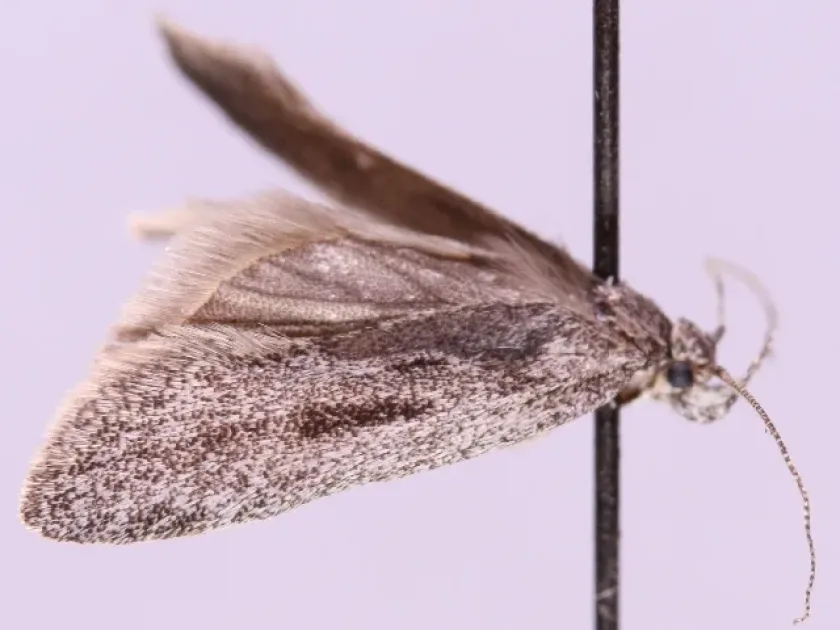
The spruce needle moth (lat. Chionodes tragicella) belongs to the order Lepidoptera, family Gelechiidae. It is a small insect with a wingspan of approximately 12–15 mm and has protective gray-brown coloration.
Adults are primarily nocturnal. The larvae of this species are specialized to feed inside the needles, making them resistant to many external environmental factors.
Systematically, this species is a highly specialized pest that has adapted to thrive on coniferous tree species in the temperate climate of Europe and Asia.
The insect's development is directly dependent on temperature; therefore, mass outbreaks are recorded in years with warm springs and moderately dry summers.
Identifying the pest at early stages is difficult because adults are barely visible against the bark of trees due to their protective mimicry.
What it damages
The primary food source for the larvae is various conifer species, especially spruce (Picea). In some cases, damage can be recorded on pine trees, particularly if the trees are already stressed.
The larvae penetrate inside the needles, eating them from within. Afterward, the outer shell of the needle becomes hollow and eventually turns yellow-brown or reddish.
The damage manifests as a loss of aesthetics and vitality of the stands. Mass infestation leads to premature needle drop, which significantly weakens the tree.
Weakened specimens become vulnerable to secondary pests, such as bark beetles, longhorned beetles, and various fungal diseases that affect the needles.
Young seedlings in nurseries suffer the most, as crown damage leads to stunted growth and occasionally the death of the plants.
When it appears
The pest's life cycle usually lasts one year. The flight of moths occurs from late spring to early summer, which coincides with the phase of active young shoot growth.
Females lay eggs directly on the needles or near the buds. The hatching larvae immediately penetrate the needle tissues.
The pests usually overwinter in the larval or pupal stage, hiding in forest litter or bark crevices, which ensures high survival rates during winter.
Pupation occurs in the spring, after which the development cycle repeats. The speed of life stages depends on the accumulated sum of active temperatures.
The peak activity of larvae occurs in the second half of the summer when they feed intensively before transitioning to the next developmental phase.
Signs of infestation
The first visual signal of the pest's presence is the yellowing or browning of individual needles in the upper part of the crown or on young branches.
Upon careful inspection, tiny entrance holes can be noticed on the needles. Inside, the needles are hollow, with typical traces of larval activity.
Often, larvae bind adjacent needles with silky silk, forming protective "cases" inside which they develop safely.
The combination of webbing between branches and premature needle drying is a reliable indicator of infestation by this needle moth.
With significant infestation, the tree's crown looks rusty, and in strong winds, an intense shedding of damaged needles is observed.
Control measures
To protect coniferous plantings, it is advisable to use an integrated approach including agrotechnical and chemical control methods.
An effective measure is conducting sanitary pruning and disposing of infested branches, which significantly reduces the pest population in the area.
The use of systemic and contact insecticides is justified during the hatching period of the larvae. The following groups of preparations are used:
- Organophosphorus compounds.
- Next-generation pyrethroids.
- Biological preparations based on bacteria (during the larval feeding phase).
Biological control methods include attracting natural enemies — parasitoid wasps and predatory insects, which effectively suppress the moth population.
Prevention includes proper care for plantings: regular watering, balanced nutrition, and protection of trees from stress factors, which strengthens their natural immunity.
Taxonomy
- Latin name
- Chionodes tragicella
- Order
- Lepidoptera (butterflies)
- Family
- Gelechiidae
- EPPO code
- GELETG
Discussion
No discussions yet — be the first.