
Asiatic rice borer
Chilo suppressalis
Description
How to identify
The Asiatic rice borer Chilo suppressalis is a destructive moth species within the Crambidae family. Adult moths are relatively small with a wingspan ranging from 20 to 30 mm, characterized by straw-colored forewings with small black spots.
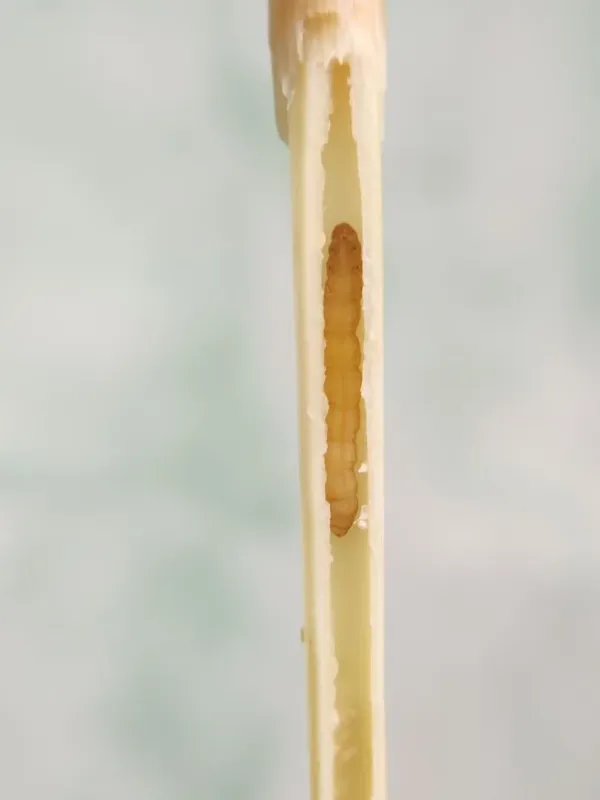
The larvae are cream or yellowish-white with distinct brown longitudinal stripes and a dark brown head capsule. They are the stage responsible for the primary damage to rice crops as they bore into the plant stems.
Females lay eggs in clusters, typically on the underside of rice leaves or leaf sheaths. These clusters are covered in a scale-like substance that protects them from environmental stressors.
Pupation occurs inside the rice stem or in the stubble. The pupa is cylindrical and brownish, adapted to stay hidden within the plant tissues until the adult moth emerges.
Depending on the latitude, the insect can complete several generations per year. Warm and humid conditions significantly accelerate their life cycle, leading to rapid population growth.
What it damages
Rice is the primary host for Chilo suppressalis. However, it also attacks other graminaceous plants such as wild rice, sedges, and reeds, which serve as alternate hosts between rice growing seasons.
Upon hatching, larvae feed briefly on the leaf surface before boring into the stem. This behavior makes them extremely difficult to reach with contact insecticides once they are inside.
Early-stage infestations cause the death of the central shoot, a condition known as "dead heart." The affected shoot turns yellow and eventually dies, which limits the number of productive tillers.
Later infestations during the booting or flowering stages lead to "white heads." These are panicles that appear white and empty because the larvae have severed the stem at the base, preventing nutrient transport to the grains.
Severe infestations can lead to total crop failure, as the destruction of stems weakens the entire plant and makes it highly susceptible to falling and lodging.
Signs of infestation
The most recognizable symptom is the presence of "dead hearts" in young rice plants. These appear as withered central leaves that stand out against the healthy green canopy.
During the grain-filling stage, the emergence of dry, bleached white panicles is a classic sign of borer activity within the internodes of the stems.
Closer examination reveals entry holes on the stems, often surrounded by "frass" or excrement, which looks like fine sawdust or brown granular material.
Stunted plant growth and reduced vigor are common indicators that a borer population is active within the field, often visible in scattered patches across the paddy.
- Withered central shoots (dead hearts).
- Empty, bleached panicles (white heads).
- Frass deposits at entry holes on stems.
Control measures
Cultural control is essential. Methods include deep plowing after harvest to destroy pupae in the stubble and flooding the fields to kill overwintering larvae.
Effective pest management involves synchronized planting within a region to prevent moths from migrating between rice fields at different developmental stages.
The use of resistant or tolerant rice varieties is recommended to limit the borer's ability to successfully enter and colonize the stems.
Chemical control must be timed precisely with the peak of moth flight and the start of larval hatching to maximize the impact of systemic insecticides.
Biological control, such as using egg parasitoids like Trichogramma species, has proven successful in reducing populations without the excessive use of chemicals.
Taxonomy
- Latin name
- Chilo suppressalis
- Order
- Lepidoptera (butterflies)
- Family
- Crambidae
- EPPO code
- CHILSU
Discussion
No discussions yet — be the first.