
Lavender clearwing moth
Chamaesphecia aerifrons
Description
How to identify
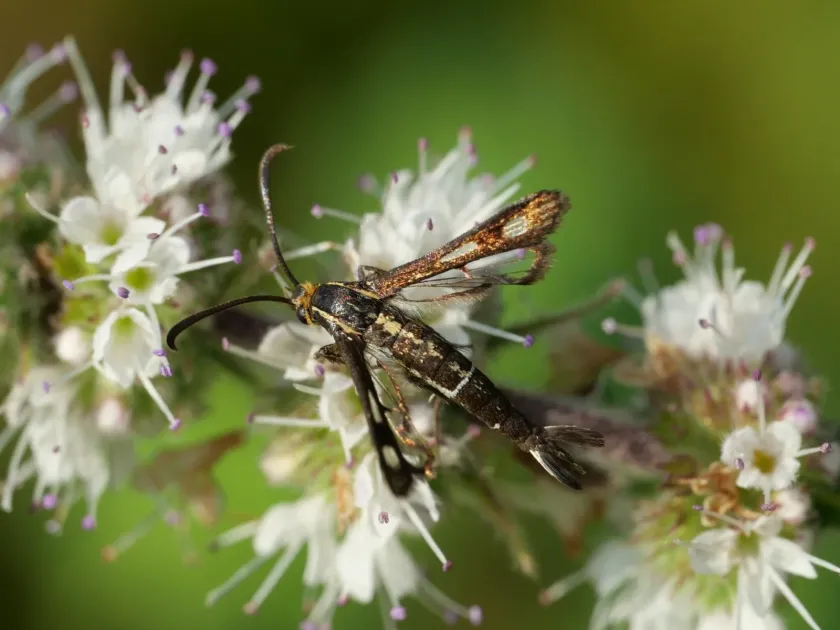
The lavender clearwing moth (Chamaesphecia aerifrons) is a member of the Sesiidae family. These insects are notorious for their mimicry, as adult moths bear a striking resemblance to wasps or hornets.
They possess transparent wings with darkened veins and borders, and their abdomens are typically marked with yellow bands, which aids in their survival by deterring predators.
The larvae are creamy-white caterpillars that thrive within the stems of host plants. Their anatomy is highly specialized for boring into the woody tissue of lavender plants.
Adults are diurnal and are most active during warm, sunny periods. Identifying the species correctly is crucial as it dictates the timing of management interventions.
Due to their secretive lifestyle, detecting adults usually requires specific pheromone lures deployed in the field during the flight season, as they are otherwise easily overlooked.
What it damages
The primary hosts for this species are lavender plants, particularly those grown in large-scale commercial fields for the essential oil industry.
Larvae feed by tunneling through the interior of the stems and the crown of the plant. This boring activity destroys the vascular tissue necessary for nutrient and water transport.
As the plant's health declines, it becomes highly susceptible to secondary infections, such as root rot and fungal pathogens, which thrive in the damaged, necrotic tissues.
Severe infestations lead to a significant decrease in the yield of flowers and essential oil, as the plant directs all its energy into trying to survive the damage.
Persistent infestations often result in the death of the plant, forcing growers to remove entire sections of the plantation and replant, leading to substantial economic losses.
When it appears
The flight season for the lavender clearwing moth usually occurs during late spring and throughout the summer months, aligning with the peak flowering period of lavender.
The species generally completes one generation per year, although temperature fluctuations can influence the duration of larval development stages.
The larvae overwinter inside the stems of the lavender plants, which provide a protected environment against winter frost and temperature extremes.
In early spring, as temperatures rise, the larvae resume feeding to gain the remaining nutrients needed for pupation, which occurs within the stem.
Timing management practices to the moth's emergence is the most challenging aspect of control, requiring accurate monitoring and prompt action once the first adults are sighted.
Signs of infestation
A classic sign of an infestation is localized wilting of branches, which often appears unrelated to environmental stress or water deficiency.
Closer inspection of the base of the plant often reveals small circular holes in the stem, often accompanied by the presence of frass (larval excrement) resembling fine sawdust.
When cutting into infected lavender stems, one can clearly see the longitudinal galleries or tunnels excavated by the caterpillars, which severely weaken the structural integrity of the plant.
Infested plants usually look stunted compared to healthy ones, showing reduced vigor, smaller flower spikes, and a general lack of overall growth.
Finally, empty pupal casings protruding from the exit holes in the stems serve as a definitive indicator that the infestation has reached the adult emergence phase.
Control measures
Integrated pest management (IPM) is the most effective approach. This includes systematic sanitation, such as removing and destroying infested stems promptly to lower the population.
Maintaining high plant vigor through proper fertilization and irrigation helps lavender plants withstand moderate levels of larval damage without major loss of productivity.
Chemical control, if necessary, must be applied with extreme precision, targeting the adult moths before they lay eggs, as chemical treatments cannot reach larvae inside the stems.
The use of pheromone-based mating disruption systems is an emerging and environmentally friendly method for managing clearwing moth populations in commercial fields.
- Monitoring for adult emergence using pheromone traps.
- Removing and burning infested plant material during winter pruning.
- Avoiding mechanical damage to the crown area during cultivation.
Taxonomy
- Latin name
- Chamaesphecia aerifrons
- Order
- Lepidoptera (butterflies)
- Family
- Sesiidae
- EPPO code
- CHAMAE
Discussion
No discussions yet — be the first.