
Clearwing moth
Chamaesphecia
Description
How to identify
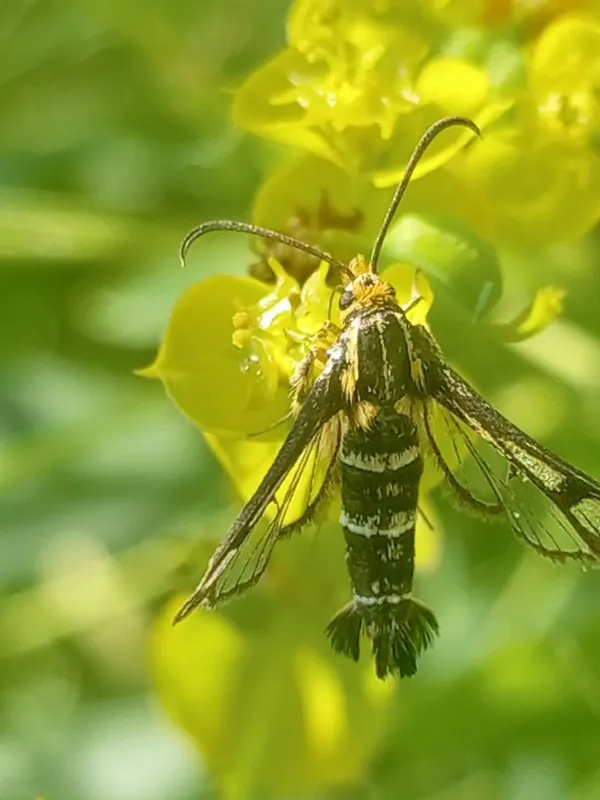
Clearwing moths (Chamaesphecia) are a family of moths that exhibit remarkable mimicry, resembling wasps or hornets. This evolutionary adaptation serves as a defense mechanism against avian predators.
The name "clearwing" refers to the transparent areas on their wings, which lack the scales typically found on other moth species. Their bodies often feature bright yellow or orange bands, further enhancing the wasp-like appearance.
Larvae are typically cream-colored with a brown head capsule. They lead an endophytous lifestyle, meaning they live and feed inside the stems, stalks, or roots of host plants, which makes them invisible for the most part of their life cycle.
Taxonomically, they belong to the order Lepidoptera, family Sesiidae. The life cycle can range from one to two years, significantly influenced by local climate conditions and the specific host plant species.
Due to their resemblance to stinging insects and their diurnal activity, they are often overlooked by gardeners until significant damage to the host plant becomes visible.
What it damages
The clearwing moth is a major pest for various woody perennials, with a particular affinity for currants (Ribes) and gooseberries. They are capable of causing localized devastation in both commercial orchards and home gardens.
The damage is primarily caused by larvae burrowing into the pith of branches. This tunneling activity disrupts nutrient and water transport, eventually causing the death of the affected branches or the entire plant.
Weakened plants are not only less productive but also become highly susceptible to environmental stressors such as drought and winter cold, as well as secondary fungal infections that enter through the entry points created by the larvae.
In cases of heavy infestation, the cumulative effect can lead to the total loss of the crop and the eventual death of the infested bushes, requiring complete removal and replacement of the plants.
Economic damage is severe because the pest is difficult to detect during the early stages of infestation. By the time symptoms appear, the internal damage to the plant's structure is often irreversible.
When it appears
The flight period for adult moths typically begins in late spring, following the end of the currant flowering period. The activity is most pronounced during warm, sunny days in June and July.
Females deposit eggs individually or in small clusters on the bark, near buds, or in pre-existing wounds on the stems. After hatching, the larvae quickly bore into the wood to initiate their destructive feeding cycle.
Overwintering occurs as larvae inside the stems of the host plant. The following spring, they resume feeding, grow rapidly, and eventually undergo pupation within the tunnels they have excavated.
An exit hole is prepared by the larva before pupation, allowing the newly emerged moth to escape easily. Understanding the exact timing of this cycle is crucial for effective chemical intervention.
Climatic variability can shift the emergence dates, making regular monitoring through traps or visual observation essential for precise timing of integrated pest management practices.
Signs of infestation
The most prominent sign of infestation is the sudden wilting and yellowing of younger shoots during the growing season. These branches often fail to recover even after adequate watering.
Closer inspection of the stems may reveal small entry holes. Sometimes, fine brown frass, which resembles sawdust, can be found near these holes, indicating that the larvae are active inside the branch.
When cutting open a suspected branch, one will see a blackened, hollowed-out tunnel running through the center of the wood. This structure is a definitive indicator of a clearwing moth presence.
General plant decline, including stunted growth and poor fruit development, is a hallmark of an established infestation. If entire branches die back repeatedly, the plant is likely hosting a population of this pest.
Careful observation of the base of the plant is vital, as larvae frequently target the lower stem or root crown, which can lead to the rapid and total collapse of the entire bush.
Control measures
The primary control strategy involves rigorous sanitary pruning. All infested branches must be removed and destroyed (burned or buried deep) to prevent the larvae from completing their life cycle and emerging as adults.
Chemical control is effective only during the short window between egg hatching and the larvae's entry into the stem. Systemic insecticides can provide better coverage than contact sprays once the pest is internal.
- Regular removal and burning of infested wood.
- Use of pheromone traps for timing and population monitoring.
- Application of biological insecticides during the peak hatching window.
- Maintaining optimal plant health to improve natural recovery capacity.
Integrated management is essential. Because the larvae remain protected within the plant tissue for most of their lives, reliance on single-mode control is often insufficient to suppress the population effectively.
By combining physical removal of infested material with precise timing of insecticides based on adult monitoring, it is possible to maintain clearwing moth populations below the economic threshold.
Taxonomy
- Latin name
- Chamaesphecia
- Order
- Lepidoptera (butterflies)
- Family
- Sesiidae
- EPPO code
- CHAMSP
Discussion
No discussions yet — be the first.