
Amber fruit fly
Chaetorellia succinea
Description
How to identify
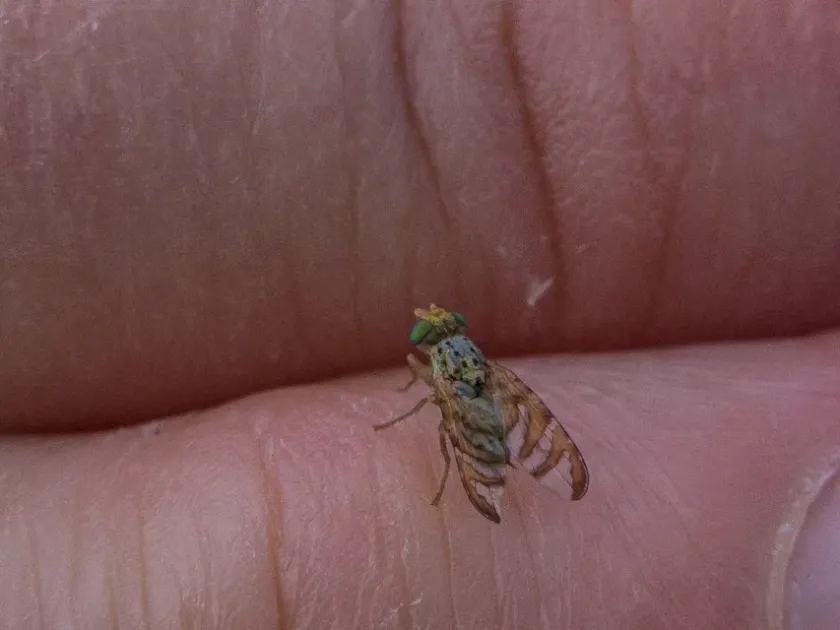
The Amber fruit fly (Chaetorellia succinea) is an insect belonging to the Tephritidae family within the order Diptera. Adults are small flies characterized by a distinct spotted wing pattern, which serves as camouflage when resting on the flower heads of host plants.
The adult fly body typically has a yellowish-brown or amber coloration, which gives the species its common name. The body length generally ranges from 4 to 6 millimeters. The eyes often display a metallic golden or greenish reflection, and the thoracic scutellum features dark bristles characteristic of this genus.
The larvae are legless, cream-colored, and taper towards the anterior end. They are equipped with black, hook-like mouthparts used to feed on the developing seeds and tissues within the flower receptacle of the host plant. This feeding behavior is specific to the larval stage.
The life cycle of this fly is strictly synchronized with the phenology of its host plants. Development involves complete metamorphosis: egg, larva, pupa, and adult. Depending on local climatic conditions, the pest may produce one or two generations within a single growing season.
The species primarily overwinters as puparia in the soil or within the dried flower heads where the final larval generation completed its development. In early spring, adults emerge to begin their search for suitable host plants for oviposition.
What it damages
The primary hosts for the Amber fruit fly are plants within the Asteraceae family, most notably species of the genus Centaurea (knapweeds). The pest poses a significant threat to commercial oilseed crops and medicinal plant seed production sectors.
Larvae enter unopened flower buds and feed on the developing seeds and the receptacle tissue. This infestation results in the complete destruction or severe malformation of seeds, rendering the harvested material unusable for planting or processing.
Damaged flower heads often turn yellow prematurely, become distorted, and dry out before reaching maturity. This leads to substantial yield losses in seed crops, which is particularly detrimental in breeding programs where seed quality and viability are paramount.
During heavy infestations, up to 50-70% of flower heads on a single plant may be impacted. This significantly reduces the overall yield and diminishes the quality of the harvested crop, as the remaining seeds are often undersized or prone to secondary rot.
The wounds created by the larvae also serve as entry points for secondary fungal and bacterial pathogens. These infections cause decay within the flower head, further degrading the health of the host plant and exacerbating the total economic loss for the farmer.
Control measures
Effective management of the Amber fruit fly requires an integrated approach that combines cultural, biological, and chemical methods. Crop rotation is the most critical cultural practice, as it disrupts the life cycle by preventing the continuous cultivation of host plants in the same area.
Deep autumn plowing after the harvest helps to bury and destroy overwintering puparia located in the upper soil layers. Additionally, managing weeds related to the Asteraceae family around the field perimeter is essential to reduce the population pressure of this pest.
Chemical control involving insecticides should be precisely timed with the peak adult emergence phase, specifically before oviposition occurs. The use of systemic insecticides can target larvae within the flower heads, but must be applied in accordance with strictly defined pre-harvest intervals.
Biological control, such as the encouragement of natural parasitoid populations, plays an important role in suppressing fly numbers. Maintaining semi-natural habitats around agricultural lands supports these beneficial insects and provides a sustainable level of long-term control.
Continuous monitoring using yellow sticky traps allows for early detection of adult populations. By assessing the number of flies trapped during the budding phase, growers can make informed decisions about whether to initiate specific control measures to protect the potential yield.
Taxonomy
- Latin name
- Chaetorellia succinea
- Order
- Diptera (flies)
- Family
- Tephritidae
- EPPO code
- CHLLSU
Discussion
No discussions yet — be the first.