
Ceroplastes stellifer
Ceroplastes stellifer
Description
How to identify
Ceroplastes stellifer, commonly known as the star scale, belongs to the family Coccidae in the order Hemiptera. It is a sap-sucking pest characterized by a distinct waxy shield.
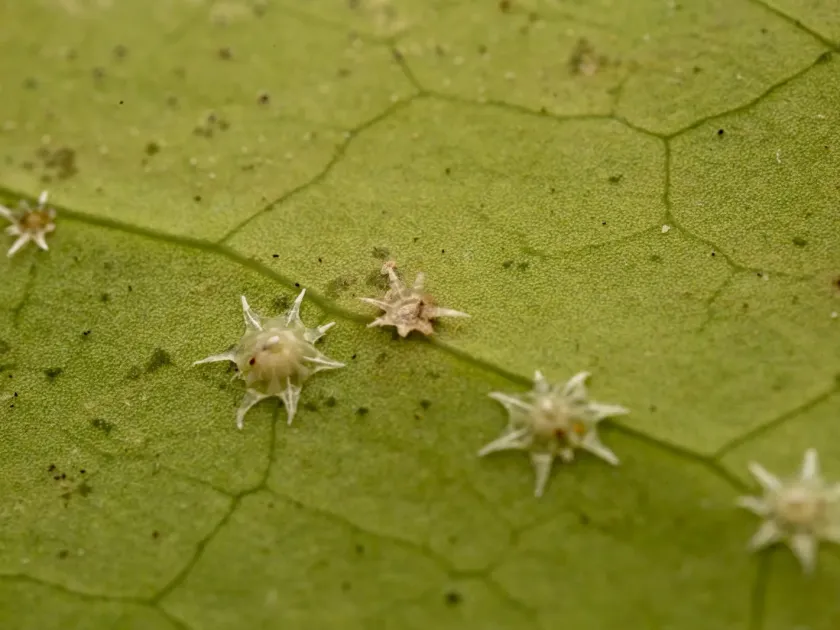
The adult female is protected by a star-shaped waxy test, which gives the insect its common name. The wax covering is usually translucent or yellowish-white, making the insects stand out on dark foliage.
First-instar nymphs, known as crawlers, are the most active life stage. They are tiny and capable of moving across the plant surface to locate the ideal site for permanent feeding.
Once settled, the females become sedentary and continue to secrete the characteristic waxy substance that acts as an effective barrier against many predators and some contact chemicals.
This species is widely distributed in tropical and subtropical regions and is a significant problem in greenhouses and indoor gardens worldwide.
What it damages
The star scale has a broad host range, including economically important crops such as citrus, as well as many ornamental species like orchids, ferns, palms, and hibiscus.
By constantly extracting phloem sap, the pests cause chlorosis, stunted growth, and a general decline in the overall vigor of the host plant.
Heavy infestations can lead to massive leaf drop and the death of individual stems or even the entire plant if the infestation is left unmanaged for an extended period.
Like other scale insects, they excrete honeydew, a sugary byproduct that accumulates on the leaves, creating a sticky mess and attracting ants.
The accumulation of honeydew serves as a perfect substrate for sooty mold fungi, which grow and cover the leaves in a black, soot-like layer, inhibiting photosynthesis.
When it appears
Under indoor or greenhouse conditions, Ceroplastes stellifer can reproduce continuously throughout the year, as there is no true seasonal dormancy in controlled environments.
The life cycle encompasses the egg stage, three nymphal instars, and the adult stage. Development is highly temperature-dependent, with warmer conditions significantly accelerating the maturation process.
Active growth periods of the host plant often coincide with higher susceptibility, as young, succulent tissues are preferred by the crawlers for colonization.
New infestations are frequently introduced via contaminated nursery stock, or during the movement of plants between indoor and outdoor locations during the growing season.
Monitoring for crawlers is crucial because they represent the most vulnerable stage in the life cycle and are the primary target for effective pesticide applications.
Signs of infestation
The most diagnostic sign of an infestation is the presence of the star-shaped waxy shields clinging to stems, branches, and the undersides of leaves.
Sticky leaves or furniture located beneath the plant are a clear indication of honeydew production, pointing towards a hidden population of scale insects.
Yellowing leaves, premature senescence, and the wilting of terminal shoots are classic physiological symptoms of severe nutrient loss caused by the pests.
The growth of black sooty mold on the foliage is a secondary symptom that highlights the presence of honeydew-producing insects on the plant.
- distinct star-shaped waxy coverings;
- sticky honeydew secretions;
- black sooty mold growth;
- wilting and yellowing leaves;
- stunted shoot development.
Control measures
Manual removal of scales using a soft brush or a cotton swab dipped in rubbing alcohol is effective for small, localized infestations on household plants.
Systemic insecticides are generally the most effective control method, as they are absorbed by the plant and kill the insects as they feed on the phloem sap.
Horticultural oils or insecticidal soaps can be used to coat the insects and suffocate them by blocking their respiratory pores, though coverage must be thorough to be effective.
Strict quarantine protocols for all new plants being added to a collection are essential to prevent the introduction of Ceroplastes stellifer into a healthy environment.
Pruning and destroying heavily infested plant parts is a recommended cultural practice to reduce the overall population pressure and prevent the spread to healthy branches.
Taxonomy
- Latin name
- Ceroplastes stellifer
- Order
- Hemiptera (bugs, aphids, leafhoppers)
- Family
- Coccidae
- EPPO code
- VINSST
Discussion
No discussions yet — be the first.