
Chinese wax scale
Ceroplastes sinensis
Description
How to identify
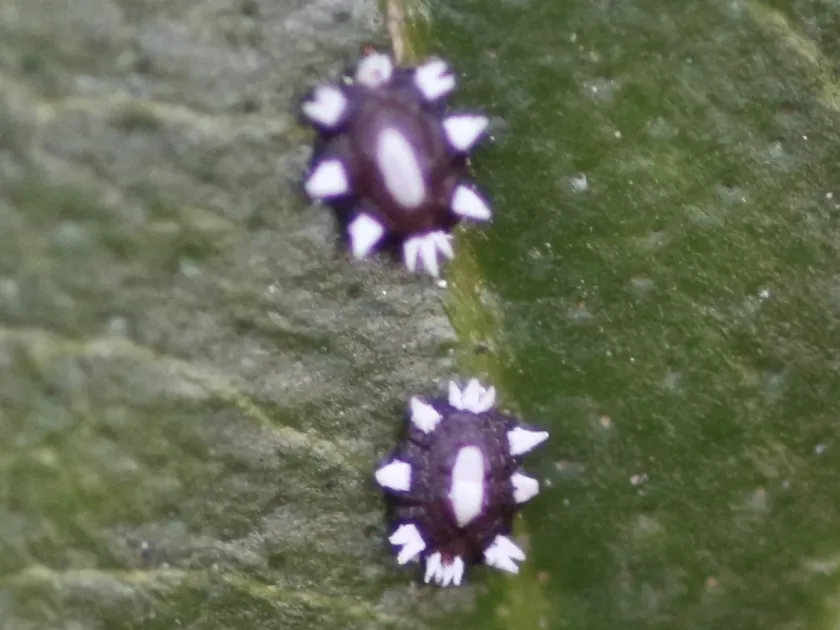
The Chinese wax scale (Ceroplastes sinensis) belongs to the Coccidae family within the order Hemiptera. It is easily recognized by the thick, white or pinkish wax layer that covers the body of the adult female, forming distinct plates.
The insect body has a semi-spherical shape, reaching 3–5 mm in size. This waxy coating serves as a powerful shield, protecting the insect from environmental stresses and many contact insecticides.
Adult females are sedentary, firmly anchoring themselves to branches or leaves. Because they spend their lives attached to the host, they are often overlooked until a significant population density is reached.
The reproductive strategy of this species involves laying a high number of eggs underneath the maternal wax shell. This ensures the survival of the offspring during the early stages of development.
The mobile crawler stage is the most critical time for population expansion. Crawlers can be dispersed by wind or physical contact between plant parts, making them highly efficient at spreading across a garden.
What it damages
This pest primarily attacks citrus species, such as lemons, oranges, and mandarins. However, its host range also includes several ornamental evergreen plants like laurel and camellia.
The insects feed by inserting their stylets into the plant vascular system to suck sap. Chronic feeding results in severe nutrient depletion, leading to stunted growth and reduced fruit yield.
Heavy infestations lead to leaf chlorosis and premature leaf drop. The structural integrity of the plant may be compromised as branches are weakened and become more susceptible to other diseases.
The excretion of honeydew provides a substrate for sooty mold fungus to flourish. This black, powdery layer blocks sunlight, which directly reduces the plant's capacity for photosynthesis.
In extreme cases, the combined effect of nutrient withdrawal and fungal cover can cause the death of entire branches or the decline of the plant itself.
When it appears
Activity cycles are dictated by regional climate, typically beginning with the emergence of crawlers in the spring. Warm temperatures are essential for the start of the insect's active phase.
During the summer months, the population undergoes rapid growth. This is the peak time for development and settlement, requiring diligent monitoring to prevent widespread colonization.
As autumn approaches and temperatures drop, the insects slow down their life processes. They typically overwinter in the adult or late-instar nymph stage, remaining attached to the bark.
In tropical and subtropical regions, multiple generations can occur annually. This continuous life cycle makes it difficult to time applications of protective treatments without careful planning.
Effective pest control is heavily dependent on identifying the peak crawler emergence period, as this is the window of maximum vulnerability for the insect.
Signs of infestation
The most evident sign is the appearance of wax-covered bumps on twigs and stems. These resemble white, hard deposits that contrast sharply with the natural color of the plant tissue.
The presence of a sticky, glistening substance on the leaves and fruit indicates the activity of these scale insects. This honeydew eventually turns black due to sooty mold colonization.
Increased ant activity on the plant is a major indicator of a scale infestation. Ants are attracted to the sweet honeydew and will actively protect the scales from natural predators.
Distorted, curling leaves on new growth indicate that the plant is struggling to thrive due to excessive feeding by the scale population.
Hidden populations can often be detected by inspecting the undersides of leaves and the junctions between branches, where nymphs prefer to settle before they develop large shields.
Control measures
Systemic insecticides are generally effective as they are absorbed by the plant and ingested by the insects during sap feeding. Application should be timed with the crawler stage.
Horticultural oils act by physically covering the insects and suffocating them by blocking their respiratory pores. These are environmentally friendly options for managing low-to-moderate populations.
Physical management includes the pruning and removal of infested branches. Destroying this material prevents further spread to healthy parts of the garden or plantation.
Biological control involves releasing natural enemies such as parasitic wasps or predatory beetles, which can significantly suppress scale populations in managed ecosystems.
Integrating ant control into the management strategy is vital, as removing ants exposes the scale insects to their natural enemies. Constant monitoring is key to maintaining healthy crops.
Taxonomy
- Latin name
- Ceroplastes sinensis
- Order
- Hemiptera (bugs, aphids, leafhoppers)
- Family
- Coccidae
- EPPO code
- CERPSI
Discussion
No discussions yet — be the first.