
Florida wax scale
Ceroplastes floridensis
Description
How to identify
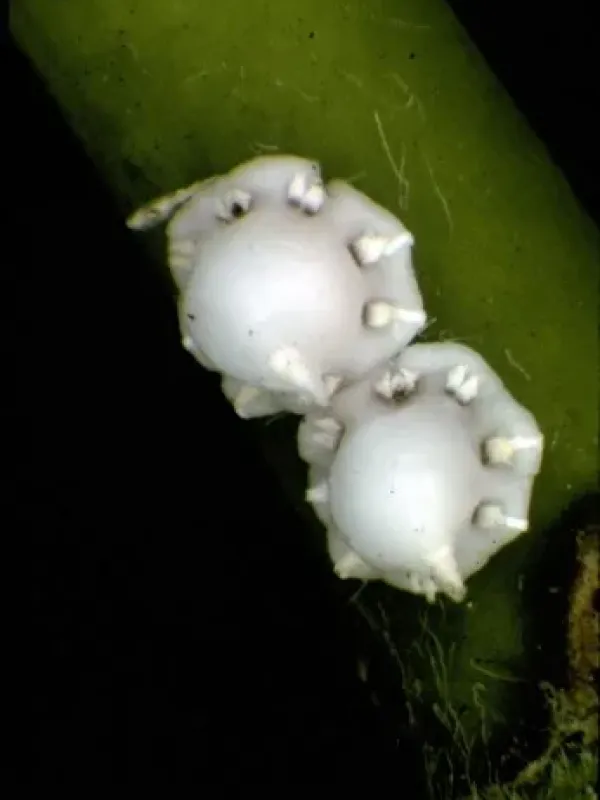
The Florida wax scale (Ceroplastes floridensis) is a prominent pest belonging to the Coccidae family. The adult female is characterized by a thick, waxy covering that is pinkish-white, often giving it a rounded, semi-globular appearance.
The wax layer serves as a highly effective protective armor, shielding the insect from natural predators and many contact insecticides. This makes the pest quite resilient in its adult stage.
Adult females typically measure between 2 and 3 millimeters. The mobile crawler stage (newly hatched nymphs) is the most vulnerable phase of the life cycle, as they do not yet possess the thick wax coating.
Reproduction is primarily parthenogenetic, allowing populations to multiply rapidly under favorable conditions. Males are extremely rare and contribute minimally to the overall life cycle of the species.
This scale is a tropical and subtropical species that thrives in warm environments. In cooler temperate regions, it is primarily found in greenhouses, conservatories, and interior landscaping.
What it damages
The Florida wax scale has a wide host range, with citrus species like lemon, orange, and grapefruit being the most common targets. It also infests various ornamental plants, including ficus, gardenia, and laurel.
By inserting their mouthparts into the plant tissue, the scale insects extract sap, causing the plant to lose vitality. Frequent feeding often results in localized necrosis and overall stunted development of the host.
The insects produce copious amounts of honeydew, a sugary substance that coats the leaves. This byproduct provides a substrate for sooty mold, which creates a black film that blocks light and inhibits photosynthesis.
Severe infestations frequently lead to leaf drop, yellowing, and the decline of entire branches. In young nursery stock, this pest can cause significant growth retardation or even death if not managed properly.
The constant drain of nutrients weakens the plant's defense system, making it more susceptible to secondary viral or fungal infections that can further jeopardize plant health.
Signs of infestation
Visible wax deposits on the stems and leaves are the most reliable sign of an infestation. These structures are often mistaken for abnormal plant growth or bits of debris.
The presence of a sticky, shiny layer on the leaf surface is a telltale sign of honeydew production. This stickiness often attracts ants, which may protect the scale insects from natural enemies.
Black, powdery soot-like spots (sooty mold) appearing on leaves are a classic indicator of scale activity. This mold thrives on the honeydew secreted by the feeding scales.
Yellowing (chlorosis) of the leaves and premature senescence occur as the plant's nutritional resources are depleted by the growing colony.
A reduction in flowering or fruit set in citrus trees is a significant indicator that the plant is struggling to maintain its physiological functions due to the pest burden.
Control measures
Effective management requires a multi-faceted approach, including cultural practices, biological control, and the strategic application of chemical agents to target the crawler stage.
Small-scale infestations can be managed by physically scrubbing the insects off with a soft brush and soapy water or an alcohol solution, which helps remove both the scales and the honeydew.
Systemic insecticides are generally the most effective chemical intervention. By applying these to the root zone or spraying them, the chemical is absorbed into the plant's sap, killing the scales during feeding.
Biological control agents, such as parasitoid wasps, can be introduced in greenhouses to reduce scale populations without relying on broad-spectrum pesticides that might harm beneficial insect populations.
- Inspect new plants thoroughly before introducing them into the collection.
- Prune and dispose of heavily infested plant parts to reduce the population.
- Monitor the population using sticky traps to determine the peak crawler activity.
- Maintain healthy plant nutrition and hydration to help the host withstand stress.
Taxonomy
- Latin name
- Ceroplastes floridensis
- Order
- Hemiptera (bugs, aphids, leafhoppers)
- Family
- Coccidae
- EPPO code
- CERPFL
Discussion
No discussions yet — be the first.