
Australian wax scale
Ceroplastes destructor
Description
How to identify
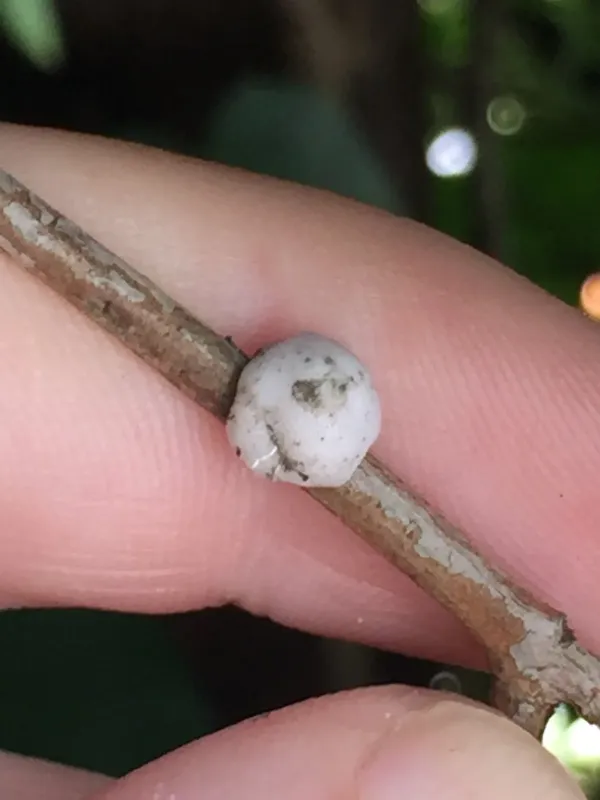
The Australian wax scale (Ceroplastes destructor) belongs to the Coccidae family within the order Hemiptera. Adult females are distinguished by their protective white or creamy-white wax covering, which forms a distinctive dome shape.
These insects grow to approximately 5–8 mm in diameter. The wax shield is dense and hard, effectively concealing the insect's body segments, which often makes it look like a plant growth or a drop of wax.
Males are rarely encountered and possess wings, while females are flightless. The species often reproduces through parthenogenesis, which allows populations to increase rapidly.
First-instar nymphs, known as crawlers, are small, oval, and mobile. This is the only stage in the life cycle where the insect can actively migrate to new locations on the plant.
Once settled, the nymph begins to secrete waxy plates that eventually coalesce into a thick, protective armor, making the adult stage resistant to many environmental stressors.
What it damages
The Australian wax scale is a polyphagous pest, causing significant damage primarily to citrus trees, such as lemons, oranges, and mandarins.
Beyond citrus, it is a common pest on various ornamental plants, including gardenias, camellias, ficus, and other broad-leaved evergreen shrubs.
By inserting their mouthparts into the plant tissue, these insects feed on sap, which causes the plant to lose vitality, leading to stunted growth and branch dieback.
A major indirect impact is the secretion of honeydew, a sugary substance that attracts ants and provides an ideal medium for the growth of sooty mold.
Severe infestations result in heavy leaf drop, reduced fruit production, and significant cosmetic damage to ornamental species due to persistent sooty mold staining.
When it appears
The life cycle is highly dependent on climate, with generations often overlapping in warmer, temperate regions, leading to a constant presence of all life stages.
The peak period for the emergence of crawlers occurs during late spring and summer, when higher temperatures facilitate rapid development.
Adult females deposit hundreds of eggs under their protective wax shield, ensuring high survival rates for the offspring until they hatch and begin to move.
The migration phase of the crawlers is the most critical time for monitoring, as they are actively seeking new feeding sites and remain susceptible to treatments.
Adults typically overwinter on the bark or undersides of leaves, anchored firmly in place, waiting for the return of warmer conditions to resume reproductive activity.
Signs of infestation
The most obvious sign of infestation is the appearance of white, wax-like mounds on the stems and leaves, which may look like small blobs of candle wax.
The presence of a sticky, shiny film on the leaves (honeydew) and increased ant activity are strong indicators that a scale colony is present.
Black, powdery soot covering the leaves is a telltale sign of sooty mold fungus, which colonizes the honeydew excreted by the scales.
Leaves may turn yellow or drop prematurely, and young shoots might appear distorted due to the intense sap extraction by large colonies.
- White dome-shaped wax scales on stems.
- Sticky honeydew residues on leaves.
- Black sooty mold growth.
- High ant traffic on plant surfaces.
- General lack of plant vigor and leaf yellowing.
Control measures
Physical removal using a soft brush dipped in a soap or alcohol solution is effective for small, isolated infestations on house plants or young garden trees.
Horticultural oils, such as white oil, are highly effective as they form a film over the scale, suffocating the insect by blocking its respiratory openings.
Chemical control with systemic insecticides is most successful when applied during the crawler emergence phase, before the insects develop their protective wax shields.
Controlling ant populations is vital, as ants protect scales from natural predators like parasitic wasps and ladybird beetles, facilitating the pest's spread.
Biological control using introduced or naturally occurring parasitoids like Metaphycus helvolus can successfully suppress large scale populations in integrated pest management programs.
Taxonomy
- Latin name
- Ceroplastes destructor
- Order
- Hemiptera (bugs, aphids, leafhoppers)
- Family
- Coccidae
- EPPO code
- CERPDE
Discussion
No discussions yet — be the first.