
Barnacle scale
Ceroplastes cirripediformis
Description
How to identify
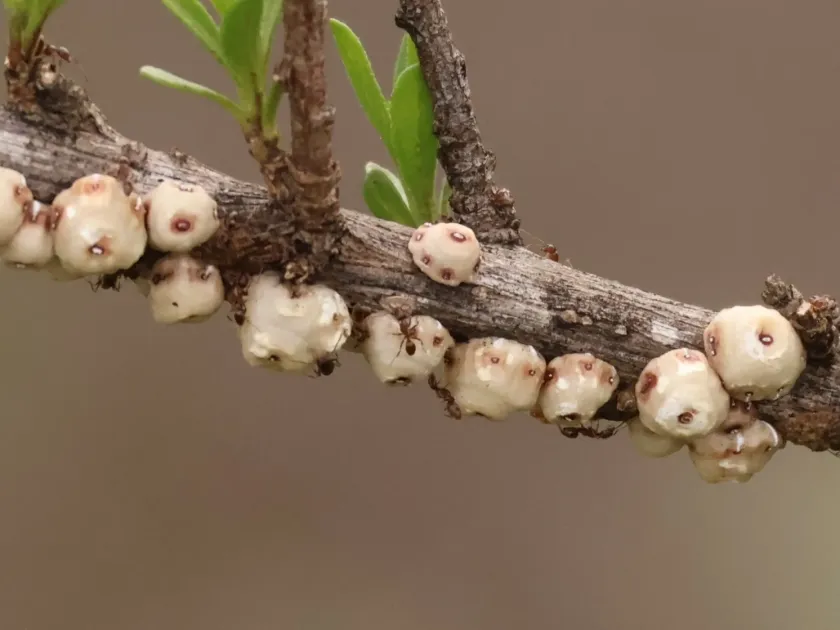
The Barnacle scale Ceroplastes cirripediformis is a member of the Coccidae family, commonly known as soft scales. Adult females are characterized by a thick, waxy, and convex shell that resembles a barnacle, featuring distinct projections or ridges on its surface.
This waxy covering is remarkably tough and opaque, serving as an effective shield against predators, environmental stressors, and standard pesticide sprays. The color of the scale typically ranges from whitish-grey to mottled reddish-brown.
Adult females reach a size of approximately 3 to 5 mm in length. Reproduction is primarily parthenogenic, allowing the population to expand rapidly without the need for males, which are rarely observed.
The first-instar nymphs, known as crawlers, are the only mobile stage. They are tiny, oval, and flattened, possessing the ability to migrate across the plant to find suitable feeding sites.
Being a tropical and subtropical species, it thrives in warm environments, making it a significant greenhouse pest in temperate climates where it does not experience winter kill.
What it damages
The Barnacle scale attacks a wide range of host plants, including citrus trees, avocado, figs, gardenias, and various ornamental shrubs. It feeds by inserting its mouthparts into the phloem to extract nutrient-rich sap.
Continuous sap extraction leads to significant plant stress, resulting in chlorosis (yellowing of leaves), premature leaf drop, and stunted terminal growth of young shoots.
As they feed, they excrete large amounts of honeydew. This sticky substance covers the foliage and branches, providing an ideal medium for the growth of sooty mold, a black fungus.
Sooty mold accumulation covers the leaves, significantly reducing the plant's ability to perform photosynthesis, which further weakens the host and decreases its aesthetic and commercial value.
Heavy infestations can lead to limb dieback and, if left untreated, the eventual death of the entire plant, especially in young or containerized nursery stock.
When it appears
The life cycle of the Barnacle scale is highly dependent on ambient temperature. In tropical climates, reproduction is continuous, with multiple generations overlapping throughout the year.
In cooler regions, activity is concentrated in the warmer months, particularly during spring and summer, when optimal conditions allow for rapid egg hatching and crawler dispersal.
The life cycle consists of the egg stage, three nymphal instars, and the adult female stage. A single female can deposit hundreds of eggs beneath her protective waxy dome, ensuring high reproductive capacity.
Crawlers are primarily spread by wind dispersal, animal contact, or through the movement of infested nursery stock between greenhouses or landscapes.
The presence of ants is a critical seasonal factor; ants often tend to scale colonies to protect them from natural enemies while harvesting the honeydew the scales produce.
Signs of infestation
The most visible symptom of an infestation is the presence of hard, bump-like, barnacle-shaped waxy scales on stems, twigs, and the undersides of leaves.
Sticky honeydew covering the leaves and stems is often the first indicator, frequently attracting bees, wasps, and ants that forage for the sugary substance.
The dark, velvety coating of sooty mold on the foliage is a secondary sign that usually indicates the presence of a mature or long-standing infestation.
Yellowing leaves and the presence of distorted, stunted growth on new shoots are clear signals that the scale population is exerting physiological pressure on the host plant.
Close inspection of the bark and leaf veins often reveals individual scales that may blend into the plant tissue, requiring a sharp eye to detect during the early stages of infestation.
Control measures
Controlling the Barnacle scale requires a multifaceted strategy, focusing on timing and penetration of the waxy shield to ensure effectiveness.
- Pruning and destroying heavily infested branches to reduce the total population.
- Washing the plant with a strong stream of water to dislodge crawlers and some adults.
- Applying systemic insecticides that are transported within the plant's vascular system.
- Using horticultural oils to smother the insects and degrade the waxy shell.
- Managing ant populations to allow biological control agents to access the scales.
Chemical applications are most successful when timed to coincide with the crawler stage, as they lack the thick waxy armor that protects the adults from contact pesticides.
Maintaining plant health through proper fertilization and irrigation helps the host withstand the stress caused by the infestation while supporting natural predatory insect populations.
Taxonomy
- Latin name
- Ceroplastes cirripediformis
- Order
- Hemiptera (bugs, aphids, leafhoppers)
- Family
- Coccidae
- EPPO code
- CERPCI
Discussion
No discussions yet — be the first.