
Buffalo treehopper
Ceresa vitulus
Description
How to identify
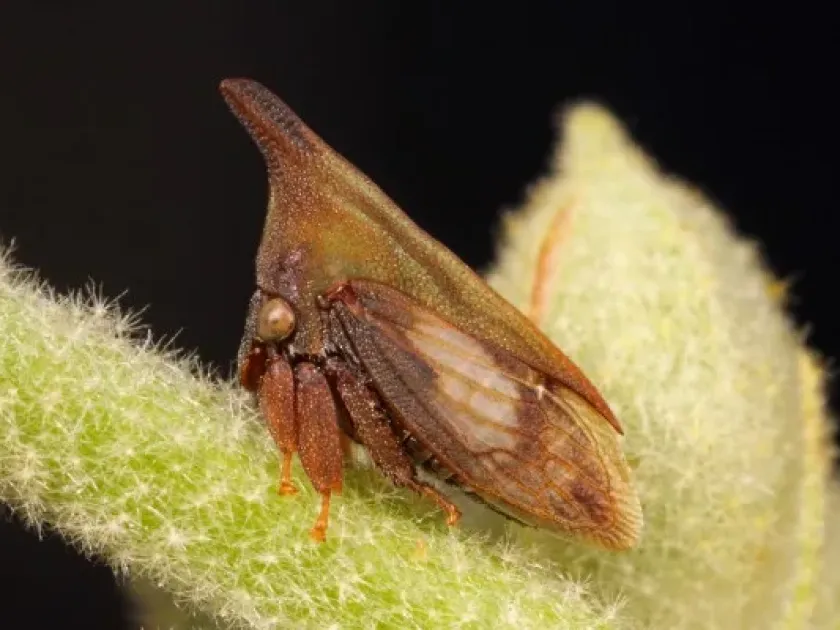
The buffalo treehopper (Ceresa vitulus) is a member of the Membracidae family within the order Hemiptera. Its common name is derived from the distinct hump on its pronotum, which resembles the silhouette of a buffalo or bison.
The adult insect is typically 8–10 mm long, with a triangular, stout body. Its coloration ranges from light green to brownish, providing excellent camouflage against leaves and twigs.
Nymphs are significantly different in appearance from adults. They are flattened, wingless, and covered in distinct spines and branched projections that help them blend into the bark of host plants.
The life cycle involves egg, five nymphal instars, and the adult stage. The species overwinters as eggs, which are inserted deep into the bark of twigs, ensuring protection against cold weather.
Adults are strong jumpers and fly well when disturbed, making them elusive, whereas nymphs are generally sedentary and prefer to stay on the undersides of leaves or protected forks.
What it damages
Buffalo treehoppers are considered polyphagous pests, capable of infesting a wide range of fruit trees, ornamental plants, and woody shrubs in nursery and garden settings.
Primary hosts include members of the Rosaceae family, such as apple, pear, plum, and cherry trees. They also affect deciduous ornamental trees and various berry-producing shrubs.
Both adults and nymphs feed on plant sap by piercing phloem tissue, which leads to reduced tree vigor, slowed growth, and stunted development of young shoots.
The most critical damage occurs during oviposition (egg-laying). Females use their ovipositors to cut deep slits into the bark of young twigs, which can effectively girdle the branch.
These wounds cause branch distortion, splitting of the bark, and general tissue weakening. The scars created serve as entry points for secondary pathogens, including fungal cankers and bacteria.
Signs of infestation
The most diagnostic sign of an infestation is the presence of characteristic V-shaped or crescent-shaped scars on the bark of young branches, indicating past or current egg-laying sites.
In spring, infested branches often exhibit delayed bud break or dieback at the tips, as the transport of water and nutrients has been compromised by the previous year's oviposition wounds.
During the growing season, a sticky substance known as honeydew may be observed on the foliage, which often leads to the development of black sooty mold on the leaves.
Heavily infested trees show overall signs of chlorosis, premature wilting, and poor canopy density, which are particularly pronounced during periods of drought or high heat stress.
Young trees may develop necrotic bark lesions around the oviposition scars, which can lead to the girdling of the main trunk or scaffold branches if the population is dense enough.
Control measures
Cultural management is the first line of defense. This includes pruning and destroying infested twigs during the dormant season to eliminate the overwintering egg population.
Maintaining a weed-free environment beneath trees is crucial, as many common weeds and cover crops provide essential food sources for young nymphs during their early development.
If chemical control is necessary, applications should be timed to target the nymphal stages, which are more susceptible to insecticides before they transition into mobile, armored adults.
Biological control plays a significant role; natural enemies such as egg parasitoids (e.g., Polynema species) can substantially reduce population numbers if the environment is conducive to them.
Proper orchard management, including adequate fertilization and irrigation, helps trees recover from physical damage and promotes more rapid wound closure after mechanical injury.
Taxonomy
- Latin name
- Ceresa vitulus
- Order
- Hemiptera (bugs, aphids, leafhoppers)
- Family
- Membracidae
- EPPO code
- CEREVM
Discussion
No discussions yet — be the first.