
Buffalo treehopper
Ceresa taurina
Description
How to identify
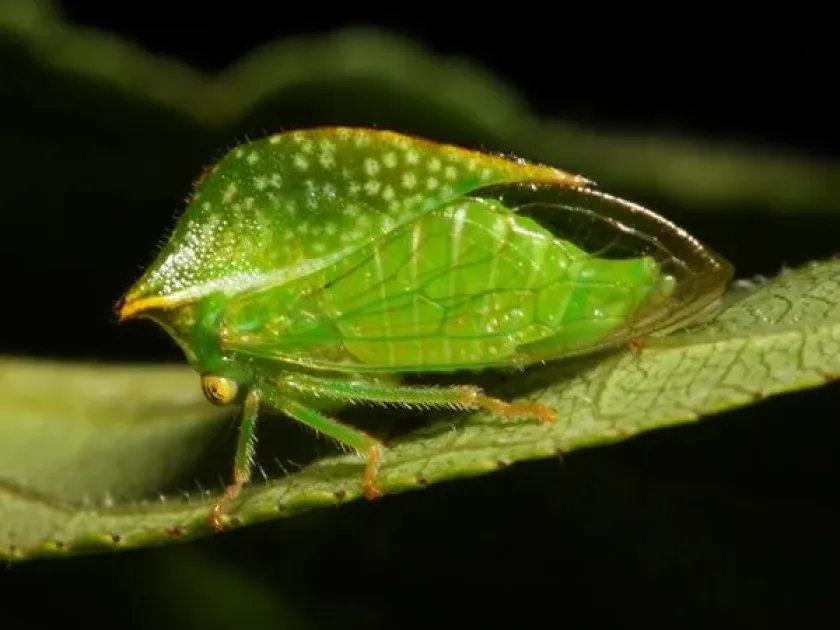
The buffalo treehopper (Ceresa taurina) belongs to the order Hemiptera and the family Membracidae. The adult insect is easily recognized by its triangular shape, which resembles the head of a buffalo.
The body of the adult is typically bright green, about 8–10 mm long, with transparent wings. Its unique shape provides excellent camouflage among the leaves of host plants.
Nymphs of the buffalo treehopper are smaller, greenish-grey, and feature distinct spiny protrusions on their backs. They are much less mobile than adults and stay hidden within foliage.
Adults are known for their high jumping ability. When approached, they will quickly leap away, making them difficult to capture or observe closely without specialized traps.
This pest is highly adaptable, living both on trees during the adult stage and on various weeds and herbaceous plants during the nymphal stage of its development.
What it damages
The buffalo treehopper attacks a wide range of fruit trees, including apples, pears, peaches, and plums, as well as grapevines and various ornamental bushes.
Damage is twofold: feeding by adults and, more significantly, the egg-laying process performed by females. Females use their ovipositor to cut deep slits into the bark of young twigs.
These cuts disrupt the tree's vascular system, often causing the twigs to wilt or die. The wounds create pathways for secondary infections like fungi and bacteria to enter the tree.
In young nurseries or young orchards, this damage is particularly severe. It can stunt growth, distort branches, and significantly decrease the overall health and productivity of the trees.
Heavy infestations lead to a loss of young shoots and buds, reducing the total yield potential of the tree for the following season and causing structural weakness in the wood.
When it appears
The pest overwinters as eggs, which are inserted under the bark of twigs in late autumn. Nymphs hatch in early spring, synchronized with the start of the plant growing season.
During the spring and early summer, nymphs feed on the succulent sap of herbaceous weeds in the orchard. This stage is crucial for their survival and development into adults.
Adults emerge in mid-summer, typically from July to August. They then migrate to trees to feed and find mates. During this time, they are most active in warm, sunny weather.
The lifecycle is completed when mated females search for suitable young branches to lay their eggs. This usually happens in late summer and autumn before the first frost.
Environmental conditions, such as mild autumns, can prolong the period of egg-laying, leading to higher populations of overwintering eggs and more damage in the following year.
Signs of infestation
The primary sign of infestation is the appearance of distinct twin scars on the bark of twigs. These scars consist of two parallel, longitudinal slits made by the female's ovipositor.
Visible branch deformation, such as twisting or curling of young twigs, is another clear indication of internal damage caused by egg-laying activities.
The presence of dense weeds within the orchard is a strong indicator of a potential treehopper problem. High weed density provides the necessary habitat for nymphs to reach maturity.
Wilting of the tips of young shoots in late summer, even when water is abundant, often indicates that damage has occurred within the stems or branches.
Cracking and necrotic patches on the bark of young shoots are common signs where females have laid eggs, leading to localized tissue death and potential susceptibility to disease.
Control measures
The most effective cultural control measure is the removal of weeds and cover crops in the orchard. By keeping the orchard floor clean, you eliminate the food source for nymphs.
Pruning damaged branches is essential. Removing infested twigs and disposing of them by burning prevents the eggs from hatching in the following spring.
Insecticides may be used if the population reaches high levels. Treatments should target the nymphal stage or the adult stage before the egg-laying period begins.
Encouraging natural predators such as parasitic wasps and predatory bugs can help maintain a natural balance and reduce the reliance on chemical pesticides in the orchard.
Ensuring that trees are healthy and not over-fertilized with nitrogen helps prevent the growth of overly soft, succulent shoots that are highly attractive to female treehoppers for egg-laying.
Taxonomy
- Latin name
- Ceresa taurina
- Order
- Hemiptera (bugs, aphids, leafhoppers)
- Family
- Membracidae
- EPPO code
- CERETA
Discussion
No discussions yet — be the first.