
Buffalo treehopper
Ceresa bubalus
Description
How to identify
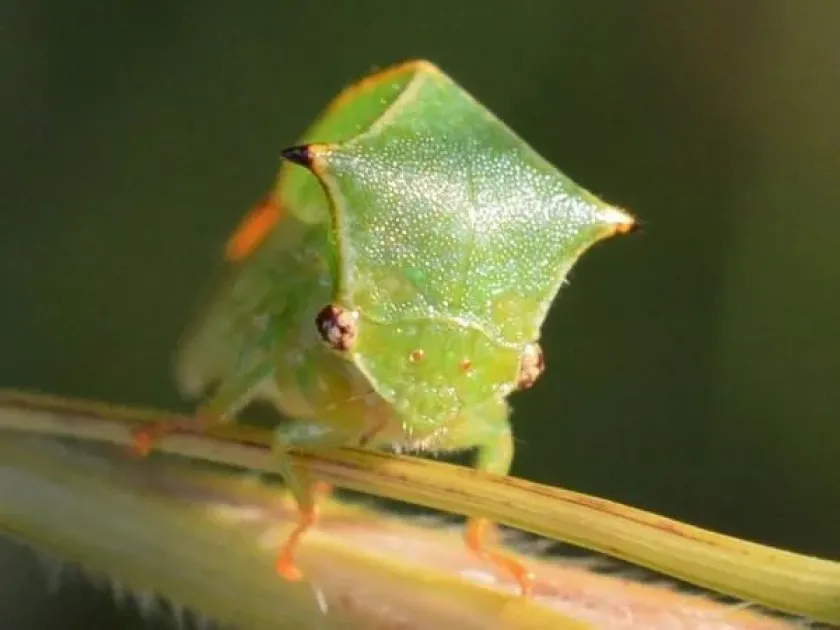
The Buffalo treehopper (Ceresa bubalus) is a member of the Membracidae family in the order Hemiptera. It is famously named for its unique pronotum, which looks like the horns of a buffalo.
Adults are typically wedge-shaped, reaching about 8–10 mm in length. Their bright green color allows them to blend perfectly with the foliage of their host plants.
These insects are gifted jumpers, thanks to their powerful hind legs, which allow them to quickly escape when they feel threatened by predators or garden workers.
Nymphs of this species look quite different from adults, featuring a flattened appearance with spiky outgrowths along their bodies to aid in camouflage and defense.
The treehopper is a polyphagous pest, meaning it can thrive on various host plants, making it a persistent challenge for orchard managers and gardeners.
What it damages
The Buffalo treehopper primarily damages woody plants, including apple, pear, cherry, and plum trees, as well as various ornamental shrubs found in landscapes.
Both nymphs and adults suck sap from tender shoots and leaves, but the most significant damage is caused by females when they lay their eggs in the tree bark.
The female uses her ovipositor to create deep, crescent-shaped slits in the bark of young branches, which often leads to severe wounding of the tree tissue.
These wounds do not heal quickly and can provide entry points for secondary pathogens, such as fungi and bacteria, which further weaken the tree's vascular system.
Heavy infestations can result in stunted growth of young trees, deformed branches, and in extreme cases, the partial dieback of sections of the canopy.
When it appears
The life cycle of the Buffalo treehopper is completed in one year, with the species overwintering exclusively as eggs embedded within the bark of twigs.
Nymphs emerge in late spring when temperatures rise, initially feeding on succulent weeds or ground covers like clover or alfalfa present in the orchard floor.
During the summer months, nymphs pass through several developmental stages before reaching their final adult form and migrating back to woody hosts.
Adult activity peaks from mid-summer through early autumn, which is when mating occurs and females begin selecting branches to lay their eggs.
Because the egg-laying stage occurs late in the season, monitoring trees during autumn is essential for identifying areas that will be prone to damage next year.
Signs of infestation
The most distinctive sign of infestation is the presence of pairs of parallel, curved slits or scars on the bark of young branches, often arranged in a row.
As the tree grows, these scars may widen, causing the bark to crack and creating rough, corky surfaces that indicate repeated egg-laying over several years.
The presence of dense weed growth, especially legumes, beneath the fruit trees often correlates with higher populations of the Buffalo treehopper in that area.
Branches that have been heavily damaged may show signs of wilting, discoloration, or slowed growth compared to adjacent healthy branches on the same tree.
The insects themselves can sometimes be spotted as they jump away when a branch is disturbed, though their coloration makes them very difficult to track.
Control measures
The most effective management strategy is to eliminate weeds and ground cover in the orchard, as this deprives nymphs of their primary food source in early spring.
Pruning and destroying infested branches during the dormant season is a highly effective way to remove egg clusters and reduce the population for the following year.
Chemical control can be utilized if populations reach economic thresholds, usually focusing on sprays during the nymph stage when they are most vulnerable.
Because the eggs are protected within the bark, contact insecticides are ineffective against the overwintering stage, reinforcing the need for preventive maintenance.
- Maintain clean cultivation in the orchard floor to inhibit nymph survival.
- Remove and incinerate heavily scarred twigs during winter pruning.
- Monitor the perimeter of the orchard to prevent migration from unmanaged wild host areas.
Taxonomy
- Latin name
- Ceresa bubalus
- Order
- Hemiptera (bugs, aphids, leafhoppers)
- Family
- Membracidae
- EPPO code
- CEREBU
Discussion
No discussions yet — be the first.