
Buffalo treehopper
Ceresa borealis
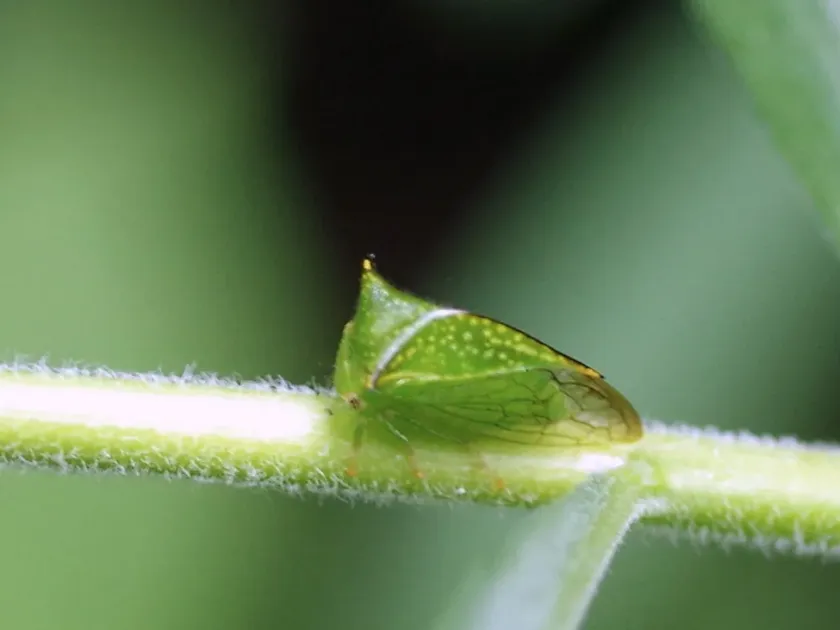
Description
How to identify
The Buffalo treehopper (Ceresa borealis) is a member of the Membracidae family within the order Hemiptera. These insects are easily recognized by their unique shape, featuring a prominent, horn-like projection on the pronotum that resembles a thorn.
Adults typically measure between 8 and 10 mm in length. Their coloration ranges from bright green to brownish-yellow, providing excellent camouflage against the foliage and stems of their host plants.
The nymphs are distinct from adults; they lack functional wings and possess spiky protrusions along their bodies. They are relatively sedentary compared to adults and are often found hiding in leaf axils or along tender stems.
The insect's biology is closely linked to woody vegetation. Adults possess strong, saltatory hind legs, allowing them to jump rapidly if they feel threatened, which often makes them difficult to catch or observe closely.
The head is oriented vertically, and the compound eyes are positioned on the sides, granting the insect a wide field of vision, which is crucial for detecting predators in its environment.
What it damages
Both nymphs and adults cause damage by feeding on plant sap. They use their specialized mouthparts to pierce the bark of twigs and stems, which weakens the plant and stunts the growth of new shoots.
The most significant damage occurs when the female lays eggs. She uses her ovipositor to create deep, crescent-shaped slits in the bark of young branches, which can lead to severe structural weakness.
These bark incisions frequently cause localized necrosis and tissue death. The damage creates entry points for various pathogens, including fungi and bacteria, which can lead to cankers and dieback.
In orchards, heavy infestations can result in the deformation of branches and a substantial reduction in overall plant vigor. Younger trees and saplings in nurseries are particularly vulnerable to these physical injuries.
The cumulative effect of feeding and egg-laying can lead to branch breakage, especially under the weight of snow or during periods of high wind, significantly impacting the productivity of fruit-bearing trees.
When it appears
The Buffalo treehopper generally completes one generation per year. The insect overwinters in the egg stage, with eggs embedded securely beneath the bark of host tree branches.
Hatching occurs in the spring, typically coinciding with the start of the plant's growth season and bud break. This timing ensures that the emerging nymphs have immediate access to succulent, nutrient-rich plant tissue.
Nymphal development proceeds through several stages over the course of the spring and early summer. During this time, they stay focused on feeding, gradually maturing into winged adults.
Adult activity peaks during the mid-summer months, usually July and August. During this period, the adults move between plants, feed, and mate to prepare for the next generation.
As autumn approaches, mated females search for suitable woody stems to lay their eggs, effectively sealing the egg-laying scars into the bark until the following spring.
Signs of infestation
The most reliable sign of a Buffalo treehopper infestation is the presence of characteristic scarring on the bark of young, tender branches. These scars appear as parallel slits or curved marks.
During the growing season, gardeners can observe adults resting on stems or the undersides of leaves. Due to their coloration, they may remain motionless to avoid detection by potential predators.
Localized sap oozing or gumming at the site of egg-laying wounds is a common observation. Over time, the bark in these areas may become cracked, darkened, or thickened due to wound response.
Visible yellowing of foliage or a lack of vigor in the terminal growth of branches can indicate feeding stress. In severe cases, twigs may appear stunted or twisted near the sites of heavy scarring.
Physical disturbance of the branches during the summer months will often cause adults to jump away, providing a clear indication that a population is present and active in the area.
Control measures
Effective management of the Buffalo treehopper requires a combination of cultural practices and targeted interventions to keep populations at manageable levels.
- Prune and destroy heavily infested branches during the dormant winter season to remove overwintering eggs.
- Maintain clean orchard floors by controlling weeds and tall grasses, which serve as essential cover for nymphs.
- Apply systemic or contact insecticides during the early nymphal stages if infestation levels exceed economic thresholds.
- Encourage natural predators, such as spiders, assassin bugs, and parasitic wasps, which can help keep treehopper numbers in check.
- Ensure overall tree health through proper fertilization and irrigation, allowing trees to better withstand mechanical damage from oviposition.
Taxonomy
- Latin name
- Ceresa borealis
- Order
- Hemiptera (bugs, aphids, leafhoppers)
- Family
- Membracidae
- EPPO code
- CEREBO
Discussion
No discussions yet — be the first.