
White-spotted treehopper
Ceresa albidosparsa
Description
How to identify
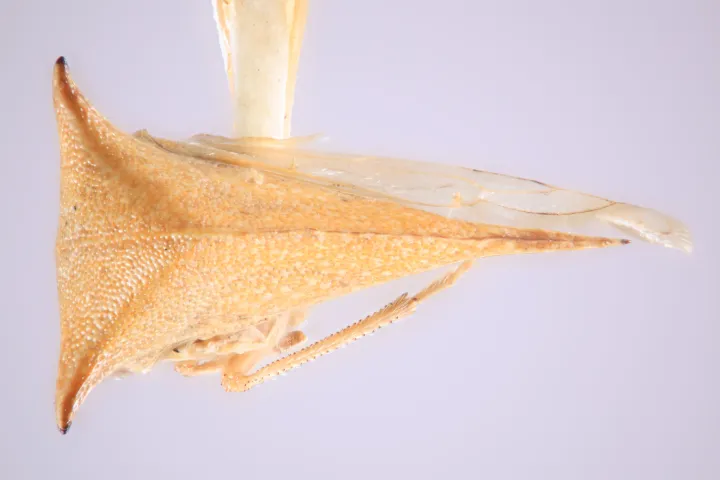
The white-spotted treehopper, Ceresa albidosparsa, belongs to the family Membracidae, order Hemiptera. It is easily recognized by its pronotum, which forms a horn-like protrusion, mimicking a thorn on the host plant.
The adult insect displays a greenish to yellowish-green body color, characterized by numerous small white spots scattered across its surface. The typical length of an adult specimen ranges from 7 to 9 millimeters.
Nymphs differ significantly in appearance, often possessing flattened bodies covered with various spines and lateral projections, which provide excellent camouflage against the bark of host trees.
Like all members of this family, they possess piercing-sucking mouthparts, specifically adapted for penetrating plant tissues to extract nutrient-rich sap.
These insects are highly agile; adults can perform rapid, forceful jumps when disturbed, making them difficult to capture or physically remove from the orchard.
What it damages
This pest affects a wide range of woody species, causing particular concern for fruit trees such as apples, pears, peaches, and cherries in commercial and home orchards.
Beyond orchard trees, it frequently colonizes ornamental shrubs and young nursery stock, where heavy infestations can severely weaken the vitality of the plants.
Both nymphs and adults feed on the sap of young shoots and foliage, leading to physiological stress, reduced photosynthesis, and stunted overall growth.
Females cause mechanical damage to the bark when ovipositing (laying eggs), which can create entry points for secondary fungal pathogens and trigger local tissue necrosis.
Prolonged feeding can lead to significant drops in yield, poor fruit development, and decreased winter hardiness of the affected trees.
When it appears
The white-spotted treehopper typically completes one or two generations per year, depending largely on the local climate and seasonal temperature profiles.
The insect overwinters in the egg stage. Females deposit their eggs beneath the bark of young twigs, creating characteristic scars that persist through the winter.
Nymphs emerge in the spring, coinciding with the period of active sap flow and the growth of fresh plant tissue, providing them with ample food sources.
Adults of the summer generation emerge mid-season. During this time, they are most active, migrating between plants and continuing their feeding behavior.
As autumn approaches, mating occurs, and females begin the process of preparing new egg clutches in the bark to ensure the survival of the next generation through the winter.
Signs of infestation
The most reliable sign of a treehopper presence is the appearance of specific bark scars on young branches, usually occurring in parallel slits or crescent-shaped marks.
The area surrounding the oviposition sites often exhibits yellowish discoloration, bark cracking, and sometimes gum exudation in stone fruits, which indicates stress.
Foliage on infested branches may show symptoms of chlorosis, leaf curl, and premature wilting due to the constant loss of plant fluids caused by the treehoppers.
Sticky honeydew secretions are often present on the leaves, which may subsequently attract ants or promote the growth of sooty mold.
- Characteristic bark slits from egg-laying
- Yellowing and premature leaf senescence
- Stunted shoot growth in the current season
- Presence of spiny nymphs on the undersides of leaves
Control measures
Effective management begins with pruning and destroying heavily infested branches, which helps remove overwintering egg masses from the orchard.
Maintaining a weed-free orchard floor is crucial, as many species of treehoppers rely on ground vegetation for cover or as alternative food sources during nymphal stages.
Chemical control involving systemic or contact insecticides may be necessary during the peak period of nymph emergence to mitigate significant population outbreaks.
Yellow sticky traps can be used to monitor adult activity and, to some extent, reduce the number of breeding adults present in the canopy.
Biological control, such as encouraging natural predators and parasitoids like egg-parasitizing wasps, serves as a sustainable way to suppress population growth over time.
Taxonomy
- Latin name
- Ceresa albidosparsa
- Order
- Hemiptera (bugs, aphids, leafhoppers)
- Family
- Membracidae
- EPPO code
- CEREAL
Discussion
No discussions yet — be the first.