
Buffalo treehopper
Ceresa
Description
How to identify
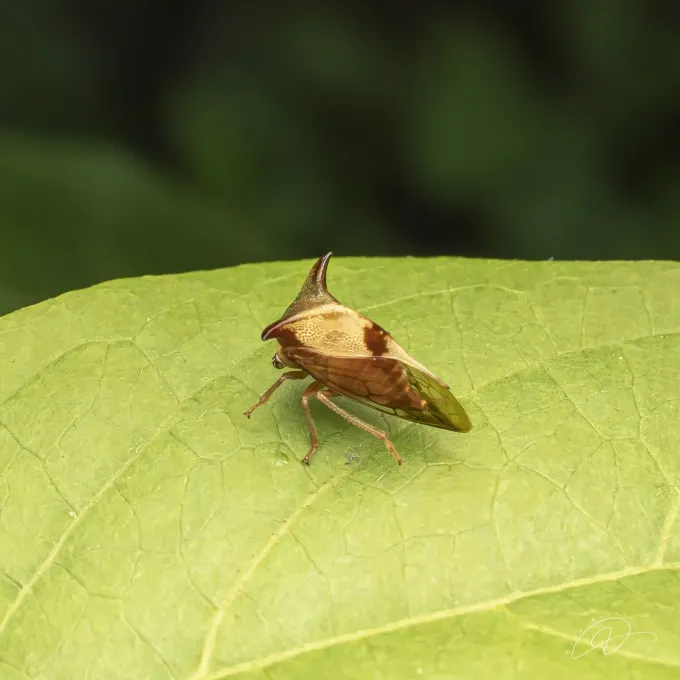
The buffalo treehopper (Ceresa bubalus) is a hemipteran insect belonging to the family Membracidae. The adult reaches 8–10 mm in length and is easily recognized by its triangular shape, resembling a buffalo due to its pronotal horns.
Its coloration is predominantly light green to yellowish-green, which provides excellent camouflage within foliage. The insect possesses a sturdy chitinous exoskeleton and powerful hind legs, allowing it to jump quickly when threatened.
The nymphs of the buffalo treehopper differ significantly from adults. They are wingless, flattened, and covered with numerous thorn-like spines, which help them remain undetected on the bark of host plants.
The life cycle is univoltine, meaning there is only one generation per year. The insect overwinters in the egg stage beneath the bark of woody plants, ensuring survival through harsh winter conditions.
Biologically, the species depends on plant sap for nutrition throughout its development stages, making it a persistent threat to healthy orchard environments during the growing season.
What it damages
The buffalo treehopper is a polyphagous pest, causing significant damage to various fruit trees, including apple, pear, plum, and peach. It also affects vineyards and many deciduous ornamental shrubs.
The most severe damage is caused by the female during oviposition. She uses a serrated ovipositor to make deep, crescent-shaped slits in the bark of young twigs to insert her eggs, causing localized trauma.
These wounds interfere with the vascular system of the shoots, leading to stunted growth, distorted branching, and the gradual necrosis of tissues around the egg-laying sites.
In addition to mechanical damage, these slits serve as entry points for pathogens. Fungal and bacterial infections often colonize the wounds, causing bark cankers that can girdle and kill young branches.
In nurseries, repeated attacks by the buffalo treehopper can lead to the structural deformation of young trees, rendering them unsalable and reducing the productivity of the orchard in the long term.
When it appears
Nymphs hatch from overwintering eggs in early spring, coinciding with the beginning of sap flow in host trees. They immediately begin feeding on the soft tissues of young green shoots.
Throughout late spring and early summer, nymphs undergo multiple molts, increasing in size and causing progressive damage as they move along the branches to feed on nutrients.
The adult stage typically emerges in mid-summer, usually during July. Adults are highly mobile, jumping frequently and flying between trees to mate and search for suitable egg-laying sites.
Oviposition occurs primarily from late summer into early autumn, specifically during August and September. Females are most active on tree branches during this period, leaving their mark for the next season.
With the arrival of autumn frosts, the adult population dies off, while the eggs remain embedded safely within the bark, remaining in a state of diapause throughout the winter until spring.
Signs of infestation
The primary sign of infestation is the presence of characteristic parallel slits on the bark of young twigs. These appear as paired, slightly curved scars that become more visible as they age.
Over time, these wounds expand, forming rough, corky ridges or deep lesions on the surface of the bark, which often look like localized areas of bark necrosis or structural scarring.
Observing jumping green insects in the canopy or in the tall grass surrounding the trees during the summer months is a reliable indicator of the presence of the buffalo treehopper.
The overall health of young trees can be an indirect indicator; trees infested by the pest often show signs of reduced vigor, yellowing leaves, or premature leaf drop on affected twigs.
Severe infestations often result in the twisting or dwarfing of twigs, which is easily noticeable during routine orchard inspections compared to healthy, non-infested branches nearby.
Control measures
Effective management begins with sanitation. Keeping orchard floors free of tall weeds and grasses is crucial, as these plants provide essential shelter and food for nymphs during the early season.
Pruning and removing infested branches during the dormant season is one of the most effective mechanical methods to reduce the egg population before the next generation emerges.
Chemical control can be applied during the nymph stage in late spring if populations reach damaging thresholds. Insecticides targeting the foliage are most effective when nymphs are actively feeding.
Promoting tree health through proper fertilization and watering helps trees recover from minor mechanical injuries and prevents opportunistic diseases from establishing in the oviposition scars.
- Regular mowing of ground cover in the orchard.
- Dormant pruning to remove egg-infested twigs.
- Monitoring populations using sticky yellow traps.
- Application of insecticides during peak nymph activity.
Taxonomy
- Latin name
- Ceresa
- Order
- Hemiptera (bugs, aphids, leafhoppers)
- Family
- Membracidae
- EPPO code
- CERESP
Discussion
No discussions yet — be the first.