
Ceratitis serrata
Ceratitis serrata
Description
How to identify
Ceratitis serrata is a dipteran insect belonging to the family Tephritidae. It is a highly significant agricultural pest, closely related to other notorious fruit flies within the Ceratitis genus.
The adult fly is characterized by patterned, colorful wings and a distinct body coloration, which helps it blend into the foliage and fruit surfaces of its host plants. Adults typically measure about 5 to 6 mm in length.
The lifecycle encompasses four distinct stages: egg, larva, pupa, and adult. Females possess a specialized ovipositor designed to penetrate the skin of healthy fruits to deposit eggs underneath.
Identifying this species in the field is challenging due to the morphological similarity to other Ceratitis species. Precise identification often requires specialized laboratory analysis of the insect's anatomy.
Due to its potential to devastate fruit production, Ceratitis serrata is classified as a quarantine pest in many regions, necessitating strict regulatory oversight.
What it damages
This pest targets a wide variety of tropical and subtropical fruits. Major host crops include citrus, mangoes, peaches, and coffee, which are highly susceptible to infestation.
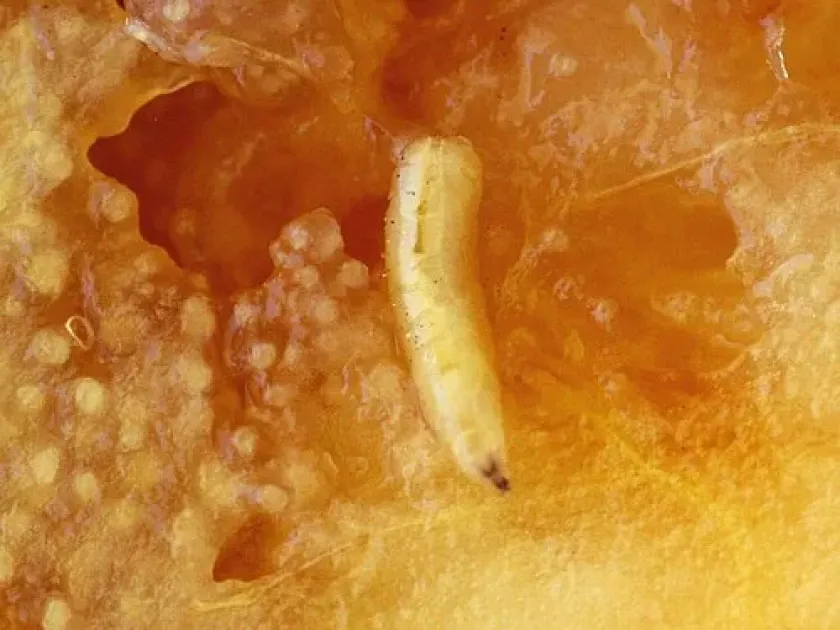
The larvae feed internally on the fruit pulp. As they consume the tissue, they cause rapid structural breakdown, turning the internal part of the fruit into a decaying, inedible mass.
The initial puncture wounds caused by the female's ovipositor create entry points for opportunistic fungal and bacterial pathogens, leading to secondary rotting and spoilage of the produce.
Under heavy infestation, crop losses can approach 100%. Infested fruits typically drop from the tree prematurely, rendering them entirely unsuitable for fresh market sale or processing.
Because of its rapid reproductive cycle, Ceratitis serrata can quickly overwhelm orchards, causing significant economic damage if not managed during the early stages of infestation.
When it appears
The activity and population dynamics of Ceratitis serrata are heavily influenced by temperature and relative humidity. Warm, stable climates favor continuous breeding throughout the year.
In regions with favorable weather conditions, the pest can complete multiple generations in a single growing season, which complicates control efforts and monitoring programs.
Overwintering typically occurs at the pupal stage, with the insects remaining in the soil or protected within fallen, decaying fruit until conditions improve for adult emergence.
Adult emergence often peaks when fruit crops reach the ripening stage, providing the pest with an ideal environment for egg-laying and subsequent larval development.
Agronomists employ pheromone-based monitoring traps throughout the season to detect the presence of adults and estimate the size of the emerging population.
Signs of infestation
The earliest signs of infestation include small, subtle puncture marks on the skin of maturing fruits, often accompanied by localized discoloration or slight depressions.
Internal examination of suspected fruits reveals winding galleries carved by larvae as they consume the flesh, often leading to softening and tissue collapse.
Premature fruit drop, particularly when fruits appear healthy from the outside, is a critical warning sign that warrants an immediate inspection of the orchard and internal fruit tissues.
When an infested fruit is cut open, whitish or cream-colored legless larvae are typically visible, moving actively through the decomposing fruit pulp.
A distinct, fermented or putrid odor emanating from fruits still attached to the tree is a classic symptom of advanced infestation caused by larval feeding and associated microbial decay.
Control measures
Rigorous quarantine and phytosanitary measures are the first line of defense, aiming to prevent the introduction of the pest into non-infested regions via international trade.
Cultural control methods involve the regular collection and deep burial or destruction of fallen fruit, which effectively breaks the pest's lifecycle by removing its primary breeding ground.
- Utilizing pheromone traps for early warning and mass trapping of adults.
- Applying protein-based food attractants to lure flies into insecticide-treated traps.
- Targeted insecticide applications during peak activity periods, following strict regulatory guidelines.
- Releasing biological control agents, such as parasitoid wasps, to reduce larval populations.
An Integrated Pest Management (IPM) approach is recommended, combining cultural, biological, and chemical methods to achieve sustainable control while minimizing environmental impact.
Ongoing monitoring of orchard conditions allows for the rapid identification of infestation hotspots, enabling localized control actions before the pest spreads across the entire plantation.
Taxonomy
- Latin name
- Ceratitis serrata
- Order
- Diptera (flies)
- Family
- Tephritidae
- EPPO code
- CERTSE
Discussion
No discussions yet — be the first.