
Ceratitis morstatti
Ceratitis morstatti
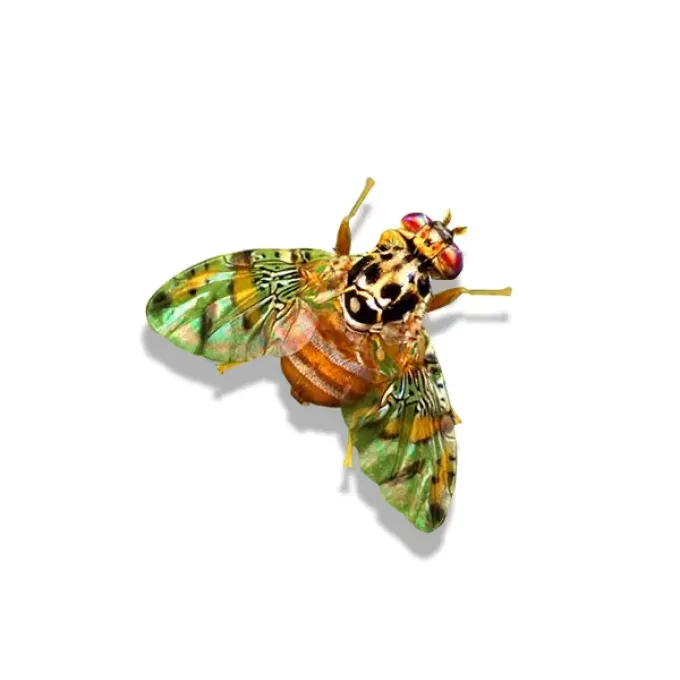
Description
How to identify
Ceratitis morstatti is a species of fruit fly belonging to the family Tephritidae, order Diptera. These flies are recognized by their intricate wing patterns and specialized behavior in targeting host plants.
Adult flies possess a distinct body coloration, often with yellowish or brownish tones, and wings marked with characteristic dark bands. These features are essential for species differentiation within the complex of fruit-infesting flies.
The larvae are small, legless, and creamy-white, adapted for living within the fleshy tissues of host fruits. They go through several larval instars, growing significantly as they feed on the fruit pulp.
The life cycle is holometabolous, comprising egg, larva, pupa, and adult stages. The female uses a sharp, sclerotized ovipositor to insert eggs beneath the skin of suitable fruits, which marks the start of the infestation.
Scientific identification usually requires microscopic analysis of the female ovipositor and the wing venation pattern to ensure accuracy in distinguishing it from other similar species in the genus.
What it damages
This pest primarily attacks a variety of fleshy fruits, including coffee berries and other tropical or subtropical crops. The damage is characterized by the destruction of the interior pulp, rendering the fruit unmarketable.
As larvae feed on the fruit tissue, they create tunnels, leading to rapid degradation and softening of the fruit. This physical damage often leads to the fruit dropping from the tree prematurely.
Infested fruits frequently suffer from secondary infections by fungi and bacteria. These pathogens enter through the egg-laying puncture or larval exit holes, causing the fruit to rot from the inside out.
In commercial orchards, this species can cause severe losses, impacting both the quantity and quality of the harvest. If left unmanaged, infestation levels can rise rapidly, threatening the entire crop.
Monitoring for signs of damage is critical, as the presence of even a few larvae can lead to widespread decay when environmental conditions favor the pest's reproduction.
When it appears
The activity of Ceratitis morstatti is heavily dependent on favorable temperature ranges and the presence of maturing fruit. Their life cycle typically accelerates during the warm season.
Populations tend to build up during the ripening phase of the host fruit, as the fruit skin becomes easier to pierce. This synchronization with host phenology is a key factor in their infestation potential.
Depending on the regional climate, multiple generations can occur within a single year. Constant environmental monitoring helps predict the peaks of adult fly emergence.
The transition from one generation to the next depends on the availability of suitable hosts; therefore, managing the availability of ripening fruit is part of the long-term control strategy.
Agronomists focus on identifying the first emergence of adults to schedule preventative applications before the egg-laying process reaches its peak intensity.
Signs of infestation
Early symptoms of an infestation include minute necrotic spots or depressions on the fruit surface, which are the sites of oviposition punctures. These spots may darken over time.
As larvae develop inside, the fruit may show localized softening or irregular bumps. In some cases, a clear liquid secretion or "weeping" may be visible at the puncture site.
A tell-tale sign of advanced infestation is the premature color change and abscission of the fruit. When opened, the interior will show necrotic trails and the presence of larvae.
An accumulation of fallen fruit under the canopy is a major indicator of high pest pressure. These fallen fruits usually contain active larvae that will eventually pupate in the soil.
Detection using trap systems containing food-based attractants or pheromones provides an early warning of the pest's arrival in the orchard long before visual damage becomes obvious.
Control measures
The most effective strategy is integrated pest management (IPM), starting with rigorous sanitation. Collecting and destroying all fallen fruit is mandatory to break the life cycle of the fly.
Mass trapping using food lures or specific pheromone traps is highly recommended to reduce the adult population levels. This strategy helps keep the population below the economic damage threshold.
Insecticide applications should be timed to coincide with the susceptible developmental stages of the fruit. Selective products are preferred to minimize impact on beneficial insects.
Biological control, including the release of specific parasitoid wasps, is an essential component for sustainable orchard management, particularly in organic production systems.
- Regular monitoring of adult populations;
- Prompt removal of infested and fallen fruit;
- Use of registered insecticide programs during peak risk windows.
Taxonomy
- Latin name
- Ceratitis morstatti
- Order
- Diptera (flies)
- Family
- Tephritidae
- EPPO code
- CERTMO
Discussion
No discussions yet — be the first.