
Marriott's fruit fly
Ceratitis marriotti
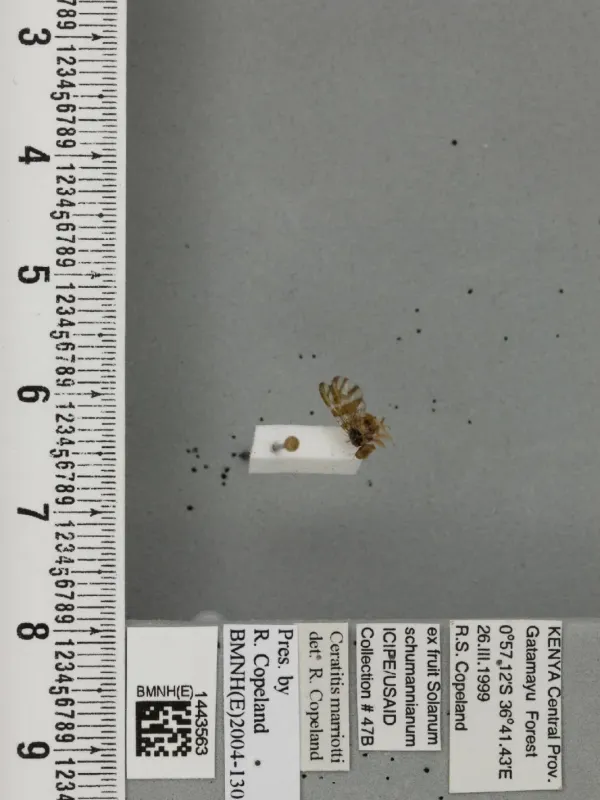
Description
How to identify
Marriott's fruit fly (Ceratitis marriotti) is a member of the Tephritidae family within the order Diptera. This species is recognized by its distinct wing patterns, which are typical for fruit flies and critical for species-level identification by entomologists.
Adult flies are relatively small and exhibit sexual dimorphism, with females possessing a specialized ovipositor designed for piercing fruit skin to deposit eggs safely into the pulp.
The larval stage consists of small, legless, cream-colored maggots. These larvae are the primary damaging stage of the life cycle, as they consume the interior tissues of the host fruit throughout their development.
The pupal stage occurs in the soil beneath host plants. The pupa is protected by a hardened, dark-brown puparium, which acts as a shield against environmental fluctuations and soil moisture.
To monitor populations effectively, professionals deploy pheromone traps designed to attract males, providing early warning signals and data necessary for implementing precise pest management strategies.
What it damages
This pest specializes in attacking various fleshy fruits. Its host range primarily includes citrus, peaches, apricots, and other orchard crops, where it can inflict significant economic losses on growers.
Larval feeding causes the destruction of fruit flesh from the inside out, creating internal tunnels and galleries. This feeding behavior often leads to premature fruit ripening, discoloration, and eventual drop.
Beyond direct feeding damage, the oviposition punctures and larval tunnels serve as entry points for secondary fungal and bacterial pathogens, which cause the fruit to rot rapidly.
High infestation rates can result in the loss of a large percentage of the harvest. Furthermore, damaged fruit is visually unappealing and structurally unstable, making it unfit for commercial processing or export.
Because Ceratitis marriotti is classified as a quarantine pest, its presence in an orchard often triggers strict regulatory actions, prohibiting the trade of produce from the affected area to protect international markets.
When it appears
The life cycle of Marriott's fruit fly is highly dependent on fruit availability and seasonal climate trends. Adult activity typically commences when spring temperatures rise above a critical threshold.
Multiple generations can occur throughout the growing season. Populations often peak during late summer or early autumn, coinciding with the maturation period of many susceptible fruit varieties.
The insect typically overwinters in the soil as a pupa. As temperatures climb in the spring, adult flies emerge, mate, and begin searching for suitable fruit hosts for their next generation.
The speed of development is dictated by temperature and humidity levels. Warm, moist conditions accelerate the reproductive rate, allowing for rapid population explosions if left unchecked.
Seasonality tracking is essential for effective pest management. By predicting the timing of peak emergence, growers can synchronize protective measures to prevent larvae from entering the fruit.
Signs of infestation
The initial signs of an infestation are small, subtle puncture marks on the surface of developing or ripening fruit, known as oviposition stings. These marks are often accompanied by slight depressions in the skin.
As the larvae mature inside, the fruit tissue begins to soften and decay. This internal breakdown is often characterized by the development of dark, water-soaked patches on the outer surface.
The most definitive sign is the presence of maggots upon slicing open the fruit. The interior may show discolored tunnels, fruit rot, and evidence of larval excrement throughout the damaged pulp.
Premature fruit drop is a common indicator of significant infestation. If a tree begins to shed fruit before it is fully mature, it is a strong signal for orchard managers to inspect for larval activity.
- Pin-sized holes on the fruit surface.
- Premature ripening and discolored skin.
- Soft, decaying spots on the fruit.
- Presence of larvae inside the fruit tissue.
- Acidic, fermented odor originating from the fruit.
Control measures
Strict phytosanitary protocols are the first line of defense. Preventing the movement of infested fruit out of known quarantine zones is crucial to stopping the spread of the fly to new regions.
Cultural control methods involve rigorous orchard hygiene, including the prompt collection and deep burial of all fallen fruit. This process eliminates the pupation sites and breaks the fly's life cycle.
Chemical control usually involves the use of toxic bait sprays. These combine a food-based attractant with an insecticide to target adults while minimizing the chemical footprint on the orchard ecosystem.
Biological control, such as releasing parasitoid wasps that feed on fruit fly larvae, offers a sustainable alternative to conventional chemical pesticides and is increasingly used in integrated pest management.
The sterile insect technique (SIT) is a highly effective, large-scale control method. By releasing millions of sterile male flies into the wild, the mating success of the pest population is drastically reduced.
Taxonomy
- Latin name
- Ceratitis marriotti
- Order
- Diptera (flies)
- Family
- Tephritidae
- EPPO code
- CERTMR
Discussion
No discussions yet — be the first.