
Fruit fly Ceratitis lobata
Ceratitis lobata
Description
How to identify
The fruit fly Ceratitis lobata is a member of the Tephritidae family, also known as fruit flies or picture-winged flies. It is a significant pest that belongs to a genus known for its capacity to infest a wide variety of fruit-bearing plants worldwide.
Adult flies are typically 4 to 6 millimeters long. Their bodies are characterized by yellowish-brown coloration with distinct dark patterns on the thorax and abdomen. These markings serve as excellent camouflage against the bark of fruit trees and the surface of fruits.
The wings of Ceratitis lobata exhibit a unique and complex pattern of dark stripes and spots, which is a key diagnostic feature for entomologists to distinguish this species from other related tephritids. Accurate identification is crucial for implementing specific management protocols.
The life cycle consists of four distinct stages: egg, larva, pupa, and adult. The female is equipped with a sclerotized ovipositor, enabling her to pierce the skin of fruits and deposit eggs directly into the fruit pulp, providing immediate access to nutrition for the emerging larvae.
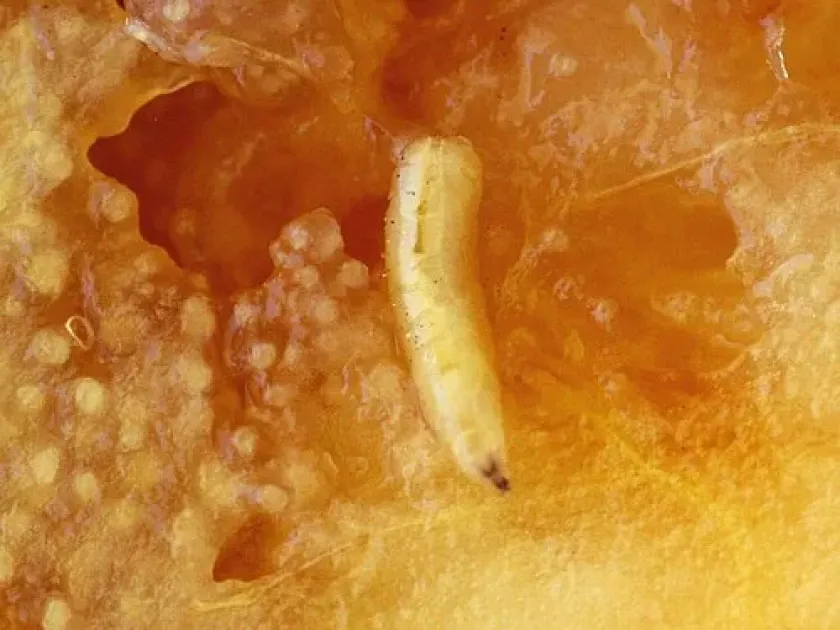
Larvae develop rapidly inside the fruit. They are cream-colored, cylindrical, and lack visible head appendages, a typical characteristic of many dipteran larvae. After completing their growth, they usually drop to the soil to pupate, which is a critical phase in their biological strategy.
What it damages
The primary damage is caused by larvae feeding inside the fruit. As they tunnel through the pulp, they destroy the internal structure of the fruit, rendering it completely unmarketable and unfit for human consumption.
The oviposition sites (punctures made by females) and the tunnels created by larvae serve as entry points for secondary pathogens, such as bacteria and fungi. This secondary infection often leads to rapid decay and rotting of the fruit while it is still on the tree.
Ceratitis lobata affects a diverse range of crops, including various orchard fruits and tropical produce. In the absence of management, the infestation can result in total crop loss, causing severe economic damage to commercial fruit producers.
Affected fruits often lose their commercial value early in the development phase. Even if the damage is internal, the fruit may exhibit external signs of softening or premature coloration changes that make them easy to identify during the sorting process.
The hidden nature of the larvae development inside the fruit poses a serious challenge for agricultural inspection and quarantine measures, as infested fruits might look healthy but contain larvae deep within the flesh.
When it appears
The seasonal activity of Ceratitis lobata is largely dictated by temperature and host plant availability. In warmer climates, the fly can remain active for most of the year, with multiple overlapping generations occurring in a single growing season.
Adult flies are most active during warm, humid conditions, which favor mating and oviposition. The timing of their life cycle usually correlates with the maturation of fruit, as females specifically seek out ripening fruits that provide the best nutrition for their offspring.
Pupae overwinter in the soil beneath the trees, emerging as adults when spring temperatures rise. This emergence is often synchronized with the early stages of fruit development in host species, allowing for immediate infestation of the new crop.
In regions with distinct seasons, the highest infestation levels are recorded during the peak harvest period. During these months, the insect population density can reach levels that require constant monitoring and frequent application of control measures.
The duration of each developmental stage is temperature-dependent. Higher temperatures speed up metabolic rates, leading to shorter life cycles and a significant increase in the number of generations per year, which exacerbates the pest pressure.
Signs of infestation
The most common sign of infestation is the presence of small puncture marks on the fruit skin, which are the sites where females laid their eggs. These spots may initially look like small depressions or minor discolorations.
As the larvae feed, the infested area may show signs of softening or darkening. If the fruit is opened, the internal pulp will appear degraded, with visible tunnels and the presence of creamy-white larvae.
Premature fruit drop is another significant indicator. If you observe a large number of fallen fruits under a tree that should still be in the maturation phase, it is highly likely that they have been infested by fruit fly larvae.
The use of yellow sticky traps or pheromone-baited traps in the orchard will help detect the presence of adult flies. A sudden increase in fly capture rates is a clear sign that protective measures must be implemented immediately.
In some cases, a faint fermentation odor may be detected near the fruit due to the activity of secondary decay microbes, which are introduced by the larvae, further signaling an advanced level of infestation.
Control measures
Effective management of Ceratitis lobata relies on an integrated pest management (IPM) approach. The most critical practice is the rigorous collection and disposal of all fallen fruit to eliminate the breeding substrate for the next generation of larvae.
Chemical control involves the strategic application of insecticides. Treatments must be carefully timed according to the economic threshold and the specific crop harvest period to ensure effective control while maintaining safety standards for consumers.
The use of mass trapping with attractants is an environmentally friendly way to reduce the adult fly population. These traps significantly lower the number of mating pairs and decrease the potential for egg-laying on ripening fruit.
Soil management, such as plowing or cultivating the area under the tree canopy, is effective in disrupting the pupal stage, exposing larvae and pupae to predators and adverse environmental conditions.
- Maintaining strict quarantine protocols for fruit movement between regions.
- Using fine mesh netting to protect individual high-value fruits or entire trees.
- Employing biological control agents, such as parasitic wasps or entomopathogenic fungi.
- Selecting fruit varieties that reach maturity outside the peak activity period of the fly.
Taxonomy
- Latin name
- Ceratitis lobata
- Order
- Diptera (flies)
- Family
- Tephritidae
- EPPO code
- CERTLO
Discussion
No discussions yet — be the first.