
Mediterranean fruit fly
Ceratitis flexuosa
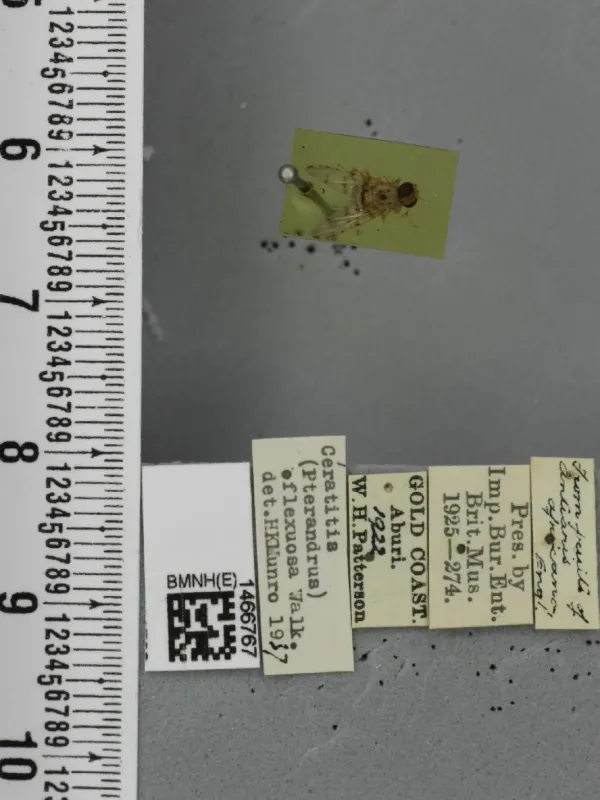
Description
How to identify
The Mediterranean fruit fly (Ceratitis capitata) is a member of the Tephritidae family within the order Diptera. Adult flies are about 4-5 mm long, with a yellowish-brown body and distinct, dark, patterned wings.
Males are easily recognized by the presence of a pair of spatula-shaped hairs on their heads, which they use during mating displays on leaves.
The larvae are creamy white, cylindrical, and tapered towards the head, reaching up to 9 mm in length. They are typical fruit-infesting maggots that feed inside the host tissue.
The pupal stage occurs in the soil, protected by a hard, brown, barrel-shaped puparium that allows the insect to survive unfavorable environmental conditions.
It is one of the world's most destructive agricultural pests due to its wide host range, high reproductive rate, and ability to disperse rapidly over long distances.
What it damages
This species is highly polyphagous and infests a vast range of more than 200 host plants, including citrus, peaches, apples, pears, coffee, and various tropical fruits.
The damage is caused primarily by the larvae, which tunnel through the fruit pulp, breaking down the internal tissues and making the fruit completely unmarketable.
Infested fruit typically shows signs of premature ripening and shedding. Once the larvae are inside, the fruit becomes highly susceptible to secondary pathogens.
Secondary infections from yeasts, bacteria, and fungi, which enter through the larval feeding tunnels, cause the fruit to decay rapidly into a wet, rotting mass.
In unprotected orchards, the infestation levels can cause total crop loss, resulting in significant economic impacts for both commercial producers and home gardeners.
When it appears
Adults emerge in early spring as temperatures rise above 12-14 degrees Celsius, initiating the seasonal cycle of colonization and reproduction.
The life cycle from egg to adult can be completed in as little as 20-30 days under warm, favorable summer conditions, allowing for multiple generations per year.
In warm climates, the population continues to build up throughout the summer and autumn, often reaching peak levels during the fruit maturation season.
The availability of susceptible fruit throughout the year is a critical factor for the persistence of the species in tropical and subtropical regions.
During the winter, the population persists as pupae buried in the soil or as larvae in late-season fruit, waiting for the return of warmer weather to resume activity.
Signs of infestation
The most visible sign of infestation is the presence of small, puncture marks on the fruit skin, which are the sites where the female deposited her eggs.
Areas around these punctures often become discolored, softened, or slightly depressed compared to the rest of the healthy fruit surface.
As the larvae grow, the fruit becomes increasingly soft to the touch, and in advanced cases, fluid may exude from the entry points of the larvae.
The sudden drop of apparently healthy fruit from trees is a strong indicator of larval activity inside the fruit, causing the tree to abort the damaged produce.
In open orchards, the presence of adults can be confirmed by observing them on fruit surfaces, especially during early morning or late afternoon hours.
Control measures
Strict quarantine protocols are the first line of defense to prevent the accidental movement of infested fruit between regions and countries.
Cultural control involves the systematic collection and deep burial of all fallen fruit to interrupt the life cycle and prevent larvae from pupating in the soil.
Mass trapping using food-based attractants or pheromone-baited traps is highly effective for monitoring and suppressing adult populations in home gardens.
Chemical control measures should be applied according to local agricultural extension advice, focusing on the adult stage before egg-laying occurs.
- Maintain clean cultivation by removing and destroying infested fruit.
- Apply biological controls, such as parasitoid wasps, to manage larvae.
- Use netting to protect small trees or individual fruit clusters.
Taxonomy
- Latin name
- Ceratitis flexuosa
- Order
- Diptera (flies)
- Family
- Tephritidae
- EPPO code
- CERTFX
Discussion
No discussions yet — be the first.