
African fruit fly
Ceratitis fasciventris
Description
How to identify
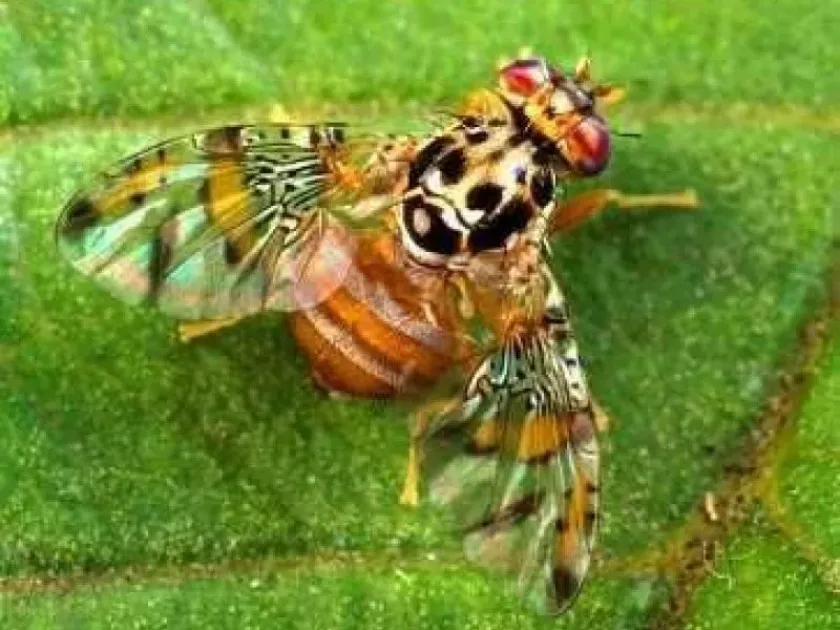
The African fruit fly (Ceratitis fasciventris) is a member of the Tephritidae family, well-known for its destructive impact on fruit production. Adult flies are approximately 4 to 6 mm long with a distinct brownish-yellow body and patterned, dark-spotted wings.
The identification of this species is complex and often requires expert entomological examination of wing patterns and abdominal morphology. They are closely related to other major fruit fly species, making surveillance a critical task for agricultural authorities.
The life cycle consists of four distinct stages: egg, larva, pupa, and adult. The female possesses a robust ovipositor that allows it to pierce the skin of ripening fruits to deposit clusters of eggs directly into the pulp.
Larvae are typically creamy-white, legless, and reach a size of about 7-9 mm. As they feed, they tunnel into the fruit, which often results in the fruit's rapid collapse and decay.
Pupation usually occurs in the soil beneath the host plant, where the pupae can remain dormant for a period until environmental conditions trigger the emergence of the next generation of adults.
What it damages
This pest is highly polyphagous, attacking a wide range of commercially significant crops including citrus, coffee, mango, avocado, and guava. The diversity of host plants makes it a persistent threat in tropical and subtropical regions.
Damage is caused primarily by larvae feeding inside the fruit, which destroys the internal structure. This renders the fruit completely unsalable, causing significant economic losses to farmers and exporters.
Secondary infections from bacteria and fungi often enter through the exit holes of the larvae, accelerating the decomposition of the fruit. This makes the remaining harvest unsuitable for processing or fresh consumption.
The fly is considered a major quarantine pest, leading to strict international trade restrictions. Exporting countries often face high costs for fruit sterilization treatments like cold storage or irradiation to ensure compliance.
The wide host range allows the African fruit fly to thrive throughout the year in many areas, shifting between different fruit species as they reach maturity, thus maintaining a continuous pressure on agricultural land.
Signs of infestation
The initial signs of infestation are small puncture marks on the surface of the fruit skin, known as 'sting' marks. These are caused by the female fly when laying eggs and may be accompanied by minor tissue discoloration.
As the larvae grow, the fruit often shows premature ripening or yellowing. In many cases, infected fruit falls to the ground before it is fully mature, even if it looks healthy from the outside.
Internal symptoms include honeycombed tunnels in the fruit flesh, which may appear watery or rotten. The texture of the fruit becomes soft and pulpy as the larvae consume the interior tissue.
Active infestations may also produce characteristic odors of fermentation, which can attract other opportunistic pests, further complicating the condition of the damaged produce.
- Sting marks on the fruit peel.
- Premature dropping of ripening fruits.
- Internal tissue decay and larvae presence.
- Adult flies captured in pheromone monitoring traps.
Control measures
Effective control starts with strict phytosanitary measures to prevent the movement of infested fruit into non-infested areas. Surveillance through pheromone-based traps is crucial for detecting early outbreaks.
Good agricultural practices, such as the regular collection and deep burial of fallen fruit, are essential. This helps to eliminate the larval reservoir before the insects can pupate in the soil.
Targeted use of bait sprays, which combine food attractants with selective insecticides, is an efficient way to reduce adult populations while minimizing the impact on beneficial insects in the orchard.
Post-harvest treatments, such as cold treatment or hot water immersion, are used by export industries to ensure the complete elimination of potential pests from the consignment.
Biological control, including the release of specific parasitoids, offers a promising eco-friendly approach to manage populations in larger agricultural landscapes and integrated pest management programs.
Taxonomy
- Latin name
- Ceratitis fasciventris
- Order
- Diptera (flies)
- Family
- Tephritidae
- EPPO code
- CERTFA
Discussion
No discussions yet — be the first.