
Copeland fruit fly
Ceratitis copelandi
Description
How to identify
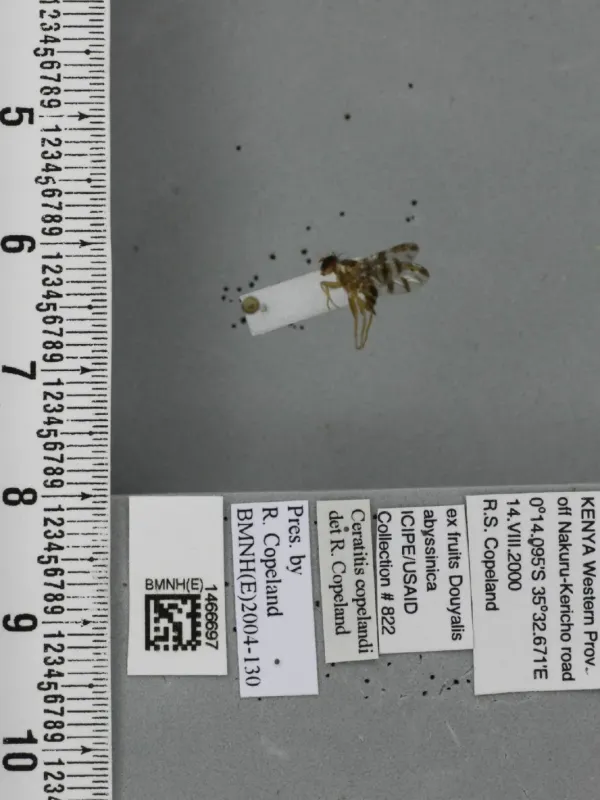
The Copeland fruit fly (Ceratitis copelandi) belongs to the family Tephritidae, a group commonly known as fruit flies or picture-winged flies. It is a highly specialized agricultural pest that closely resembles other members of the genus Ceratitis.
Adults exhibit a distinct pattern on their wings and body, which is a key diagnostic feature for species identification. Experts use specialized morphological markers, such as the shape of the ovipositor in females and specific wing venation patterns, to distinguish this species from others.
The lifecycle follows a complete metamorphosis consisting of four distinct stages: egg, larva, pupa, and adult. The fly undergoes these transitions within and around the fruit, completing its development in a relatively short period under optimal temperatures.
Females are highly efficient at detecting suitable host fruits. Using a sharp ovipositor, they deposit eggs under the skin of the fruit, providing an immediate food source for the hatching larvae.
The pupal stage occurs in the soil, where the larvae migrate after completing their feeding phase. This soil-dwelling stage makes the pest particularly resilient, as it protects the insect from various environmental pressures and insecticide applications.
What it damages
This pest affects a wide range of fruit crops. The larvae feed directly on the pulp of the fruit, causing significant structural damage as they tunnel through the ripening tissue.
The damage caused by larvae often facilitates the entry of secondary pathogens, such as bacteria and fungi. This leads to rapid decay and fermentation of the fruit, rendering it completely unmarketable and inedible.
Heavy infestations result in substantial crop losses for farmers. Fruit often drops prematurely from the tree, and the remaining harvest may fail to meet quality standards for commercial distribution.
Because the larvae develop internally, the damage is often invisible until the later stages of infestation, making early detection and proactive management crucial for minimizing financial losses.
The economic impact is particularly severe due to quarantine regulations. Even low levels of infestation can lead to the rejection of entire fruit consignments during export inspections.
Signs of infestation
Early signs of infestation include small, subtle puncture marks on the fruit skin where the female laid its eggs. These sites may show slight discoloration or depressions as the tissue begins to breakdown.
As the larvae grow, the internal feeding causes softening of the fruit. In many cases, the fruit might show premature ripening or uneven color changes that stand out from healthy produce in the orchard.
Cutting open an infested fruit typically reveals the larvae, which are small, legless, and white. Their feeding creates complex galleries or tunnels within the fruit, often filled with frass and decaying matter.
A foul, fermented odor is a common indicator of advanced infestation. This smell attracts other insects and signals that the fruit is already spoiled and prone to rapid collapse.
Observing high numbers of dropped, rotting fruit under the canopy is a strong indicator of an active population in the orchard, necessitating immediate inspection of the remaining harvest.
Control measures
Integrated Pest Management (IPM) is essential for controlling Ceratitis copelandi. A foundational practice is the rigorous collection and disposal of fallen fruit, which prevents larvae from reaching the soil to pupate.
The use of monitoring tools such as pheromone traps is vital. These traps help detect the arrival of adult flies, allowing growers to time their control interventions precisely when they are most effective.
Chemical control involving bait sprays is a common strategy. By using a food-based attractant mixed with an insecticide, growers can reduce the need for widespread spraying, targeting only the pests and minimizing impact on beneficial insects.
Biological control, including the release of specific parasitoid wasps that target fruit fly larvae, has shown potential in reducing population densities within orchards over the long term.
Strict phytosanitary measures are the final line of defense. Restricting the movement of fresh produce from infested regions is crucial to preventing the further spread of the Copeland fruit fly into new, uninfected areas.
Taxonomy
- Latin name
- Ceratitis copelandi
- Order
- Diptera (flies)
- Family
- Tephritidae
- EPPO code
- CERTCP
Discussion
No discussions yet — be the first.