
Mediterranean fruit fly
Ceratitis capitata
Description
How to identify
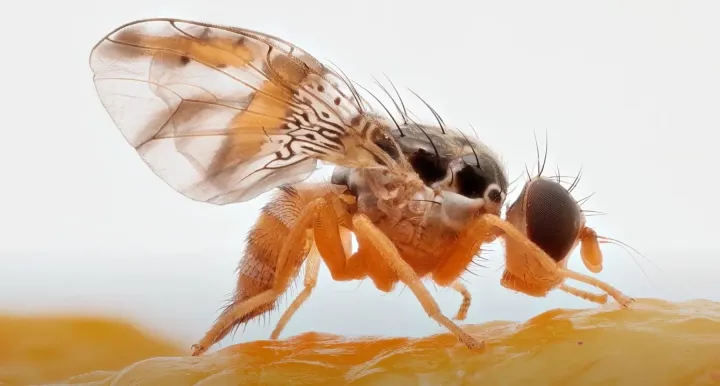
The Mediterranean fruit fly (Ceratitis capitata) belongs to the Tephritidae family. The adult fly is 4–5 mm long, with a yellowish-brown body and characteristic patterned wings.
The thorax shows a silvery-white sheen with black spots, while the abdomen features dark cross-bands. Females are equipped with a sharp ovipositor used to puncture the skin of ripening fruit for egg-laying.
Larvae are legless, white or creamy, and reach lengths of 7–9 mm. They are tapered at the front and possess a cone-like shape, facilitating movement through the fruit pulp.
Pupation occurs in barrel-shaped puparia, which are typically found in the top layers of soil or hidden within fallen fruit debris beneath host trees.
This species is globally recognized as a significant quarantine pest, capable of rapid proliferation and adapting to a wide variety of climatic conditions across many regions.
What it damages
The pest is highly polyphagous, attacking over 200 different plant species. Primary host crops include citrus, peaches, apricots, pears, apples, figs, and persimmons.
Damage begins when the female lays eggs under the fruit skin. As larvae hatch, they burrow into the fruit, creating internal tunnels that accelerate decay and rot.
The punctures made by the female serve as entry points for bacteria and fungi, which turn the internal pulp into a liquid, inedible mess in a very short time.
Economic losses are severe, primarily due to premature fruit drop and the loss of commercial viability for infected crops, rendering them unsuitable for export or retail.
In uncontrolled environments, infestations can lead to total crop loss, making constant monitoring and proactive management essential for large-scale fruit production.
When it appears
The life cycle of the fruit fly depends heavily on temperature and humidity. Under optimal conditions, one generation can be completed in just 20 to 30 days, allowing for multiple overlapping generations.
The species overwinters mainly as pupae in the soil. Adult emergence begins once temperatures consistently rise above 12–15°C, triggering the start of the breeding season.
Peak activity generally occurs in late summer and early autumn when a wide range of host fruits reach the stage of ripening, making them highly attractive for egg deposition.
Optimal environmental conditions for the pest include temperatures between 25°C and 30°C. Excessive heat or drought can temporarily slow down adult flight activity.
As temperatures drop in late autumn, the flies gradually reduce their metabolic rates, although reproduction may continue on late-season crop varieties until the first frosts.
Signs of infestation
One of the first signs of infestation is the appearance of small, dark, sunken spots on the surface of the fruit, marking the exact site of the female's oviposition.
Upon cutting open the fruit, tunnels made by feeding larvae are visible. The surrounding tissue often displays dark discolouration, fermentation, and a distinct, sharp, acidic odor.
Premature fruit drop is a common indicator of infestation. Fruits that appear healthy from the outside may be heavily infested internally by larvae feeding on the pulp.
- Dark, bruised spots on the fruit surface.
- Soft, decayed patches developing around entry points.
- Premature ripening and change in color.
- Presence of live larvae inside the fruit pulp.
Adult flies can sometimes be observed on the foliage of host trees, especially during early morning hours, as they forage for dew or honeydew secreted by aphids.
Control measures
Cultural control is a primary defense, requiring the daily collection and proper disposal of fallen fruit. Burying debris at least 50 cm deep prevents adult emergence.
Pheromone traps are essential for monitoring fly populations. These tools help determine the threshold for starting insecticide applications, ensuring precise and effective management.
Chemical control involves applying authorized insecticides that are safe for use during the fruit-ripening stage, while strictly adhering to pre-harvest interval requirements.
Biological control options, including the use of entomopathogenic fungi or beneficial nematodes, can be used to manage larvae levels in the soil under the tree canopy.
Strict quarantine measures on fruit movement are critical to prevent the introduction of Ceratitis capitata into new, uninfected agricultural regions.
Taxonomy
- Latin name
- Ceratitis capitata
- Order
- Diptera (flies)
- Family
- Tephritidae
- EPPO code
- CERTCA
Discussion
No discussions yet — be the first.