
Mediterranean fruit fly
Ceratitis
Description
How to identify
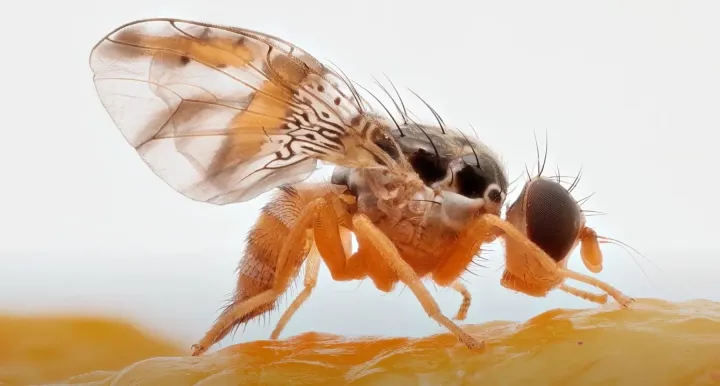
The Mediterranean fruit fly (Ceratitis capitata), commonly known as the medfly, is a serious insect pest belonging to the family Tephritidae. The adult fly is about 4–5 mm long, with a distinct yellowish-brown body and characteristic dark, mottled patterns on its wings.
The head is pale with green-reflective eyes, and the female possesses a sharp, needle-like ovipositor used to puncture the skin of ripening fruits for egg-laying.
The larvae are legless, creamy-white in color, and grow up to 9 mm in length. They are equipped with black oral hooks that allow them to tunnel through and feed on the internal pulp of fruits.
Pupation typically occurs in the soil beneath the host tree. The pupa is enclosed in a brownish, barrel-shaped casing known as a puparium, which protects it from environmental stress.
Because of its ability to survive in various climates and its broad host range, it is considered one of the most destructive agricultural pests worldwide.
What it damages
The medfly is a highly polyphagous pest, capable of infesting over 200 types of fruit and vegetable crops, including citrus, stone fruits, coffee, and pome fruits.
When the female lays eggs, she creates a puncture wound that provides entry points for various pathogens, leading to rapid tissue decay and internal rotting of the fruit.
The developing larvae feed voraciously on the pulp, leaving behind a tunnelled, watery mass that renders the fruit completely unmarketable and inedible.
Affected fruits often drop prematurely from the tree, leading to significant yield losses. In severe cases, entire harvests can be destroyed if control measures are not implemented.
The damage is particularly devastating because it is often hidden until the fruit reaches a stage where chemical treatments are no longer safe or effective.
When it appears
Adult flies emerge in the spring when temperatures consistently rise above 12–15°C, usually coinciding with the onset of the fruit-bearing season.
The life cycle is highly temperature-dependent; in warm subtropical climates, a single generation can be completed in as little as 3 to 4 weeks, facilitating rapid population growth.
Peak infestation usually occurs in late summer and autumn, when the majority of late-maturing fruit varieties are susceptible to egg-laying activity.
The pest overwinters primarily in the pupal stage within the soil, although in warmer climates, breeding may continue year-round if host fruits remain available.
Multiple generations occur per year, which makes the management of this pest a constant challenge for growers throughout the entire growing season.
Signs of infestation
The primary symptom is the presence of tiny sting-like punctures on the surface of the fruit, often surrounded by a small area of discoloration or bruising.
Internal decay is a telltale sign; if you slice open an infested fruit, you will find larval tunnels and the larvae themselves, often accompanied by a sour fermentation smell.
Premature ripening and the sudden drop of fruits that appear otherwise healthy are classic indicators that the fruit is being consumed from the inside out.
- Small sap droplets exuding from the entry points of the ovipositor.
- Softened patches of skin that yield to pressure.
- Tiny exit holes on fallen fruit through which mature larvae have crawled to pupate in the soil.
Regular monitoring using pheromone-baited traps is the most reliable way to detect the presence of the fly before visual damage becomes widespread.
Control measures
Strict quarantine measures are the first line of defense, including the restriction of fruit movement from infested areas to prevent the spread of the pest.
Integrated Pest Management (IPM) strategies utilize mass trapping with food attractants or pheromones to reduce the adult population density in orchards.
Sanitation is critical: all fallen fruit must be collected and disposed of daily—either by deep burial (at least 50 cm) or by incineration—to break the larval life cycle.
Chemical control involves the timely application of insecticides targeting the adult stage, strictly adhering to pre-harvest intervals to ensure consumer safety.
Soil management, such as tilling the soil under the tree canopy during winter, helps expose and destroy pupae, significantly reducing the potential population for the following season.
Taxonomy
- Latin name
- Ceratitis
- Order
- Diptera (flies)
- Family
- Tephritidae
- EPPO code
- CERTSP
Discussion
No discussions yet — be the first.