
Horned treehopper
Centrotus
Description
How to identify
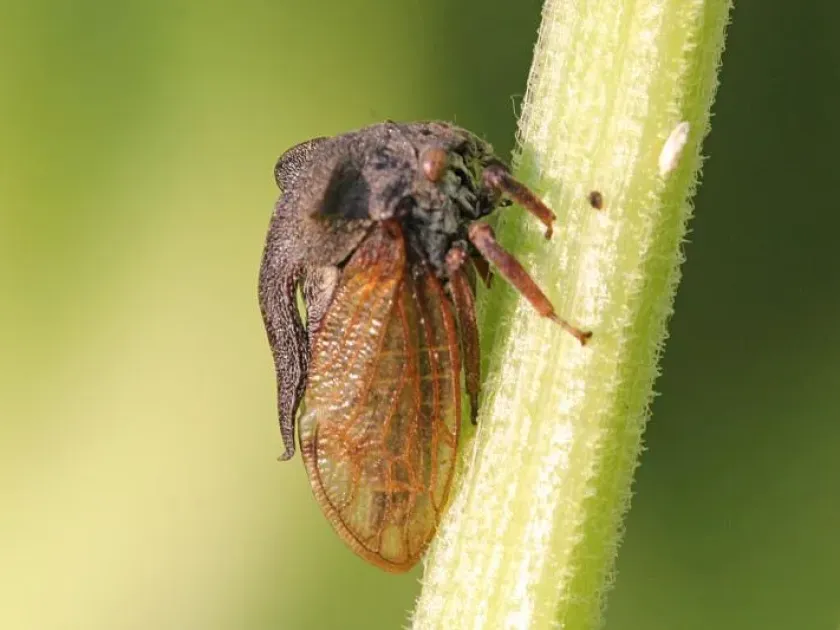
The horned treehopper (Centrotus cornutus) is a member of the Hemiptera order, belonging to the Membracidae family. The adult insect measures approximately 8–10 mm and is easily identified by a prominent horn-like projection on its pronotum.
The insect possesses a dark brown coloration, which provides excellent camouflage against tree bark. Its wings are transparent with distinct veining and fold flat over the body when resting.
Nymphs, or immature treehoppers, look markedly different from adults; they have flattened bodies covered in various spines and projections that assist them in clinging to plant surfaces.
They are notoriously elusive, often positioning themselves on young shoots or leaf petioles. Their protective coloring makes them extremely difficult for orchardists to spot during routine inspections.
The life cycle encompasses the egg stage, five nymphal instars, and the adult stage. In most temperate regions, the species completes only one generation per year.
What it damages
Centrotus cornutus is a polyphagous pest that affects a wide range of woody plants. Fruit trees, including apple, pear, cherry, and plum, are particularly susceptible to their feeding habits.
Beyond orchards, this treehopper inhabits forest trees such as oak, beech, and alder. These surrounding wild hosts often serve as reservoirs that facilitate the spread of the pest into nearby agricultural areas.
Damage occurs primarily through the extraction of sap from young shoots and leaf stems. This feeding behavior drains the plant's resources and disrupts the normal flow of nutrients and moisture.
Furthermore, female treehoppers inflict physical damage on bark when laying eggs. These incisions create deep, lingering wounds that weaken the structural integrity of twigs and bark.
High infestation rates lead to stunted growth, premature yellowing of foliage, and a decrease in fruit production, making the tree more vulnerable to secondary diseases.
When it appears
The treehopper overwinters primarily in the later nymphal stages. They typically find shelter within bark crevices, under plant debris, or in the leaf litter at the base of trees.
In spring, when temperatures consistently rise above 12–15°C, nymphs become active. They migrate up the branches to feed on the sap of newly emerging buds and tender young shoots.
Adults emerge from June through August, which represents the period of highest flight activity and reproductive behavior within the orchard environment.
Egg-laying takes place in late summer and autumn. Females insert eggs into the bark of twigs or leaf petioles, where they remain safely embedded through the winter months.
The seasonal population density is highly dependent on weather conditions; warm and humid spring weather accelerates development and significantly increases the risk of heavy infestation.
Signs of infestation
The most reliable sign of an infestation is the presence of characteristic bark scars or slits left by the females during the egg-laying process, which can lead to localized necrosis.
Infested shoots may show visible signs of stress, including curling, deformation, and dieback of the branch tips. Foliage often exhibits premature yellowing and drooping.
Nymphs can be found by inspecting the base of branches or leaf axils. Although relatively immobile, they may display rapid, jerky movements or jumps when disturbed.
Ants are frequently observed on affected branches because they feed on the honeydew secreted by treehopper nymphs as they extract sap from the host plant.
- Curling and deformation of young shoots and tips.
- Visible scars or incisions on bark surfaces.
- Presence of sticky honeydew residue on leaves.
- Increased ant activity on branches and stems.
Control measures
Agricultural management is the first line of defense. Regular pruning during dormant periods allows for the physical removal and destruction of twigs containing egg clusters.
Orchard sanitation is crucial; removing weeds and undergrowth around the base of trees helps eliminate habitats used by nymphs for protection and secondary feeding.
If populations reach critical levels, systemic or contact insecticides may be necessary. Applications must be timed carefully to avoid harming pollinators and other beneficial insects.
Promoting a healthy environment for natural predators such as spiders, lacewings, and predatory bugs is an effective long-term strategy to naturally suppress treehopper numbers.
Applying sticky bands on the trunks of fruit trees during the spring can help trap nymphs as they migrate, significantly reducing their ability to colonize the upper canopy.
Taxonomy
- Latin name
- Centrotus
- Order
- Hemiptera (bugs, aphids, leafhoppers)
- Family
- Membracidae
- EPPO code
- KNTRSP
Discussion
No discussions yet — be the first.