
Celidodacus
Celidodacus
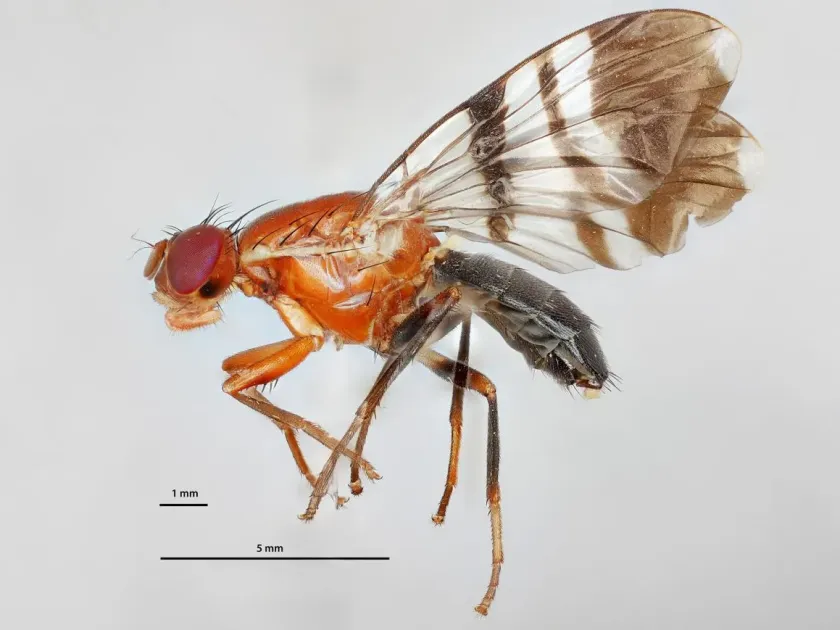
Description
How to identify
Celidodacus is a genus of insects belonging to the Tephritidae family, also known as fruit flies or picture-winged flies, within the order Diptera. These small flies are often recognized by the intricate patterns on their wings, which serve as camouflage in their natural habitat.
Adult specimens are characterized by the specific structure of the female ovipositor, which is adapted for piercing plant tissues to lay eggs. Morphologically, they closely resemble other dangerous members of the fruit fly family, requiring professional microscopic examination for accurate classification.
The larvae are typically legless, white or yellowish, and taper towards the front. Pupation generally occurs either inside the host fruit or within the top layers of the soil, where they form a hard, protective puparium.
The biology of the genus is tightly linked to specific host plants, as the fruit provides the essential nutrients for larval development. Adults feed on floral nectar and aphid secretions, maintaining activity throughout the growing season.
While the distribution of Celidodacus can be localized, favorable climatic conditions often trigger rapid population growth, posing a significant risk to the yield of various horticultural crops.
What it damages
This pest primarily infests the fruits of various vegetable and orchard crops, depending on the specific species within the genus. Primary targets include members of the Cucurbitaceae and Solanaceae families.
The larvae cause the most significant damage by developing inside the fruit. They feed on the pulp, creating numerous tunnels that lead to premature softening and decay of the produce.
Infested fruits lose their commercial value quickly and become unsuitable for storage or transport. Often, secondary fungal or bacterial infections enter through the tunnels, causing the fruit to rot completely.
In years of heavy infestation, losses can reach 70–90% of the total yield, making Celidodacus a serious threat to commercial agriculture and vegetable farming operations.
Beyond direct crop destruction, the presence of larvae in fruit often triggers quarantine restrictions, preventing farmers from exporting or selling their products, leading to severe financial losses.
When it appears
The emergence of adults typically coincides with the flowering stage and the beginning of fruit set in host plants. The initial flight of the flies usually occurs in late spring or early summer, depending on regional weather patterns.
A single generation cycle can last between 3 to 6 weeks, heavily influenced by ambient temperature. High summer temperatures significantly accelerate larval metabolism and shorten the development timeline.
Females are most active in egg-laying during the morning and evening, when air temperatures are most favorable. Multiple generations can occur within a single growing season.
Overwintering typically occurs as pupae in the soil or protected plant debris, allowing the species to survive harsh winter conditions. Spring emergence is synchronized with the warming of the upper soil layers.
Monitoring programs using pheromone or food-based traps are essential for identifying the start of mass flight, allowing growers to time their insecticide applications effectively.
Signs of infestation
The first visual sign of infestation is the presence of tiny puncture marks on the surface of young fruit, where females have inserted their eggs. Slight discoloration or a small spot often appears around these punctures.
As larvae develop inside, the fruit surface may become deformed or feel soft to the touch. In some cases, sap or fluid leakage from the fruit is visible at the infestation site.
Cutting open an infested fruit reveals internal cavities filled with larval waste and decaying tissue. The larvae themselves are usually easily visible upon inspection of the fruit's interior.
Premature yellowing or dropping of ovaries and young fruit is a common sign. Heavily infested plants at early growth stages often shed their entire crop load.
Adult presence can be confirmed by inspecting the undersides of leaves or by using yellow sticky traps, which attract these flies due to their color sensitivity.
Control measures
Effective control relies on crop rotation and the prompt removal of post-harvest debris, where pupae may overwinter. Deep autumn plowing is a successful method to reduce the survival rate of pupae in the soil.
For small-scale gardening, using protective nets is a highly effective, non-chemical method to prevent female flies from accessing the fruit to lay eggs.
Systemic insecticides may be used during the peak flight periods, provided that growers strictly adhere to pre-harvest intervals to ensure no chemical residues remain in the final produce.
Biological control options include the introduction of natural enemies, such as parasitic wasps, which can infest the larvae or eggs of the pest, naturally limiting population growth.
- Deploy food-based or pheromone traps for monitoring.
- Regular collection and destruction of fallen/infested fruit.
- Timed insecticide treatments during the flowering stage.
- Cultivation of pest-resistant plant varieties.
Taxonomy
- Latin name
- Celidodacus
- Order
- Diptera (flies)
- Family
- Tephritidae
- EPPO code
- CELISP
Discussion
No discussions yet — be the first.