
Hazelnut bud mite
Cecidophyopsis vermiformis
Description
How to identify
The Hazelnut bud mite (Cecidophyopsis vermiformis) is a microscopic pest belonging to the family Eriophyidae. It is an extremely small, worm-like mite, measuring approximately 0.2–0.3 mm in length, which makes it invisible to the naked eye.
These mites possess a unique biological structure adapted for living within the tight spaces of dormant buds. They belong to the order Acariformes and are specialized parasites of the genus Corylus.
The mite's life cycle is continuous within the buds. They overwinter as adults, nymphs, and eggs inside infested buds. The population increases rapidly as the environmental temperature rises during the early spring.
Dispersal occurs mainly during the early spring when adult mites migrate from old, infested buds to new, developing ones. This migration is influenced by wind and contact between branches.
Due to their high reproductive rate and short generation time, these mites can build up significant populations in a relatively short period, causing severe damage if left unmanaged.
What it damages
The primary hosts of this mite are hazelnut (Corylus avellana) and other related hazel species. The mites feed by piercing the plant tissues and extracting cell contents, which leads to physiological stress.
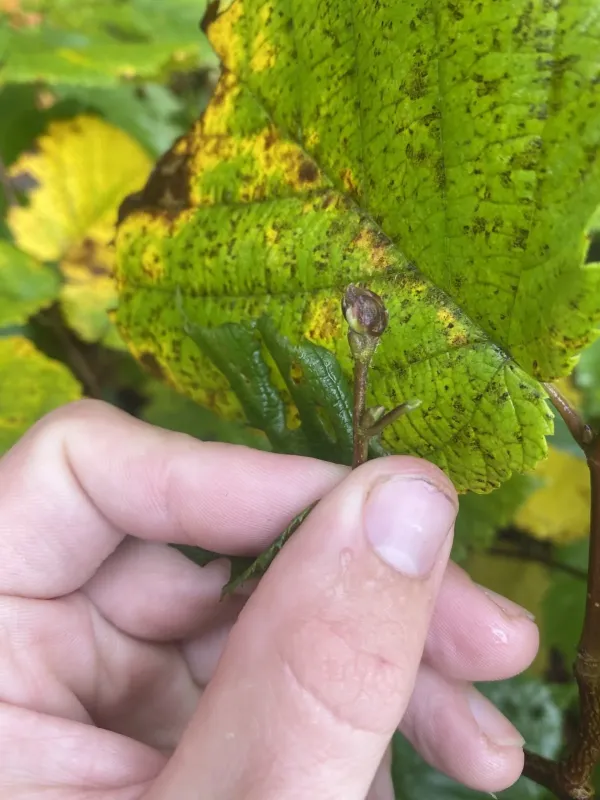
The most distinctive damage is the formation of enlarged, spherical buds, commonly known as "big buds." These malformed buds contain hundreds or even thousands of mites feeding and reproducing inside.
Damage to the generative buds is the most economically significant, as it leads to the loss of potential female flowers and catkins, directly reducing the hazelnut harvest for the current and future years.
In cases of severe infestation, the plant’s growth is stunted. Foliage developing from infested buds may appear distorted, chlorotic, or weak, significantly reducing the overall vigor and health of the hazelnut bush.
Furthermore, the physical damage to bud scales creates entry points for various bacterial and fungal pathogens, potentially leading to secondary infections that further weaken the host plant.
Signs of infestation
The most reliable sign of a Hazelnut bud mite infestation is the presence of swollen, rounded buds that look significantly larger and misshapen compared to healthy, elongated buds during the winter and early spring.
Infested buds fail to develop normally. In spring, they often remain dormant or produce tiny, withered, and deformed leaves that do not contribute to the plant's photosynthesis or overall growth.
A widespread infestation leads to a thinning canopy, with many branches appearing bare or showing clusters of dead, dried-out buds that fell off or failed to sprout during the growing season.
Visual inspection with a 10x or 20x magnification hand lens can reveal the presence of the microscopic mites and their debris, such as cast skins and excrement, within the open bud scales.
Reduced yield is a late-stage sign, where the farmer notices a significant decrease in nut production in specific sections of the orchard or on particularly susceptible hazelnut cultivars.
Control measures
Cultural control is the first line of defense. Growers should prune and remove infested branches with big buds before the migration period starts in spring, ensuring the material is burned or properly disposed of.
Selecting resistant cultivars when establishing a new orchard is a critical management strategy. Some hazelnut varieties show significantly lower susceptibility to mite colonization compared to others.
Chemical control must be timed precisely to coincide with the mite migration phase. Applying acaricides when mites are exposed and moving between buds is essential for effective population reduction.
Rotate the use of chemical products with different modes of action to prevent the development of pesticide resistance in the mite population, which is a common problem in long-term orchard management.
Biological monitoring using sticky traps or regular orchard scouting helps in determining the exact timing for intervention, ensuring that control measures are both environmentally responsible and economically efficient.
Taxonomy
- Latin name
- Cecidophyopsis vermiformis
- Order
- Mites
- Family
- Eriophyidae
- EPPO code
- CECPVE
Discussion
No discussions yet — be the first.