
Taxus bud mite
Cecidophyopsis psilaspis
Description
How to identify
The Taxus bud mite (Cecidophyopsis psilaspis) is a microscopic pest belonging to the family Eriophyidae. These tiny arthropods are invisible to the naked eye, measuring only a fraction of a millimeter.
The mite has a worm-like, elongated body, typically white or yellowish. They are highly specialized parasites that live primarily within the bud scales of Taxus species throughout their development.
Their life cycle is synchronized with the growth stages of the yew tree. Mites overwinter inside the dormant buds, which provides them with essential protection from low winter temperatures.
During the spring, as buds begin to swell, the mite population becomes active. Mites migrate to new growing points, spreading through wind or physical contact with infected branches.
Due to their microscopic size and hidden habitat, they are often overlooked until significant symptoms of plant damage become apparent in the landscape.
What it damages
The yew (Taxus baccata and related species) is the primary host. The mite feeds on the internal tissues of the buds, causing significant stress to the host plant.
The feeding activity triggers abnormal tissue growth, resulting in the formation of galls. These galls disrupt the normal development of new shoots and leaves, reducing the plant's aesthetic value.
Heavy infestations can lead to stunted growth and a thinning canopy. In severe cases, the affected branches may fail to produce healthy foliage, causing a loss of density in the yew's crown.
Young plants are particularly vulnerable to mite damage. Significant stunting can ruin the intended shape of hedges and topiaries, which are common uses for yew trees in gardening.
Additionally, the weakened tissues caused by mite infestation can become entry points for various secondary fungal pathogens, further compromising the health of the yew tree.
Signs of infestation
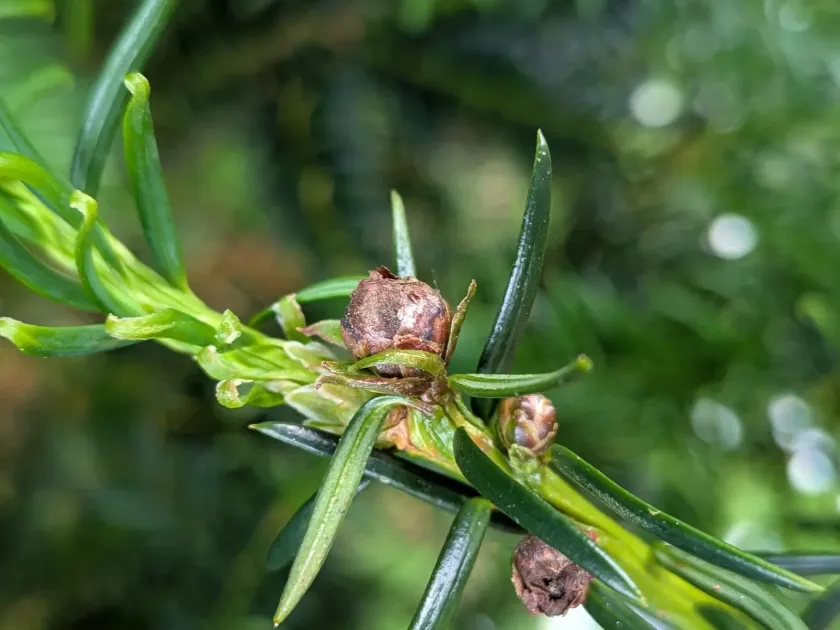
The most distinctive symptom is the appearance of hypertrophied (enlarged) buds. Instead of their normal shape, these buds look swollen, rounded, and distorted.
These infested buds often fail to open properly in the spring. If they do open, the resulting shoots are often malformed, twisted, or have abnormally short and chlorotic needles.
A cluster of dry, damaged bud scales on the tips of shoots is a tell-tale sign of mite activity. These areas often lack the vibrant green color characteristic of healthy yew growth.
In mid-summer, infected trees may show areas of reduced density or sparse growth, as the damaged buds have died back instead of producing a healthy new branch.
Closer inspection of the suspected buds will show they are loose and cluttered with debris, which is a result of the mites feeding and multiplying under the protective scales.
Control measures
The most important control measure is the early detection and removal of infested material. Prune affected branches and destroy them immediately to prevent the spread of the population.
Chemical control should be implemented using specific acaricides. Because mites are protected inside the buds, systemic products that are absorbed by the plant tissue are the most effective.
Treatment should be timed with the migration period of the mites, usually in the spring. Applying multiple treatments ensures that emerging mites are also targeted.
Maintaining high plant vigor through proper irrigation and balanced fertilization helps the tree withstand mite pressure, although cultural practices alone are rarely sufficient for eradication.
- Sanitize pruning tools between cuts to prevent mechanical transmission.
- Use acaricides based on abamectin or sulfur compounds.
- Monitor hedges and individual specimens regularly for signs of bud swelling.
Taxonomy
- Latin name
- Cecidophyopsis psilaspis
- Order
- Mites
- Family
- Eriophyidae
- EPPO code
- ERPHPS
Discussion
No discussions yet — be the first.