
Blackcurrant gall mite
Cecidophyopsis malpighianus
Description
How to identify
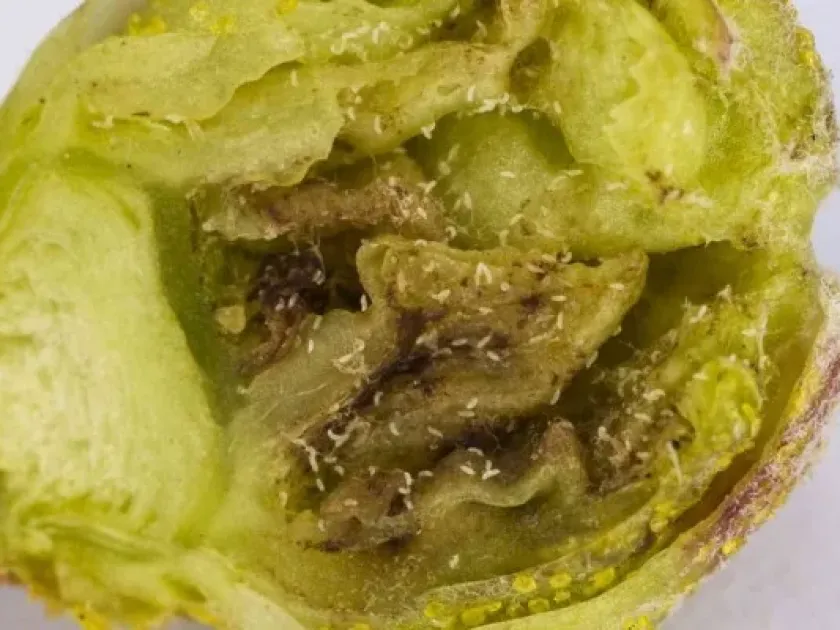
The Blackcurrant gall mite (Cecidophyopsis ribis) is a microscopic pest belonging to the Eriophyidae family. It is invisible to the naked eye due to its extremely small size, measuring only about 0.2 mm in length.
These mites have a worm-like, pale-colored body with only two pairs of legs. They reside primarily within the buds of host plants, where they feed on plant tissues and undergo their life cycle.
As part of the Eriophyoidea superfamily, these mites are highly specialized pests. They are known not only for the direct damage they cause to buds but also for transmitting the reversion virus.
The reproduction rate of the mite is very high, allowing it to rapidly colonize entire bushes during the growing season. The spread occurs via wind, insects, or human activities during pruning and maintenance.
The lifecycle is strictly tied to the phenology of the host plant, ensuring the mite has constant access to food throughout the year, except for the dormant winter period.
What it damages
The primary host for this mite is the blackcurrant, which is highly susceptible. Redcurrants and gooseberries can also be affected by this pest under favorable conditions.
The mites feed inside the buds, causing them to swell and form characteristic galls that look like small, rounded heads. These buds fail to develop normally, resulting in stunted growth.
In addition to physical damage, the mite transmits the reversion virus. This virus prevents fruit production and causes leaves to become narrow, distorted, and lose their characteristic scent.
Infested branches become weaker, less cold-resistant, and eventually barren. Over time, the entire bush can become unusable for fruit production, forcing the grower to remove it.
The economic impact on commercial plantations is severe, as the mite can lead to the total loss of the harvest and the need to replace entire fields with healthy stock.
When it appears
Mite activity peaks in early spring when adults migrate from old, infested buds to new, developing buds. This period coincides with the flowering stage of the currant bushes.
Migration starts when the air temperature rises above 5°C. This window of time is crucial because the mites are exposed outside the protective scales of the buds, making them vulnerable to treatment.
During the summer months, the mites reproduce within the newly formed buds. Their activity level depends on temperature and humidity, but they remain active until the autumn.
In autumn, as the plant enters dormancy, the mites settle deep within the scales of the buds. This provides them with excellent protection against harsh winter weather conditions.
The winter months are spent inside these dormant buds, where the mites survive until the return of favorable spring temperatures, ready to restart the cycle.
Signs of infestation
The most recognizable sign is the presence of swollen, rounded, deformed buds in winter and early spring, which contrast sharply with the healthy, narrow, and sharp buds.
Infected buds fail to sprout properly in spring; instead, they may produce stunted leaves or remain as dry, empty husks on the stems of the plant.
Symptoms of the reversion virus include a change in leaf shape, where leaves become narrow and serrated, and the flowers develop a purple color with elongated petals.
- Presence of enlarged, gall-like buds on stems.
- Lack of growth or stunted leaf development in spring.
- Reduced fruit set or complete sterility of the shrub.
- Specific leaf deformations indicative of the reversion virus.
Regular visual inspections during the dormant season are highly recommended for early detection of the pest and to limit its spread within the garden.
Control measures
The primary control method is the manual removal and destruction of all swollen, infested buds in late winter or early spring before they begin to open.
Always source planting material from certified nurseries. Using disease-resistant varieties is the best long-term strategy for preventing infestations in the garden.
In cases of heavy infestation, it is necessary to prune back the affected branches severely or remove and burn the entire infected bush to stop the spread of mites.
Chemical control is possible using acaricides, which should be applied during the migration period in early spring. Multiple applications are often required to achieve effective control.
Proper plant care, including balanced fertilization and regular pruning, keeps the bushes vigorous and helps them better tolerate or resist the pressure of the gall mite.
Taxonomy
- Latin name
- Cecidophyopsis malpighianus
- Order
- Mites
- Family
- Eriophyidae
- EPPO code
- CECPMA
Discussion
No discussions yet — be the first.