
Laurel gall mite
Cecidophyes lauri
Description
How to identify
The laurel gall mite, Cecidophyes lauri, belongs to the Eriophyidae family. These microscopic pests are extremely small, worm-like, and cannot be seen with the naked eye.
They possess only two pairs of legs, which are situated near the front of the body. Their biology is deeply intertwined with the development of Laurus nobilis buds and young foliage.
The mites overwinter in the crevices of buds or beneath the bark scales of the plant. As temperatures rise in spring, they move to fresh, developing tissues to feed and reproduce.
The reproduction cycle is relatively fast, and they spend most of their life cycle protected within the leaf tissues, which complicates traditional pest control efforts.
Dissemination is largely passive, occurring via wind currents or through the movement of infested nursery stock between gardens and plantations.
What it damages
The primary host for this pest is the bay laurel (Laurus nobilis). The damage is highly specific, causing morphological changes in the plant's leaves and shoots.
The mites feed on young, succulent leaves, causing the plant to develop characteristic galls. These structures provide both a food source and protection for the mites.
Significant infestations can lead to severe stunting of shoots. This is particularly problematic for nurseries where the visual appearance of the laurel is of paramount importance.
Although the damage is rarely fatal to a mature, healthy tree, it renders the plant unsightly and weakens its overall physiological state over time.
Persistent infestations lead to heavy leaf deformation, reducing the photosynthetic area of the tree and causing premature leaf drop in extreme cases.
When it appears
Activity resumes in early spring, synchronized with the opening of buds. This is when the mites migrate from their overwintering sites to new growth.
Throughout the growing season, multiple overlapping generations occur. The mites remain active as long as there is new succulent tissue available on the host plant.
As autumn approaches and temperatures drop, the mites seek out protective bud scales or sheltered crevices where they will remain until the following spring.
In greenhouses or temperate climates, the mite can remain active for longer periods, potentially causing constant damage if left untreated.
Timely monitoring during the bud-burst phase is the most critical window for identifying the start of a new infestation cycle.
Signs of infestation
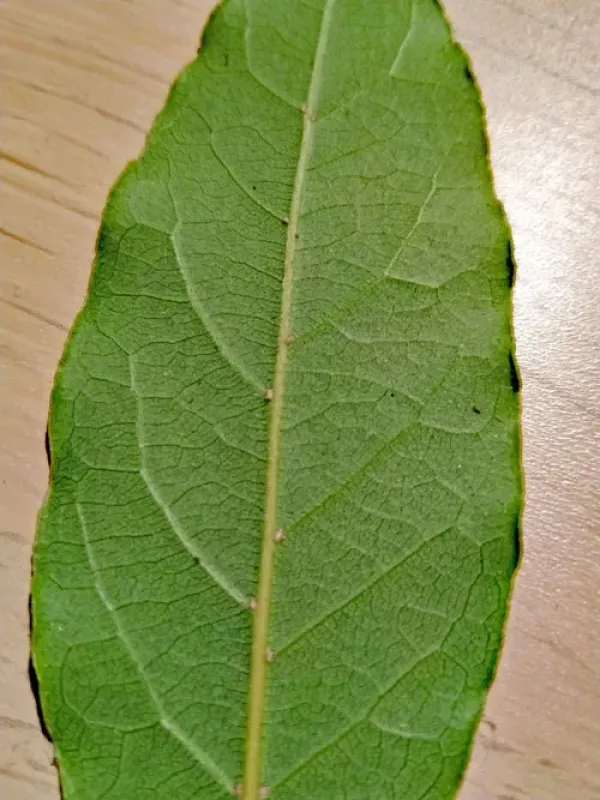
The most reliable sign of an infestation is the presence of abnormal growths or deformations on the surface of the leaves, known as erinea or galls.
- Presence of small, wart-like protrusions on the leaves.
- Reddish or yellowish discolorations appearing on young foliage.
- Curling, twisting, or crinkling of leaf blades.
- Stunted development and swelling of apical buds.
- Velvety or felt-like growth on the undersides of the leaves.
Control measures
Controlling Cecidophyes lauri requires an integrated approach. Relying solely on one method is usually insufficient due to the pest's protected position within the plant.
Sanitation is a critical first step. Pruning and destroying affected branches immediately can significantly reduce the initial population size in the garden.
Systemic acaricides are essential because they move through the plant's vascular system, reaching the mites hiding inside the galls where contact sprays fail.
It is recommended to rotate different classes of chemical treatments to prevent the development of pesticide resistance within the mite population.
Maintaining optimal growing conditions, including proper nutrition and hydration, helps the plant remain resilient and recover faster from mite-induced stress.
Taxonomy
- Latin name
- Cecidophyes lauri
- Order
- Mites
- Family
- Eriophyidae
- EPPO code
- CECDLA
Discussion
No discussions yet — be the first.