
Four-legged mite
Cecidophyes
Description
How to identify
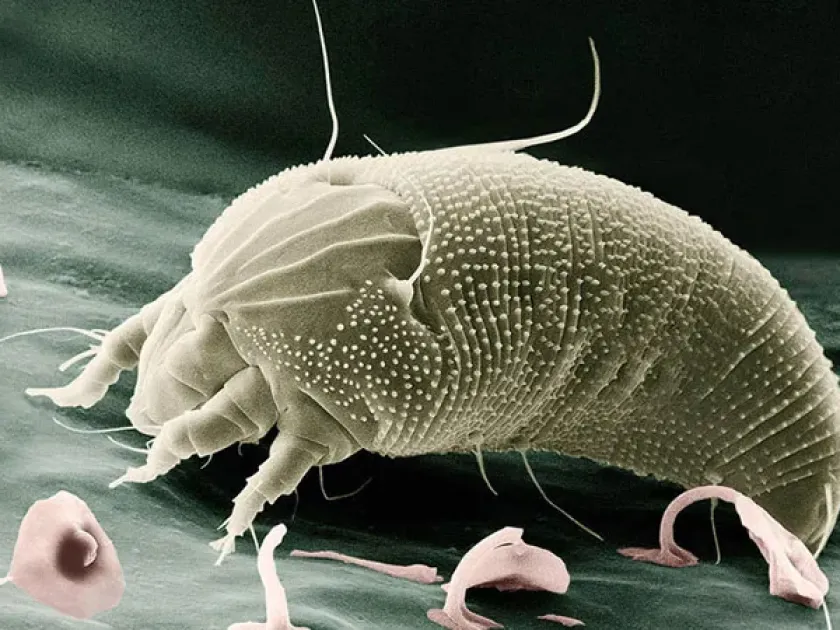
Four-legged mites (Eriophyidae) are microscopic pests belonging to the order Acariformes. They are easily distinguished by their elongated, worm-like appearance and the fact that they possess only two pairs of legs located at the anterior end of the body.
These mites are extremely small, typically measuring between 0.1 and 0.3 mm, which makes them invisible to the naked eye. Agronomists often rely on 10x to 20x magnification to spot them on plant surfaces.
The life cycle is rapid and consists of egg, two nymphal stages, and adult. A single female can produce several generations within one growing season under optimal conditions, leading to quick population growth.
Overwintering occurs as fertilized females seek refuge in bark crevices, under bud scales, or in other sheltered areas on the host plant. They become active as soon as temperatures rise in the spring.
Dispersal is primarily passive, facilitated by wind, rain, or human activities such as pruning and transportation of infested plant material, making spread prevention difficult.
What it damages
These mites are highly specialized, with many species causing the formation of galls—abnormal outgrowths of plant tissue. A well-known example is the plum gall mite (Cecidophyes phloeocoptes).
The primary hosts include various stone fruits and some ornamental trees. The mites feed by piercing plant cells and injecting enzymes that cause the plant to create a gall around the pest.
Galls serve as both a feeding site and a protective shelter for the mite colony. However, they act as a nutrient sink, diverting essential energy away from fruit and shoot development.
Severe infestations can lead to significant yield losses, stunted growth, and the decline of trees. In extreme cases, the accumulation of galls can cause the death of entire branches due to severe metabolic stress.
Furthermore, these galls can provide entry points for secondary pathogens, including fungi and bacteria, which may exacerbate the overall damage to the plant's health.
When it appears
The mites emerge from their overwintering sites in early spring, coinciding with the swelling of buds. This is the most critical window for observing the pest's migration.
Development is most intense during the spring and early summer when plants produce fresh, succulent growth. During this time, the population density reaches its peak as new galls are rapidly formed.
As the season progresses and plant tissues harden, the formation of new galls decreases. Many mites then migrate back to the buds to prepare for the dormant season.
Late summer and autumn are periods when the mites settle into their overwintering locations. They remain on the tree, surviving through the winter in a state of reduced metabolic activity.
Environmental factors like mild, wet springs can lead to higher infestation rates, necessitating proactive monitoring starting from the very first signs of bud break.
Signs of infestation
The most prominent sign of an infestation is the presence of galls—small, tumor-like growths—located at the base of buds or on leaves. These may change from pale green to brown as they age.
Buds heavily infested with mites often appear bloated or distorted. They may fail to open properly in the spring, leading to weakened or non-existent shoot growth.
Leaf deformation is another common indicator, where foliage may curl, show patches of chlorosis, or exhibit stunted growth. This significantly reduces the plant's photosynthetic capacity.
A general lack of vigor in the tree, characterized by reduced annual shoot elongation and dieback of smaller twigs, is often associated with long-term mite activity.
- Distorted bud development.
- Presence of visible galls.
- Reduced overall tree vigor.
- Premature abscission of fruit.
Control measures
Cultural control is a primary management strategy. Pruning and destroying heavily infested branches before the mites migrate to new buds can significantly reduce the population density.
Chemical control involves the application of acaricides. Timing is critical: treatments are most effective when the mites are migrating, typically before and immediately after the flowering period.
It is important to use authorized products and rotate chemical classes to prevent the development of mite resistance, which is a common issue with eriophyid species.
Biological control, using predatory mites or entomopathogenic fungi, can be useful in integrated pest management programs, although effectiveness varies depending on the specific environmental context.
Maintaining high plant vigor through proper fertilization and irrigation helps plants withstand mite attacks and limits the severity of the damage caused by these pests.
Taxonomy
- Latin name
- Cecidophyes
- Order
- Mites
- Family
- Eriophyidae
- EPPO code
- CECDSP
Discussion
No discussions yet — be the first.